
Blog / Growth Risk
Reducing Risk with a Revenue-to-Value Operating System
By Russ Holder
3-minute read
Picture a company that grew 18% last year. The board is pleased. Then you look underneath. One customer accounts for 31% of revenue. Most of the new business closed at a discount in the last two weeks of each quarter. The forecast missed by more than ten points, in the right direction this time.
That's an illustration, not a client. But you've probably sat across from a version of it.
The revenue is real. So is the risk. And the income statement reports only one of them.
Revenue and value can move apart.
Finance teams are good at measuring how much revenue a company generates. They're less equipped to measure how much of that revenue turns into lasting enterprise value.
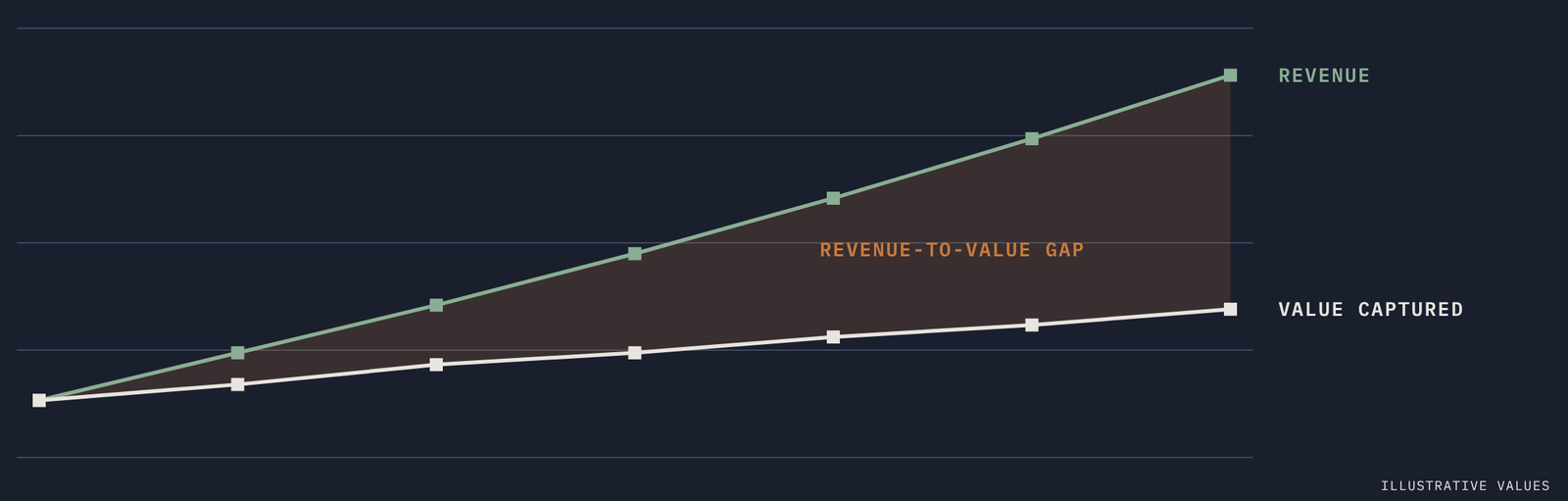
I call the difference the Revenue-to-Value Gap. It's the distance between the revenue a company produces and the long-term value it captures from it.
Some revenue builds value. It comes from customers who fit, stay, pay full price, and buy again. It's spread across enough accounts that no single loss hurts. It arrives on a schedule you can forecast.
Other revenue looks identical on the top line and does the opposite. It's concentrated, discounted, hard to repeat or dependent on one rainmaker. It inflates this year's number and adds little to what the business is worth. Sometimes it subtracts, because a buyer or lender will mark the whole company down for it.
The wider that gap, the more risk you're carrying. Most of it never appears in a monthly package.
Three risks hide inside a healthy growth rate.
When I look at a company through this lens, the exposure tends to fall into three kinds.
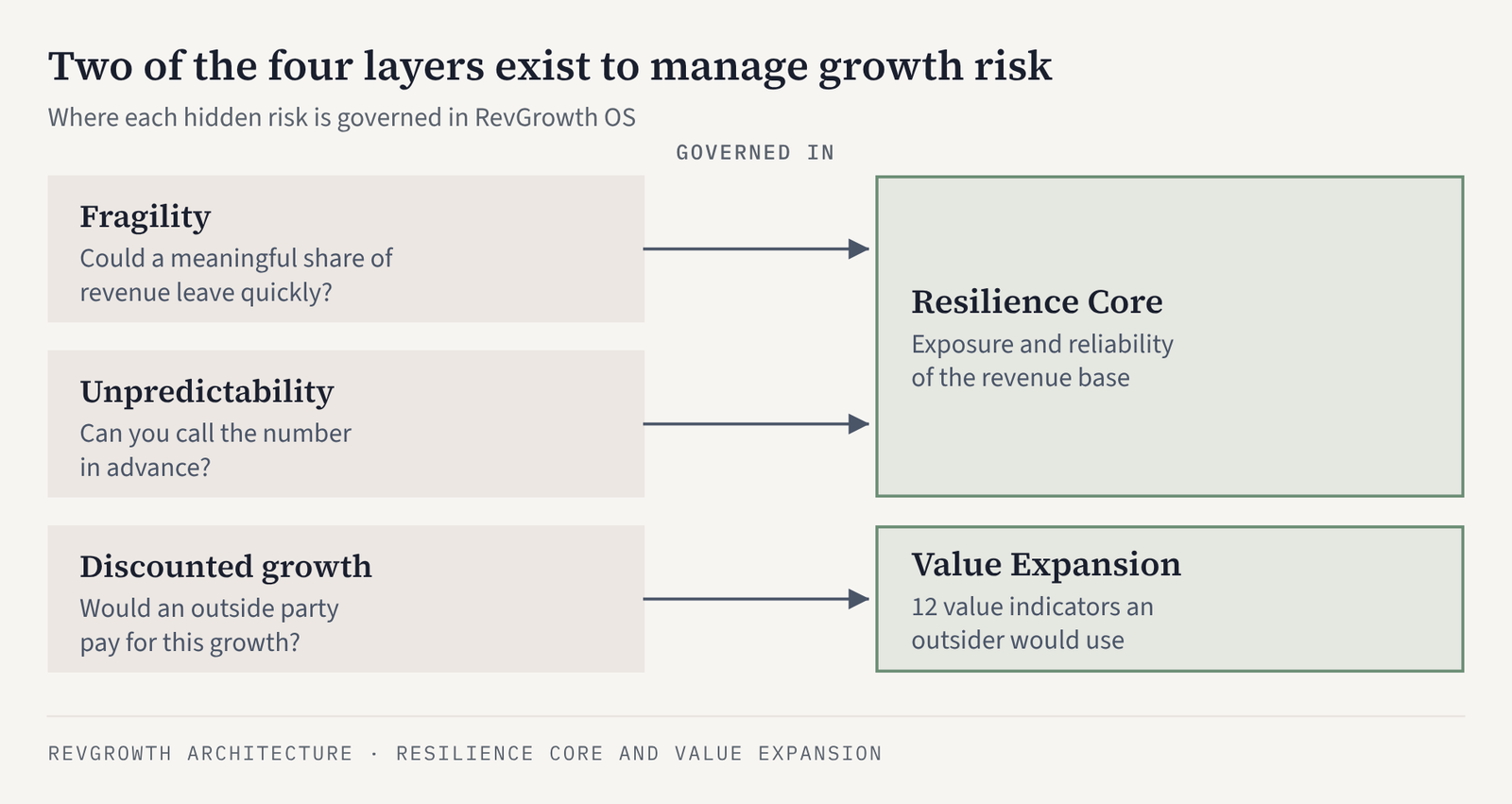
Fragility. Could a meaningful share of revenue leave quickly? Customer concentration is the obvious case. So is thin retention, a product line propping up the rest, or a key relationship held by one person. Fragile revenue is fine until it isn't, and the timing is never yours.
Unpredictability. Can you call the number in advance? A company that hits plan by accident is as hard to run as one that misses. You can't commit capital, staff a plant, or set covenants on a forecast nobody trusts. Volatility has a cost of its own, and you're the one who pays it in every lender conversation.
Discounted growth. Would an outside party pay for this growth? Buyers and investors don't value revenue at face. They ask how durable it is, how it was produced and whether it will continue without the current team's heroics. Growth that can't answer those questions gets a haircut.
Notice what these have in common. None is about how much revenue you have. All three are about how the revenue is made.
Risk in growth comes from running it without controls.
Here's a comparison you'll appreciate. Nobody would run the financial side of a business without controls. Segregation of duties, reconciliations, approval limits, a close process. Those don't exist because people are dishonest. They exist because an uncontrolled process produces surprises.
Now look at the process that produces revenue. Where are the controls?
In most mid-market companies, there aren't any, beyond a pipeline review and a quota. Nobody has defined what a good customer looks like in terms that are tight enough to enforce. Discount authority is loose. Retention is noticed after the fact. Concentration is tracked on a slide and managed by nobody.
That's the opening for an operating system. I use the term on purpose. An operating system is a defined structure with standards, measures, and owners, and it runs whether the best people are in the room or not. Lean gave operations one. The close gives finance one. Growth can have one, too.
What a Revenue-to-Value Operating System puts in place.
RevGrowth OS is built on four layers, and two of them exist mainly to manage the risks above.
The first two layers are about producing revenue well. Strategic Foundation sets which customers and markets the company is built to win, which is where good-fit revenue starts. Revenue Engine covers the nine drivers of acquisition, retention, and transaction value.
The third layer, Resilience Core, deals with fragility and predictability. Its drivers address how exposed the revenue base is and how reliably it performs. This is where concentration and forecast confidence stop being observations and become things someone is accountable for.
The fourth layer, Value Expansion, tracks 12 value indicators. These are the measures an outside party would use to judge the quality of your growth. They tell you whether this year's revenue is widening or closing the gap.
Each driver gets a definition, a score, and an owner. Each score can be compared with the RevGrowth Benchmark, which covers 212 companies. That turns growth risk from a feeling into something you can put on a page and track.
The benchmark also suggests that structure and performance aren't a trade. Ranked by score, the bottom quartile averages 5.7% growth, and the top averages 38.6%. Companies with more structure in place are growing faster.
Put growth risk on the same page as growth.
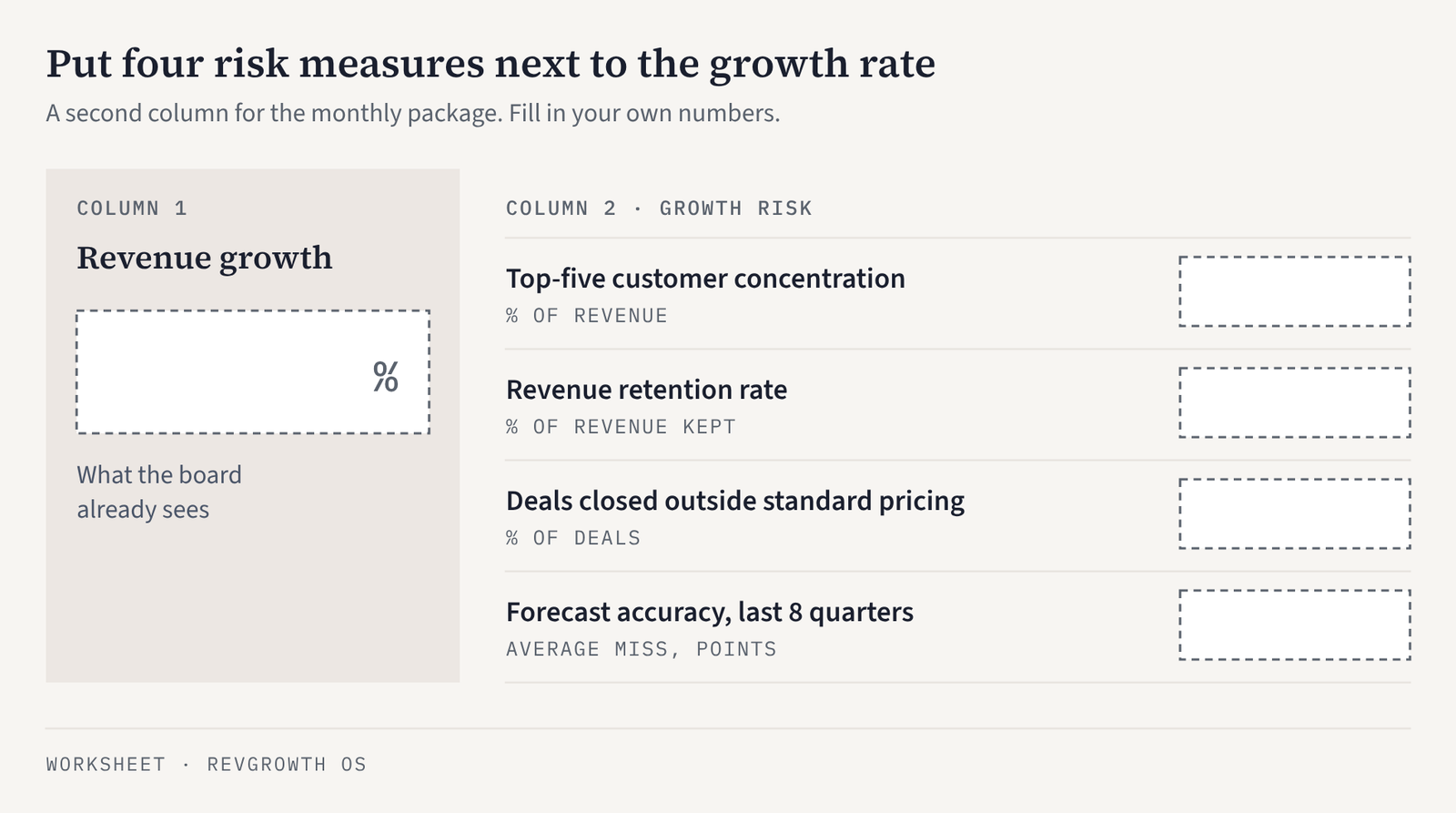
You don't need a new system to start. You need a second column.
Next to this year's revenue growth, write down four things. Your top-five customer concentration. Your revenue retention rate. The share of deals closed outside standard pricing. And your forecast accuracy over the last eight quarters.
If you can pull those quickly, you're ahead of most. If any of them takes a week to assemble, that's a finding in its own right. You can't manage a risk you measure once a year.
Then ask the question that matters. If growth continues at its current rate and those four numbers don't change, is the business becoming more valuable or only larger?
If you'd like a structured read, the RevGrowth Simulation is free. It models your revenue drivers against the benchmark and shows where the gaps sit. For a CFO, it's a way to see the growth plan through a risk lens before the money goes out.

Russ Holder
Founder & CEO, RevGrowth OS. 30 years in growth strategy, five published books.
You've read what the data says. Now run your numbers through it.
A one-hour working session with your own data. We run it through the RevGrowth Benchmark live, so you see the method applied to your company before you spend a dollar.
One hour. Your data. Zero cost.