
RevGrowth Architecture
Every company has a growth architecture. Most were never designed.
The RevGrowth Architecture is the blueprint underneath predictable growth. Four levels, supporting one another, that turn a handful of 1% improvements into 20-40% annual growth in revenue, profits, and enterprise value.
Not a strategy. A structure.
One hour. Your data. Zero cost.
Your growth strategy isn't failing. It has nowhere to land.
You've run the offsite. You've set the number. You've hired the rep, bought the tool, rebuilt the website.
Some of it worked. None of it held.
That's not an execution problem. It's a structural one. Improvements don't compound when there's nothing built to hold them - they leak out through a positioning gap, a retention gap, a leadership bottleneck, and land back where they started by Q3.
You're running a $50M ambition on a $10M operating system.
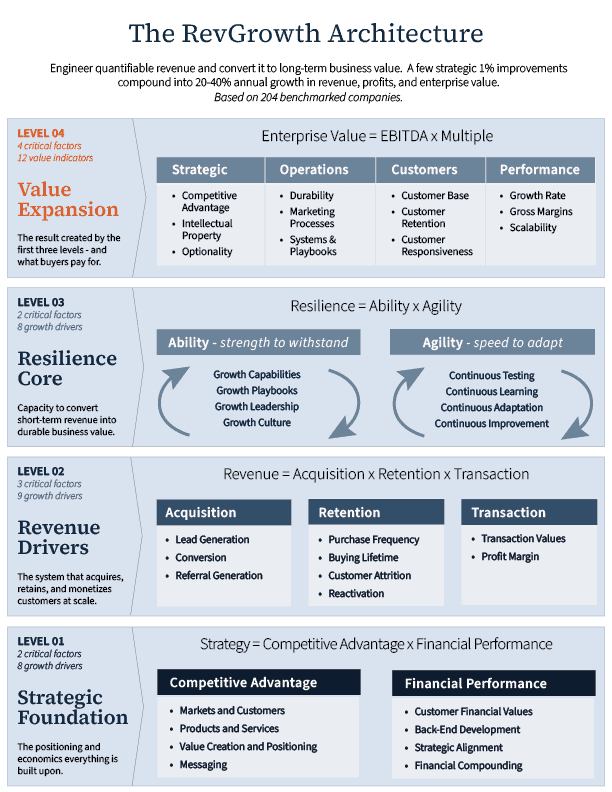
Four levels. Built bottom-up. Each one load bearing.
The RevGrowth Architecture organizes everything that produces growth into four levels, built bottom-up.
- Level 01 sets what you sell and to whom, and what that's worth.
- Level 02 is where compounding happens.
- Level 03 determines whether it keeps happening when conditions change.
- Level 04 converts all of it into enterprise value.
You can't skip a level. And you can only get away with skipping one for a while.
Level 01
Strategic Foundation
Strategy = Competitive Advantage x Financial Performance
The positioning and economics everything else rests on.
Most growth problems get diagnosed at the top of the stack and fixed at the bottom.
The Strategic Foundation answers two questions: why a buyer should choose you, and whether the math works when they do. Competitive advantage without financial performance is a hobby. Financial performance without competitive advantage is a margin that erodes.
Competitive Advantage
Markets and Customers
Products and Services
Value Creation and Positioning
Messaging
Financial Performance
Customer Financial Values
Back-End Development
Financial Compounding
Strategic Alignment
Build a revenue engine on a weak foundation and you'll spend more to sell something the market values less. The engine works. It's just pushing uphill.
Level 02
Revenue Drivers
Revenue = Acquisition x Retention x Transactions
Where the compounding 1% improvements live.
Revenue comes from three places and only three: acquiring customers, keeping them, and what happens in each transaction.
Acquisition
Lead Generation
Conversion
Referral Generation
Retention
Purchase Frequency
Buying Lifetime
Reduce Customer Attrition
Reactivation
Transaction
Average Transaction Value
Profit Margin
Nine revenue drivers. Most companies pull one - usually lead generation - and pull it hard.
That's the expensive way. Nine growth drivers moved a little multiply against one another. One driver moved hard just adds. Same effort. Different math.
Level 03
Resilience Core
Resilience = Ability x Agility
How the organization grows and adapts capability.
A revenue engine produces growth. It doesn't protect it.
Resilience is two things multiplied. Ability is what your organization can do. Agility is how fast it can learn to do something else.
Ability (strength)
Growth Capabilities
Growth Playbooks
Growth Leadership
Growth Culture
Agility (speed)
Continuous Testing
Continuous Learning
Continuous Adaptation
Continuous Improvement
Strong and slow gets outmaneuvered. Fast and weak gets outlasted. It's a product, not a sum - a zero on either side zeroes the result.
Level 04
Value Expansion
Enterprise Value = EBITDA x Multiple
What the business is worth when growth is predictable.
Growth and value aren't the same thing. You can grow revenue and destroy multiple.
The multiple is a judgment about durability. A buyer, a board, or a lender is asking one question: does this keep happening without the current owner in the room?
This is the Big Bonus of using the RevGrowth Operating System - most of this happens automatically.
Strategic
Lead Generation
Conversion
Referral Generation
Operations
Resilience
Marketing Processes
Systems & Playbooks
Customers
Customer Base
Customer Retention
Customer Responsiveness
Performance
Growth Rate
Gross Margin
Scalability
Level 04 isn't an exit strategy. It's the scoreboard for whether the first three levels were built or improvised.
Why the order is the whole point.
Every level depends on the one beneath it.
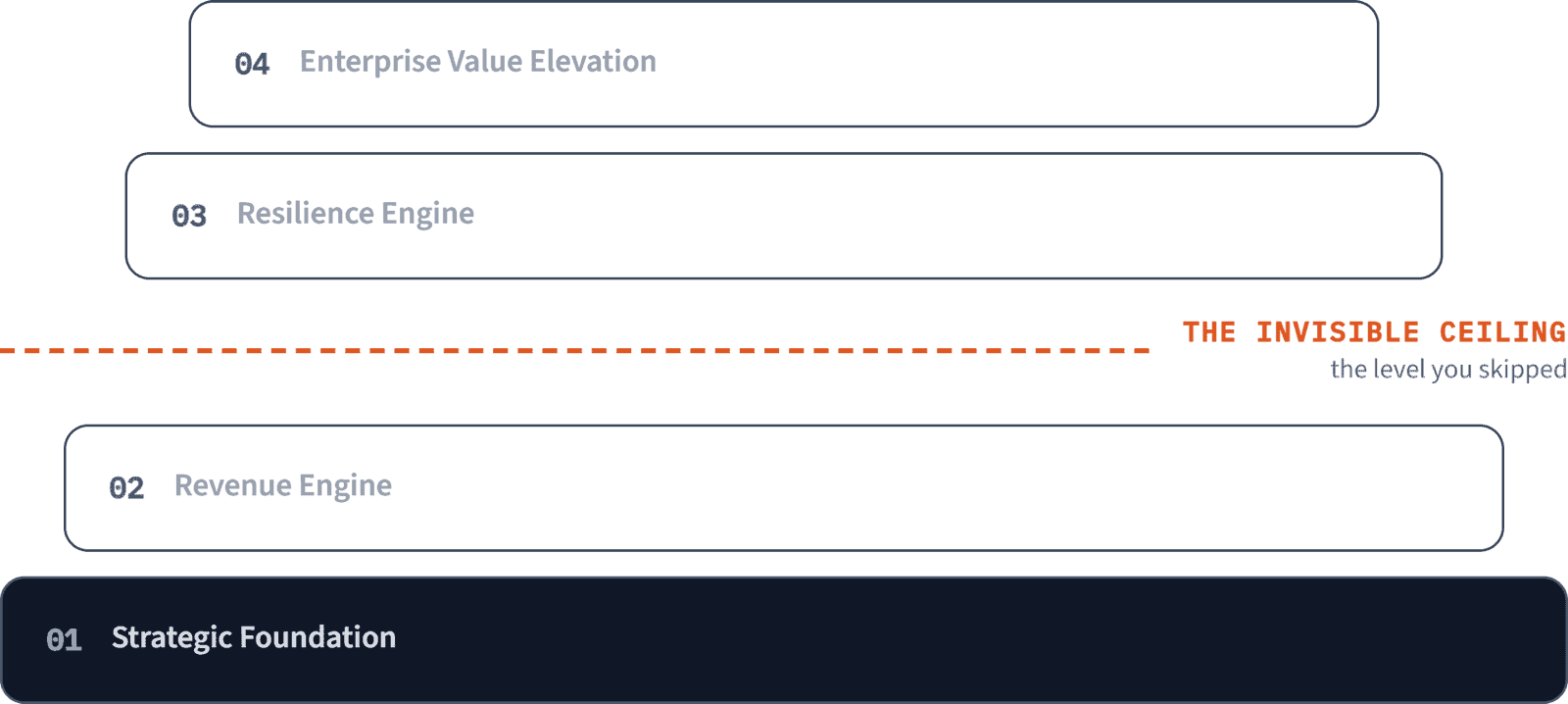
Optimize the Revenue Engine on a weak Strategic Foundation and you scale a positioning problem. Build resilience around an engine that doesn't compound and you've made a plateau durable. Chase valuation without the three levels underneath and you're pricing a story.
Most companies work top-down: valuation goal, then revenue target, then tactics. The Architecture is built bottom-up.
That's the ceiling you keep hitting. It isn't the market. It's the level you skipped.
Diagnose. Build. Compound.
The Architecture is the first of three components.
01 - RevGrowth Architecture - You Are Here
Map it.
The structure you to build, in the order it has to be built.
02 - RevGrowth Benchmark
Measure it.
Where you stand against 200+ mid-market companies across 4 non-negotiables, 7 critical factors, and 25 measurable drivers.
03 - RevGrowth Engine
Move it.
The operating rhythm that keeps 1% improvements accumulating instead of resetting.
The architecture tells you what to build. The benchmark tells you what each level and driver is costing you.
Why two sets of four?
RevGrowth Architecture - 4 levels - what we build
RevGrowth Benchmark - 4 non-negotiables - what we measure
They're deliberately not the same four things renamed. The benchmark scores your growth system; the levels are the structure you build to move those scores — starting with the level costing you the most.
Two days to the blueprint. Then the build.
RevGrowth Simulation
One hour, your data, no cost. We run your numbers through the model and show you which level is capping your growth.
RevGrowth Installation
A two-day intensive with your leadership team. You leave with the architecture mapped, the constraint level identified, and a sequenced build plan.
RevGrowth Assurance
Ongoing support while the build happens, because the failure mode isn't a bad plan. It's a good plan with no one holding the sequence.
Your strategy isn't broken. Just un-architected.
The RevGrowth Architecture is built for mid-market industrial and B2B companies - manufacturers, distributors, and services firms between $10M and $500M in revenue. It's the right fit if:
THE PATTERN
Most companies at this stage aren't underperforming. They're overperforming relative to what they've built - which is exactly why it stops working at scale.
FAQs
Common questions we get about the RevGrowth Architecture.
How is this different from a growth strategy?
A strategy tells you what to pursue. An architecture tells you what has to exist for the pursuit to hold. Most strategies fail at Level 02 or 03 — not because the strategy was wrong, but because nothing was built to carry it.
Do we have to build all four levels?
No. You build where you're weakest and where it will help you achieve your objectives. The benchmark identifies constraint levels and opportunities; most companies work on one or two at a time.
How long does this take?
It takes two days to complete the RevGrowth Benchmark and RevGrowth Engine. After that, you'll have a prioritized, quantified action plan tailored to your business and needs. Foundation work is usually slower than engine work. We'll tell you which you're facing before you commit to anything.
We already have a strategic plan. Does this replace it?
Usually, it explains it. Most plans contain the right intentions distributed across all four levels with no sequence. The Architecture puts them in build order.
What size company is this for?
Mid-market industrials and B2B - roughly $10M to $500M in revenue. Manufacturers, distributors, and services firms.
See your architecture before you build anything.
One hour. Your data. We'll show you which of the four levels is capping your growth, and what it's costing you annually.
No deck. No pitch. Your numbers in the model.
60 minutes - built on your data - CEO level - no obligation