
Growth Diligence for Private Equity
RevGrowth Provenance
Growth diligence, value creation, and exit prep for private equity, run on one documented instrument.
Quality of earnings tells you the numbers are real. It doesn't tell you whether the mechanism that produced them survives the transaction. RevGrowth Provenance is how RevGrowth OS answers that question — the documented chain of custody on a company's growth infrastructure, established before you sign, maintained while you own it, and verified the day you sell it.
One hour. Your data. Zero cost.
The question standard diligence doesn't ask.
Private equity diligence is, by design, exhaustive. Quality of earnings. Customer concentration. Contract terms. Legal, tax, IT — each with its own workstream and its own advisor. By the time a deal closes, a sponsor usually knows more about the target than the target's own board does.
And almost none of that diligence answers the one question that determines whether the growth number in the CIM survives the transaction: is this growth a system, or is it a person?
Founder-led and family-owned mid-market companies — a large share of PE deal flow in industrial and B2B sectors — very often grow through what amounts to heroics: a founder's personal relationships, a single rainmaker's book of business, pricing logic and key-account judgment that live entirely in someone's head. From inside a management presentation, that reads as commitment and hustle. From a diligence seat, it should read as the opposite — a growth number with a single point of failure, and a transaction is precisely the event most likely to remove the person it was running through.
RevGrowth OS exists to answer that question with a number instead of a hunch, at the three moments in a deal where the answer actually changes what you do next. A claim you can't point to isn't evidence, it's a slide. The record that makes it evidence is what we call RevGrowth Provenance.
What RevGrowth Provenance is.
Documented growth infrastructure, chain of custody included.
In any market where two otherwise-identical assets trade at very different prices - art, watches, real estate - the difference is often paperwork. An asset with a documented, verifiable history commands a premium over an identical one without it, because the buyer isn't taking the seller's word for what they're getting. Growth infrastructure works the same way. Almost nobody treats it that way yet.
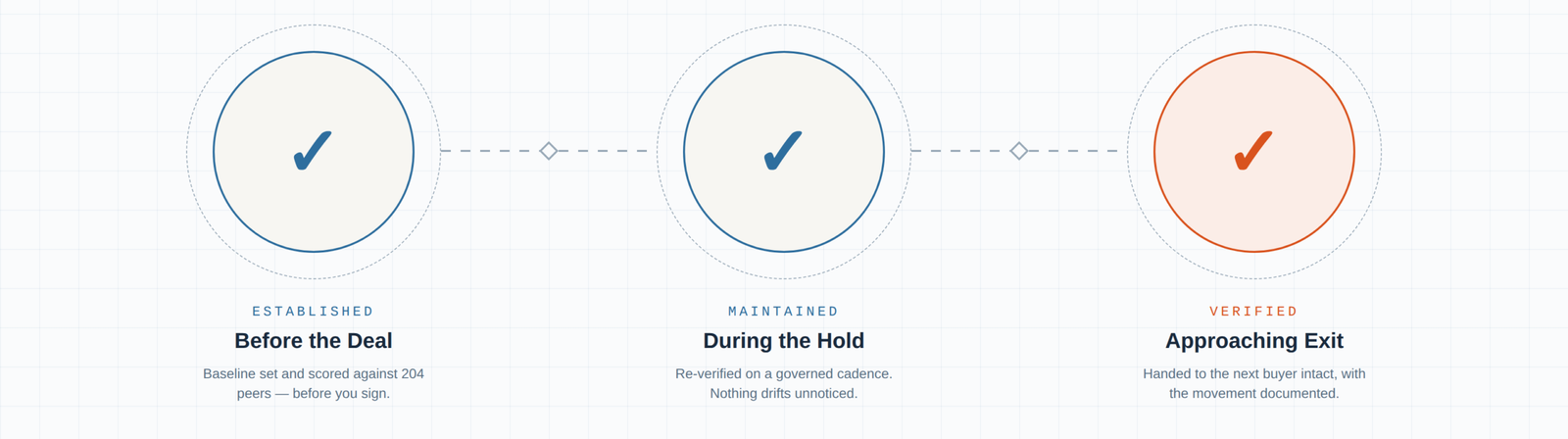
RevGrowth Provenance is the record that survives the sale: the same benchmark, scored against the same 200-plus company dataset, at every point where the growth number changes hands or gets re-priced. Not a diligence exhibit built once and filed. Not a value-creation deck rebuilt from scratch for the board. One instrument, three timestamps.
The documented chain of custody on your growth number.
One instrument, three timestamps. Nothing rebuilt, and nothing taken on faith.
A company that can produce that record isn't asking anyone to underwrite its growth story on faith. It's handing over the instrumentation.
"RevGrowth Provenance isn't a fifth pillar bolted onto the RevGrowth Operating System. It's what Benchmark, Architecture, and Engine look like end to end, when the record has to survive a change of ownership."
- Russ Holder, Founder & CEO or RevGrowth OS
One instrument. Three points in the deal lifecycle.
Here's what that record actually looks like at each of the three points in a deal. Nothing gets rebuilt between phases - the baseline you score at close is the baseline you're still measuring against on day 1,000.
PHASE 01 - PRE-CLOSE
Before the Deal
RevGrowth Benchmark
Growth diligence run as its own workstream. The same rigor a quality-of-earnings review applies to the financials, now applied to growth.
- Is this growth a system, or a person?
- Specific gaps, quantified as dollars.
- A measured baseline for the 100-day plan.
PHASE 02 - HOLD PERIOD
During the Hold
RevGrowth Architecture & Engine
One shared blueprint for the leadership team. One governed cadence, sustained by RevGrowth Assurance, that keeps it running.
- CEO, CFO, CRO see the same gaps.
- Owner and date on every initiative.
- Re-benchmarked, board-ready, every cycle.
PHASE 03 - PRE-EXIT
Approaching Exit
Value Expansion
Enterprise Value = EBITDA x Multiple. Hand the next buyer the instrumentation instead of a growth story.
- An exit-ready growth exhibit for the CIM.
- The heroics question, pre-answered.
- Quartile movement across the hold, proven.
The Evidence
Growth compounds with proximity to the architecture.
7X
Top quartile companies grow roughly seven times faster than bottom quartile companies in the same dataset.
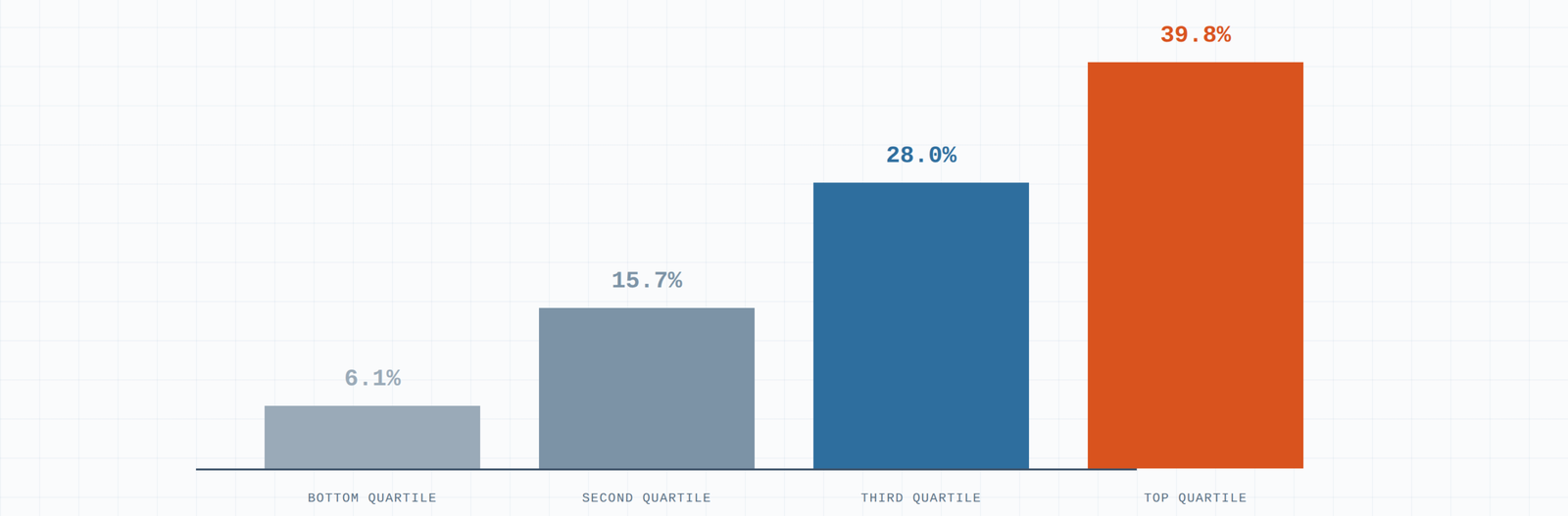
Annual growth rate (CAGR) by RevGrowth Benchmark Score quartile, across the 200+ company dataset. Not talent, not luck - proximity to the Architecture, measured.
That spread isn't a rounding error in a deck. It's large enough to change a deal's underwriting.
Across the RevGrowth Benchmark's 200-plus company dataset, growth compounds with the score in a straight line — roughly seven times the growth rate of the companies furthest from the standard, frequently selling into the same markets, sometimes with a weaker product. It's the same spread whether you're the one measuring a target before you sign or the one being measured by the next buyer's diligence team.
Who it's for.
Deal Partners & Principals
An underwriting-grade read on whether a target's growth is a system or a person — before you sign, not eighteen months in.
Operating Partners & Value-Creation Teams
One instrument, run the same way across every portfolio company, so quarterly reviews compare apples to apples instead of each portco's own story.
Portfolio Company CEOs and CFOs
A shared blueprint the whole leadership team — and the board — can see the same gaps on, and a cadence that keeps the plan in front of the people accountable for it.
One caveat, same as everywhere else in this system: it's not for sponsors looking for validation. RevGrowth Provenance tells a target — or a portfolio company — exactly where it stands, including the parts that don't help the deal thesis.
What this isn't.
RevGrowth OS doesn't replace quality of earnings, legal diligence, or the rest of a standard process. It sits alongside them, closing the one gap almost none of them cover: whether the growth number you're underwriting is an asset that will still be producing eighteen months from now, or a number a specific person happened to be producing right up until the day you bought it.
It's also not a one-time diligence exhibit - that's exactly the failure mode Provenance exists to fix. The instrument you score a target on at close is the same one your value-creation team re-runs annually, which is the only way "we improved growth infrastructure during the hold" becomes a provable sentence instead of a claim in a sell-side deck.
This is an instrument, not a replacement.
Your operating partners know what good looks like. What they lack is a way to prove where a company stands before the debate starts, and a way to compare two companies without relitigating both from scratch.
Benchmark first. Argue second. The argument gets much shorter.
For Operating Partners
Questions sponsors ask.
How is this different from commercial due diligence?
Commercial diligence assesses the market. RevGrowth Benchmark assesses the company’s ability to capture it, scored against companies of comparable size and model.
Does the management team resist it?
The score is objective and the comparison set is peers, not an ideal. Most teams engage with it because it finally makes the growth conversation specific.
What do you need from us to start?
The Simulation runs on the company’s own data in a single hour. No preparation, no data room, no cost.
Can this run pre-close?
Yes, with target cooperation. With management access, the full Benchmark runs as it would post-close.
Without that access, the scoring is limited to what the data room and customer conversations support — a directional read on the growth engine rather than a complete position. We will tell you which drivers we could not score.
Run one company thought it. Decide from there.
The RevGrowth Simulation is a one-hour working session using a portfolio company's own data.
Bring one company, or a target you are underwriting now. In an hour you will see where its growth engine scores, where it sits against peers, and what the gap is worth.
If it earns a second conversation, we will have one. If it does not, you have spent an hour.
Benchmark your strategy. Engineer your growth.