
Blog / Enterprise Value
Same Revenue, Different Price: the case for Equity Evolution
By Russ Holder
3-minute read
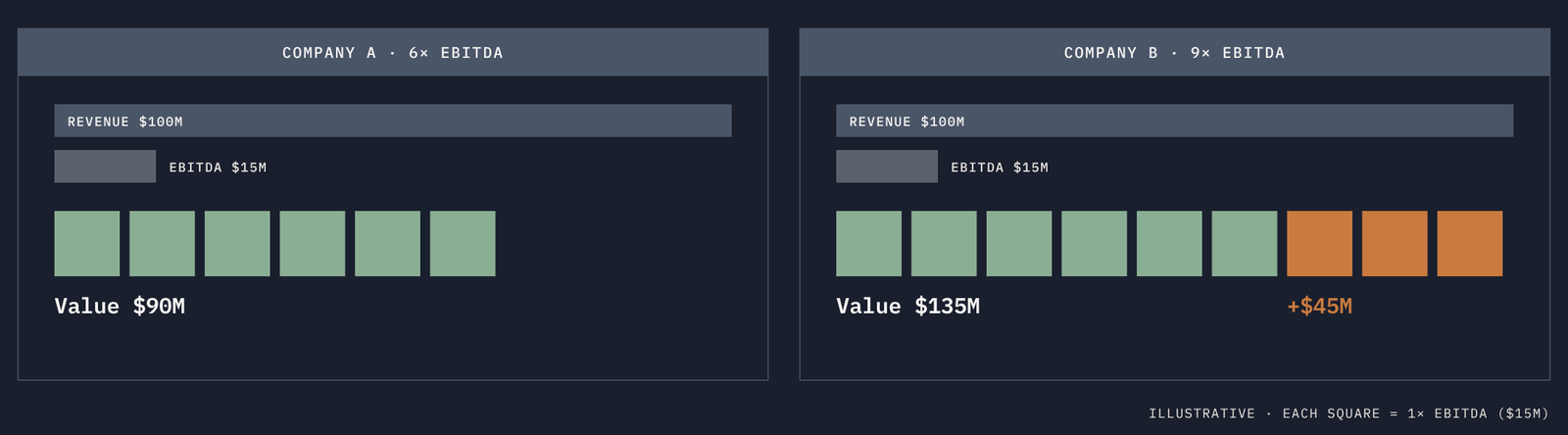
Two companies each do $100 million in revenue and $15 million in EBITDA. Same industry, same region, similar customers. One sells for six times earnings. The other sells for nine.
The numbers are illustrative, but the pattern is one every banker and buyer knows. On those figures, the difference is $45 million. Neither company earned a dollar more than the other.
The second owner had something the first did not.
Not more revenue. A different kind of revenue, produced by a different kind of company. That difference defines Equity Evolution. It deserves more of a CEO's attention than the growth rate.
Revenue is this year's score. Equity is the long game.
Most growth conversations focus on revenue. It is the number in the plan, the bonus formula, and the first question from the board.
Revenue is also short-term by nature. It resets every January. You earn it, book itk, and start over.
Equity value is cumulative. It reflects what a knowledgeable outsider expects the business to produce in future years and their confidence in that outcome. It determines what an owner receives, what a lender will extend, and what the next generation inherits.
The two are related, but loosely. A company can grow revenue for five years and add little to its value. Another can grow more slowly and become worth far more. I call the distance between them the Revenue-to-Value Gap.
Equity Evolution is the case that this gap can be managed. Value is not discovered at the closing table. It is built deliberately, year by year, as the structure behind growth matures.
Buyers pay for how revenue is made.
Think about what a buyer is doing in diligence. They've seen your financials. They know what you earned. Everything else they ask is an attempt to answer one question: will this continue without you?
That's why they dig into customer concentration. It's why they want retention by cohort, pricing discipline, pipeline history, and who holds the key relationships. They're testing whether the earnings come from a system or from a set of circumstances.
When the answer is a system, confidence rises and so does the multiple. When the answer is three big accounts and a founder who knows everybody, the multiple falls. Or the deal gets structured with an earnout that pushes the risk back onto the seller.
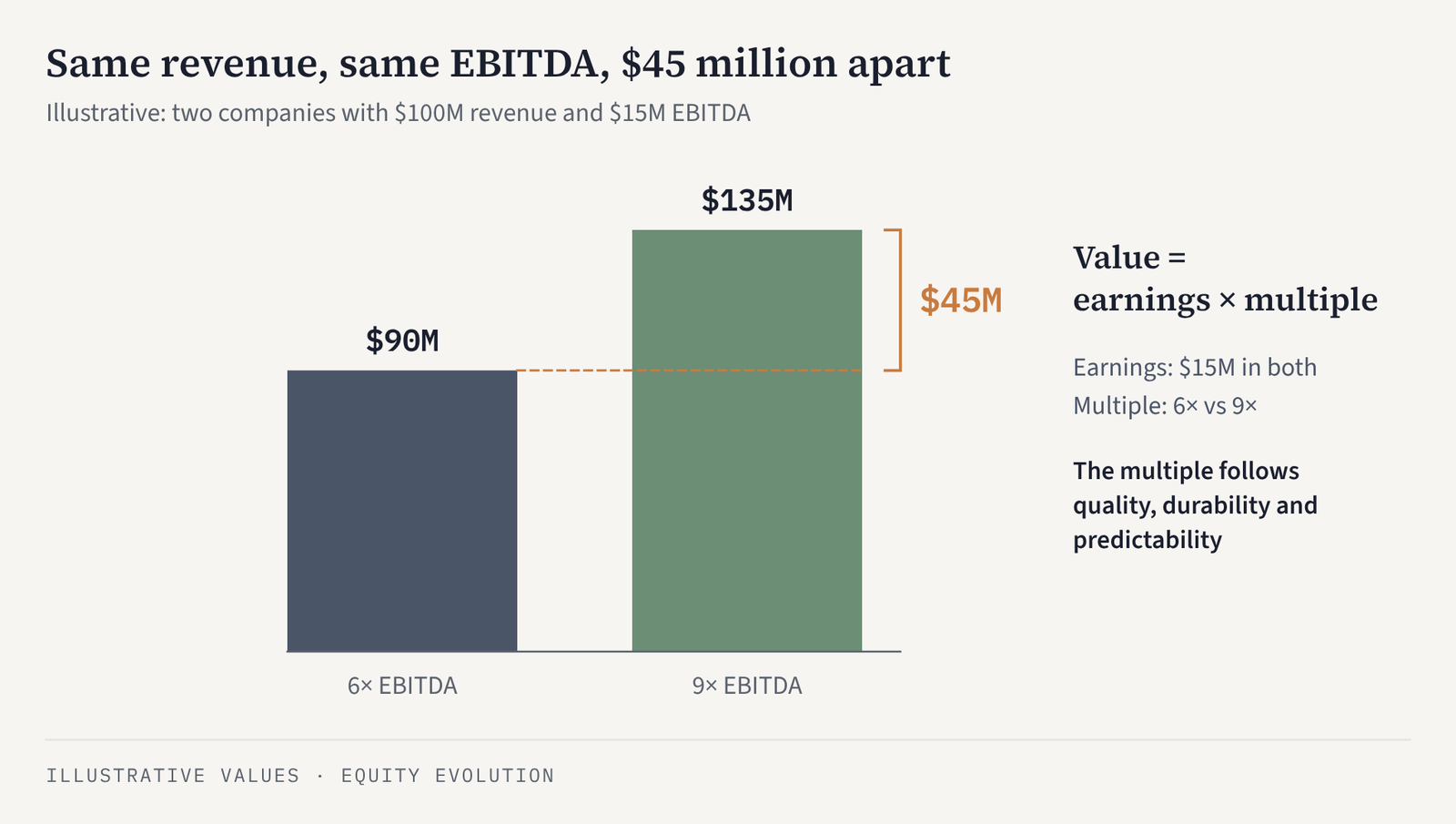
Value is earnings times a multiple. Most growth work focuses on earnings. The multiple is driven by quality, durability, and predictability. It responds to structure, not effort.
Why I call it Equity Evolution.
I chose this name because it doesn't happen in a quarter.
In the RevGrowth Architecture, value builds through four layers. Strategic Foundation gets the company aimed at customers and markets it can win and keep. Revenue Engine produces revenue through acquisition, retention, and transaction value. Resilience Core makes that revenue hard to break. Value Expansion is where all of it shows up in what the business is worth.
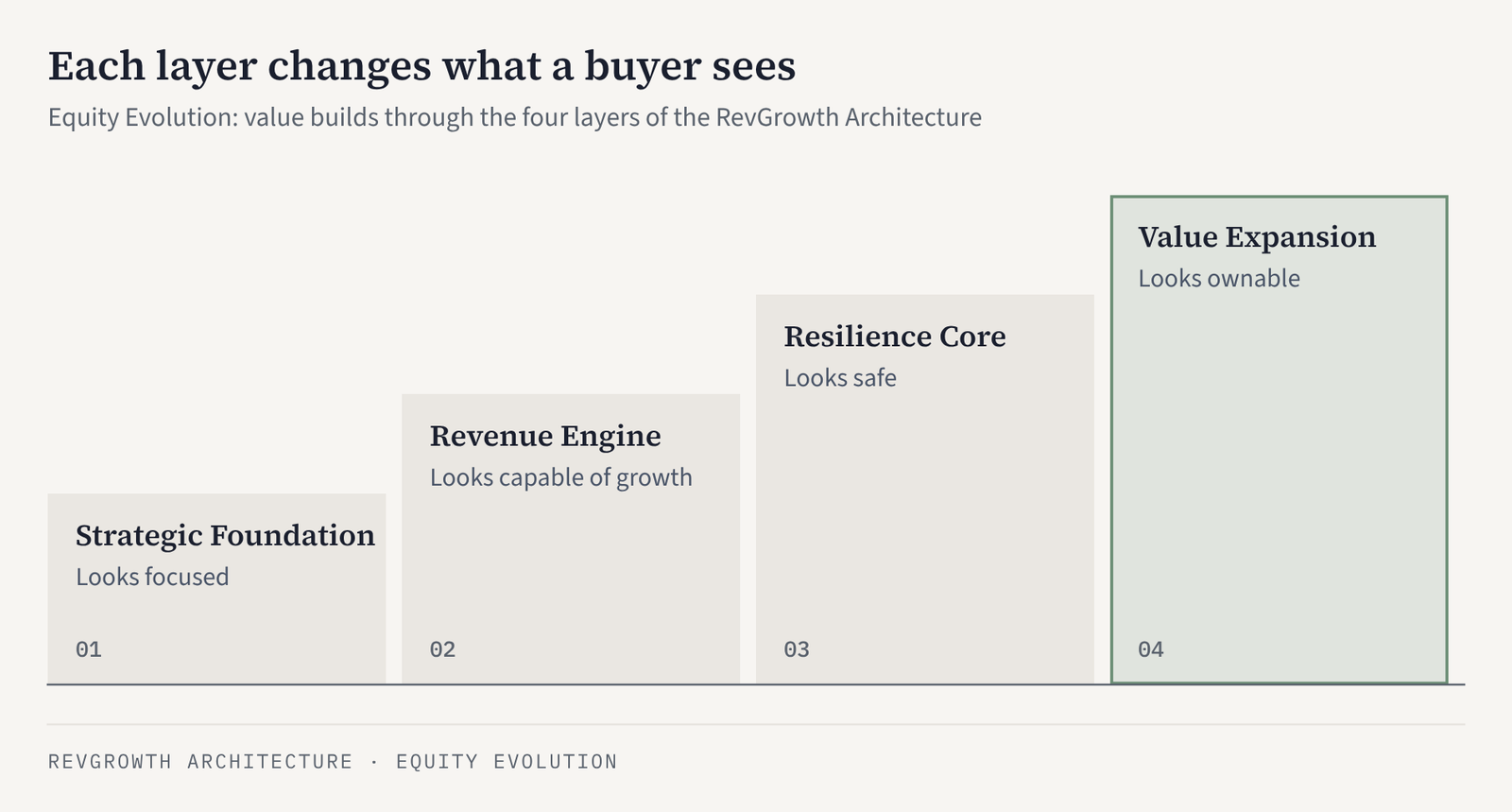
Each layer changes what an outsider sees. A company with a clear foundation looks focused. One with a working engine looks capable of growth. Add resilience, and it looks safe. By the time the fourth layer is in place, the company looks like something a buyer can own without holding their breath.
We track that fourth layer with 12 value indicators. They're the measures a serious buyer or investor would use to judge the quality of your growth. They're worth looking at long before anyone is in the room asking for them.
To be clear about where this sits in the model, Equity Evolution isn't a fifth layer or another program. It's the reason the four layers exist. It's the valuation case for running growth on a Revenue-to-Value Operating System in the first place.
This matters even if you never plan to sell.
I hear this objection often, mostly from owners of family companies. We're not for sale, so why think like a seller?
Because the things that raise a sale price are the same things that make a company better to own.
Revenue that doesn't depend on a few accounts lets you sleep. A growth process that works without the founder in every deal lets you take a vacation and, eventually, hand over the keys. Predictable results get better terms from a bank. A business that's worth more gives you choices when circumstances change, and circumstances always change.
Ignoring this has a cost. A company that chases revenue without regard to quality can become larger and more fragile at the same time. The work may look like progress, but value does not follow. This is difficult to see internally, because every report shows positive results.
Ask a different question in your next planning cycle.
Here's a practical change you can make this year.
When the growth plan comes together, the usual question is how much revenue it adds. Ask a second one of every major item in it. Does this make the company worth more, or only larger?
A big account won at a thin margin that raises your concentration makes you larger. A program that lifts retention among your best-fit customers makes you worth more. They might add the same revenue. They don't add the same value.
You'll find the question sorts a plan quickly. Some initiatives clear both bars. Some clear one. A few turn out to be buying this year's number at the expense of the business.
If you'd like to see where your company stands, the RevGrowth Simulation is free. It models your revenue drivers against the RevGrowth Benchmark of 212 companies and shows where the gaps are. It's a useful first look at how much of your growth is turning into value.

Russ Holder
Founder & CEO, RevGrowth OS. 30 years in growth strategy, five published books.
You've read what the data says. Now run your numbers through it.
A one-hour working session with your own data. We run it through the RevGrowth Benchmark live, so you see the method applied to your company before you spend a dollar.
One hour. Your data. Zero cost.