
Blog / Enterprise Value
What Buyers Pay for Beyond EBITDA
By Russ Holder
3-minute read

Most owners track EBITDA closely. Few can articulate why one company earns a six-times multiple, and another earns nine.
EBITDA is the starting point. The multiple reflects the buyer's assessment of its quality. That assessment depends on factors not visible in the income statement.
The multiple is a forward-looking judgment.
A buyer does not pay for last year's earnings. Those are history. The price reflects the next five to ten years of earnings, adjusted for the buyer's confidence in the reliability of those earnings.
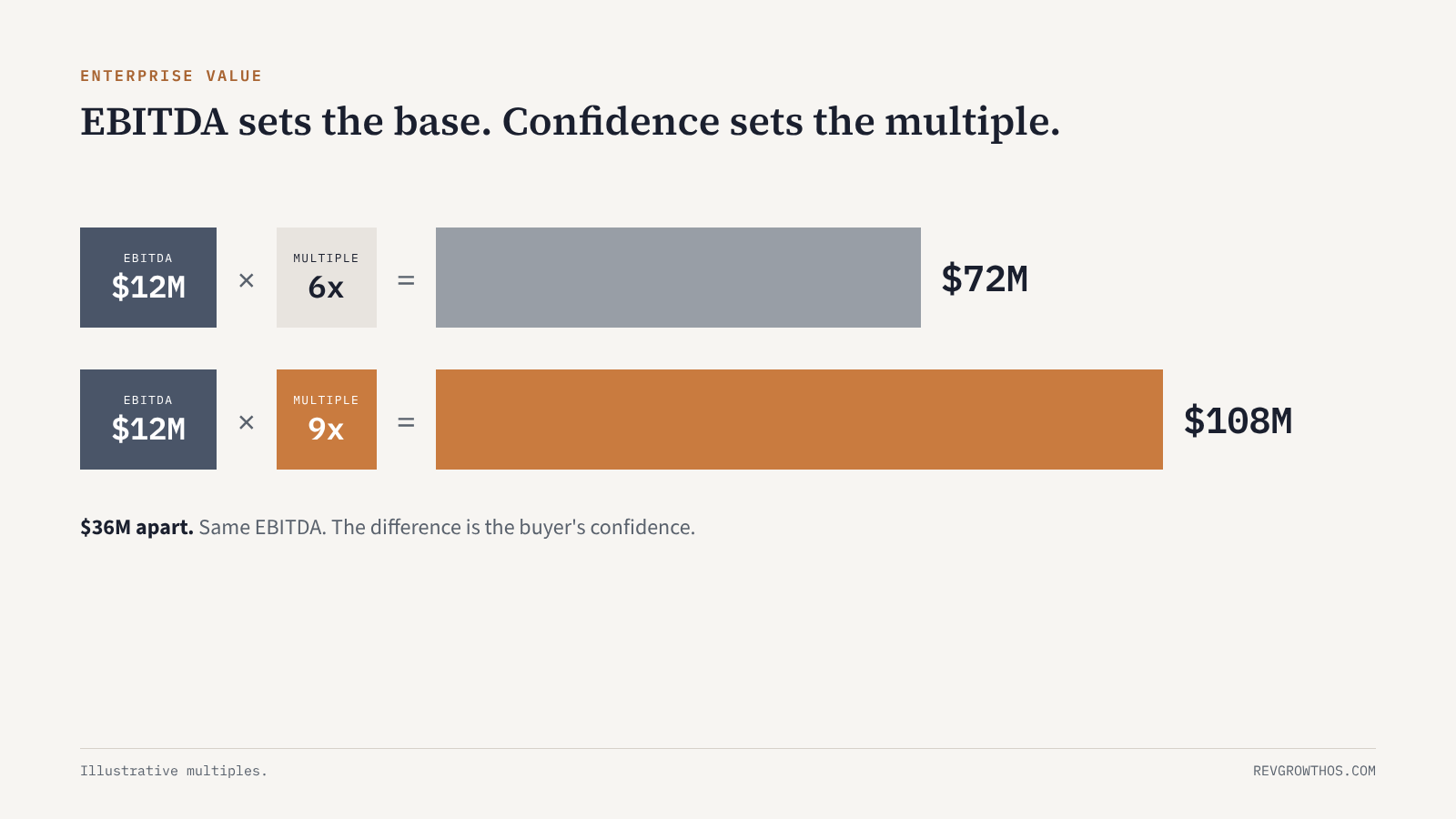
Consider two companies, each with $12 million in EBITDA. One is expected to grow steadily. The other faces the risk of losing its largest customer. At six times versus nine times EBITDA, the price difference is $36 million. The variable is confidence, not earnings.
The key question is not just how to add EBITDA. It is what builds the buyer's confidence in future performance.
Buyers build confidence from what they can verify. Not from the management presentation, but from data they can reconstruct themselves. They look for recurring themes across multiple years, not isolated numbers.
Six things buyers test.
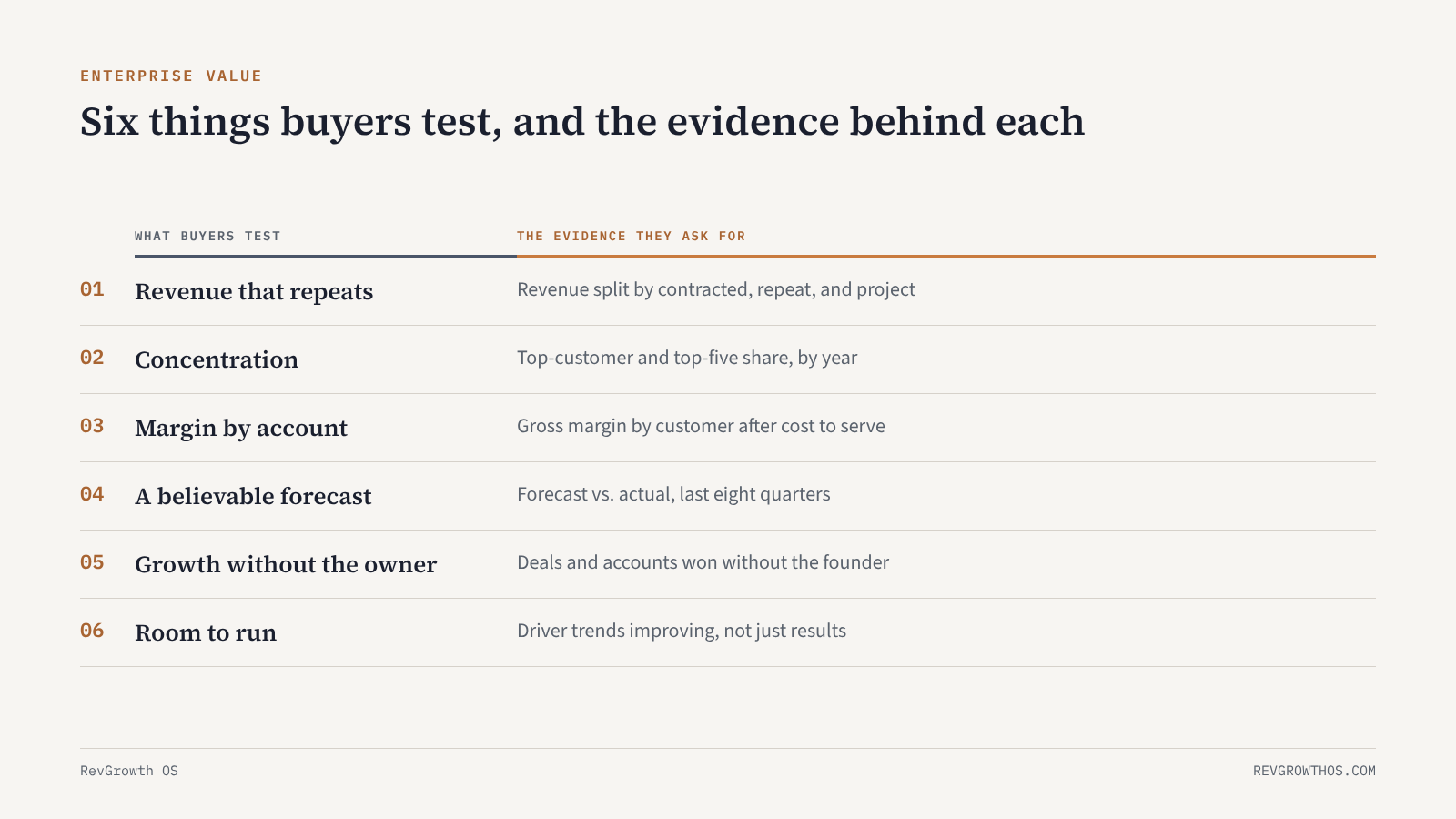
During diligence, buyers focus on a consistent set of questions. Each factor influences the multiple.
How much revenue repeats. Contracted and recurring revenue is worth more than project revenue that has to be won again. Buyers will split your revenue into those buckets whether you do or not.
How concentrated it is. If your top customer is 20% of sales, the buyer prices the risk of losing them. The same goes for a single channel or distributor.
Whether margins hold up by account. Average margin hides a lot. Buyers look for the accounts that lose money once you load in the cost to serve them.
Whether the forecast is believable. A company that has hit its forecast within a few points for three years gets the benefit of the doubt. One that misses in both directions doesn't.
Whether growth survives the owner leaving. If the founder closes the big deals and holds the key relationships, the buyer is buying a business that may not work without the seller. That gets priced, or it gets an earnout.
Whether the growth has room to run. A buyer pays for the next chapter. Evidence that the growth drivers are improving, not just the results, makes that chapter easier to believe.
Only one of the six, room to run, looks forward in any speculative sense. The other five are about evidence that already exists in your records today, or doesn't.
Evidence beats explanation.
Every owner can explain why growth will continue. Buyers have heard every version. What matters is evidence: retention data over several years, margin by account, forecast accuracy, and growth that doesn't depend on a single individual.
This is why preparation must begin well before a sale. Historical records cannot be created retroactively.
A banker can help present the narrative. Only your operating record provides proof.
Could you show a buyer, today, how much of last year's revenue renewed?
Build the multiple, not just the earnings.
Most value creation plans focus on EBITDA because it is familiar and measurable. That work is important. The greater opportunity is often in the multiple, driven by the six factors above.
In our benchmark of over 200 mid-market companies, the top quartile grows at 38.6 percent annually, while the bottom quartile grows at 5.7 percent. Growth rate is one factor. More important is whether that growth is built in a way a buyer can verify and trust.
Owners sometimes ask if this work is worthwhile years before a sale. It is. Each of the six factors also describes a company that is easier to operate, easier to finance, and less reliant on the owner's daily involvement.
Run your own diligence first.
Before a buyer conducts diligence, apply the six tests to your own company. Segment revenue by type. Calculate customer concentration. Analyze margin by account. Compare forecast to actual results for the past eight quarters. Identify relationships that depend on you personally.
Ideally, have someone outside the leadership team perform this analysis, as a buyer's analyst would. Owners often assess their own company less critically.
The weakest area is where buyers will negotiate most aggressively. It is also where you have the greatest opportunity to improve value while you control the process.
The free RevGrowth Simulation is a quick way to see how your company measures up against 200-plus peers on the drivers buyers care about.

Russ Holder
Founder & CEO, RevGrowth OS. 30 years in growth strategy, five published books.
You've read what the data says. Now run your numbers through it.
A one-hour working session with your own data. We run it through the RevGrowth Benchmark live, so you see the method applied to your company before you spend a dollar.
One hour. Your data. Zero cost.