
Blog / Enterprise Value
Quality of Revenue: Why Some Revenue is Worth More
By Russ Holder
3-minute read

Finance teams focus heavily on quality of earnings. Buyers require it. A QoE report is standard in any serious transaction.
Quality of revenue receives less attention. Yet this is where value is judged. Earnings are the outcome. Revenue quality determines if those earnings will recur.
Two dollars of revenue can appear identical on the P&L but carry different value to a buyer.
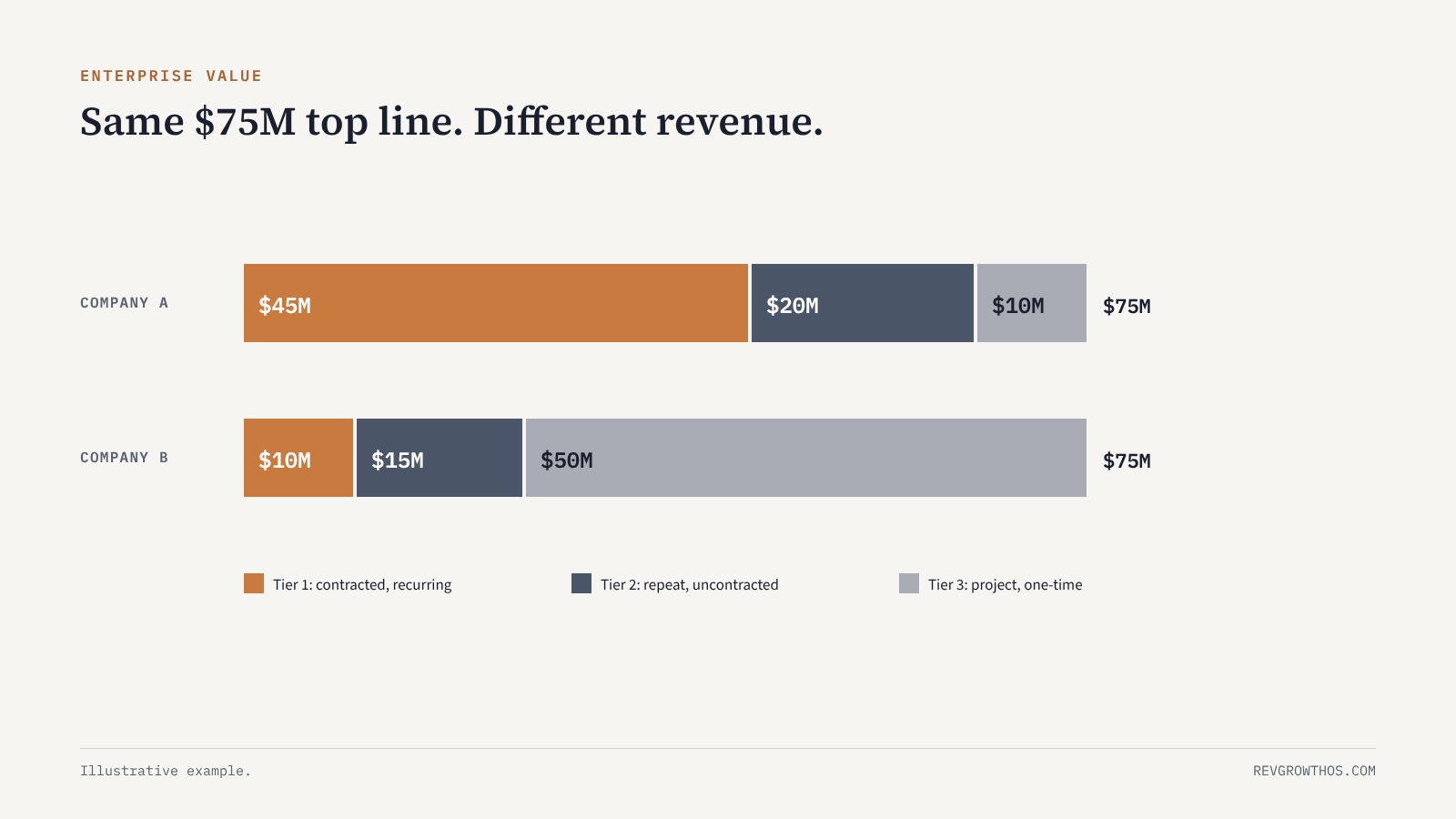
Two companies, same top line.
Picture two $75 million businesses. The first has $45 million under multi-year service and supply agreements, another $20 million in repeat orders from long-standing customers, and $10 million in one-time projects. The second has $50 million in projects won through bids, $15 million in repeat orders, and $10 million under contract.
On the income statement, they look the same. To a buyer, they are not. The first has most of next year's revenue secured. The second must win most of it again.
Even with identical margins, the first company commands a higher price. Its earnings are more likely to persist. That is what the buyer values.
Sort revenue into tiers.
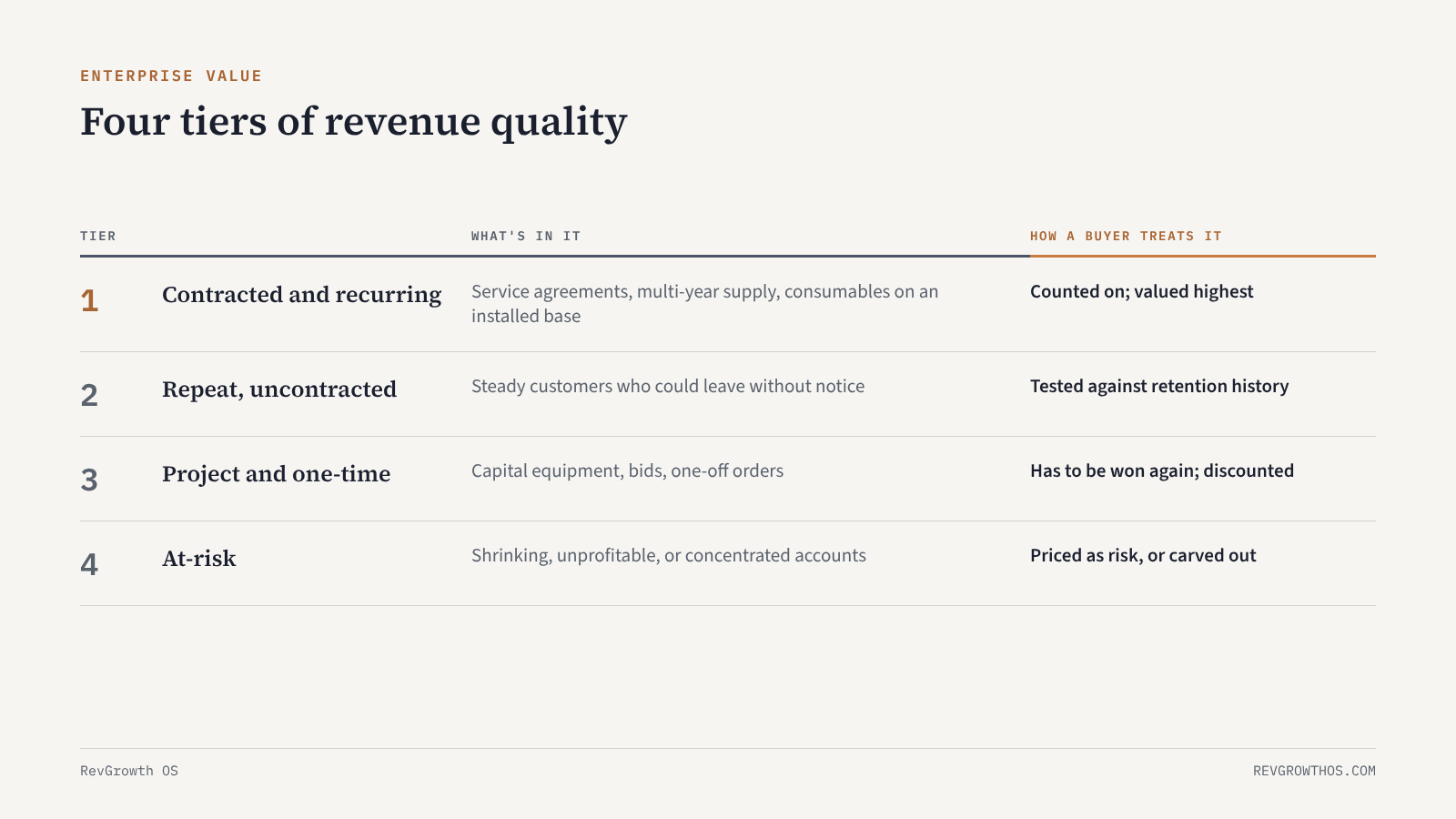
The simplest approach is to sort every dollar by how likely it is to recur.
Tier 1: contracted and recurring. Service agreements, multi-year supply contracts, subscriptions, and consumables tied to an installed base. This revenue renews on its own unless something goes wrong.
Tier 2: repeat but uncontracted. Customers who order steadily but can leave at any time. This revenue is usually reliable but carries real risk.
Tier 3: project and one-time. Capital equipment, bids, and one-off orders. This revenue must be won each time again.
Tier 4: at-risk. Revenue from accounts that are shrinking, unprofitable, or so concentrated that their loss would be material.
Most CFOs can build a rough version of this from the ERP within days. Start with the top hundred customers. They usually account for most of the revenue. The long tail can be estimated. The initial mix often reveals unexpected patterns.
Be strict with Tier 1. A contract cancellable on thirty days' notice belongs in Tier 2. So does a recurring customer whose orders depend on a single project.
Layer in margin and concentration.
Tiers show revenue durability. Two additional filters reveal value.
First, margin by account. A Tier 1 contract that loses money after accounting for service and parts is not high-quality revenue. It is a long-term loss.
Second, concentration. A Tier 2 customer at 18% of sales carries more risk than ten customers at 2% each. Buyers analyze this. You should as well.
A third filter is trend. Is each tier growing or shrinking as a share of total revenue? A rising Tier 1 share signals a different trajectory than growth concentrated in Tier 3.
Assess how much of your revenue qualifies as Tier 1 under buyer scrutiny.
Move revenue up the tiers.
Quality of revenue is not fixed. Leading mid-market companies improve it deliberately.
They attach service agreements to equipment sales, converting one-time projects into recurring streams. They convert steady repeat customers into contracted accounts through supply agreements or vendor-managed inventory. They reprice or exit unprofitable accounts. They reduce concentration by building additional tiers of large accounts.
Each action moves revenue up a tier. None requires a larger top line. Each increases the value of existing revenue.
This is gradual work, measured in years. That is why it is worth starting early. Buyers look for sustained improvement in the revenue mix, not a last-minute surge in contracts.
Report it next to revenue.
CFOs should add a quality-of-revenue view to quarterly reporting: tier mix, top-customer share, and margin by tier. Present this alongside the top line to the board.
Over time, this shifts the conversation. The board moves from asking if revenue grew to asking if the right revenue grew. Buyers ask the same question.
This approach benefits the company internally. Sales teams recognize that service agreements and supply contracts are more valuable than first-year revenue indicates. Compensation plans can be adjusted to reflect this.
If you want to see how your revenue drivers compare with 200-plus mid-market companies, the free RevGrowth Simulation is a good place to start.

Russ Holder
Founder & CEO, RevGrowth OS. 30 years in growth strategy, five published books.
You've read what the data says. Now run your numbers through it.
A one-hour working session with your own data. We run it through the RevGrowth Benchmark live, so you see the method applied to your company before you spend a dollar.
One hour. Your data. Zero cost.