
Blog / Enterprise Value
Becoming an Investable Mid-Market Company
By Russ Holder
3-minute read

Many good companies are not investable. They are profitable, well-run, and respected in their markets. But when an investor looks closely, the business is hard to underwrite.
Investable is a specific condition. An investor can see how your company grows, believe it will keep growing, and see how capital can accelerate it. Most owners only consider this when a sale is imminent. By then, it is late.
The conditions are well understood. Investors know what they look for. Most owners have not viewed their company through that lens.
What investors are actually underwriting.
An investor is not buying your company as it is today. They are buying a plan for what it becomes over several years.
To underwrite that plan, investors need three things. They need to know where revenue comes from and why it repeats. They need to see that the company can run and grow without the owner holding every relationship. They need to see room to grow: drivers that can be improved, markets that can be extended, and a team that can execute.
If any of these are missing, the investor passes, lowers the price, or structures the deal to protect their position.
Strategic buyers approach it differently. They focus on how your customers, products, and people fit with theirs. They still need to believe the revenue will survive the transition. The same questions apply.
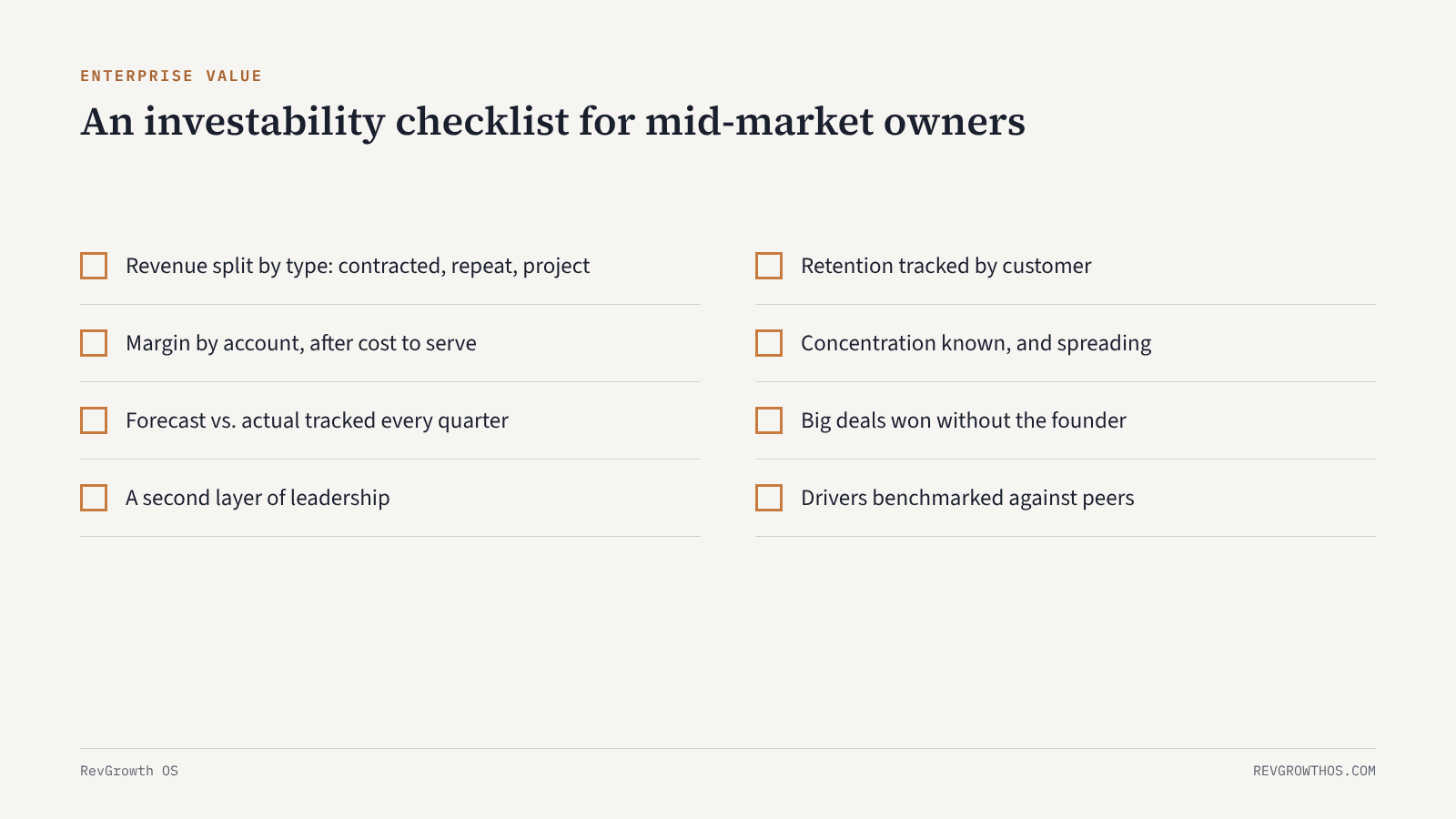
The gaps that make good companies hard to invest in.
A handful of gaps appear repeatedly in strong mid-market companies.
The founder is the growth engine. Big deals, key accounts, and pricing decisions all run through one person.
The numbers live in people's heads. Revenue is reported, but customer retention, margin by account, and forecast accuracy are not.
Revenue is hard to categorize. No one can say how much is contracted, how much repeats, or how much is project work.
The management team is thin. No one below the owner has run a function at the scale the investor's plan requires.
The growth story lacks evidence. The owner believes the company can double, but no data shows which drivers would make that happen.
Customer concentration is high. One or two accounts make up a large share of revenue, and the relationships are personal.
None of these gaps is fatal. All of them reduce value at the table.
The result is usually a price adjustment or a structure that shifts risk back to the seller, such as an earnout, a larger rollover, or an escrow. The owner pays for the gaps either way. Fixing them ahead of time is almost always cheaper.
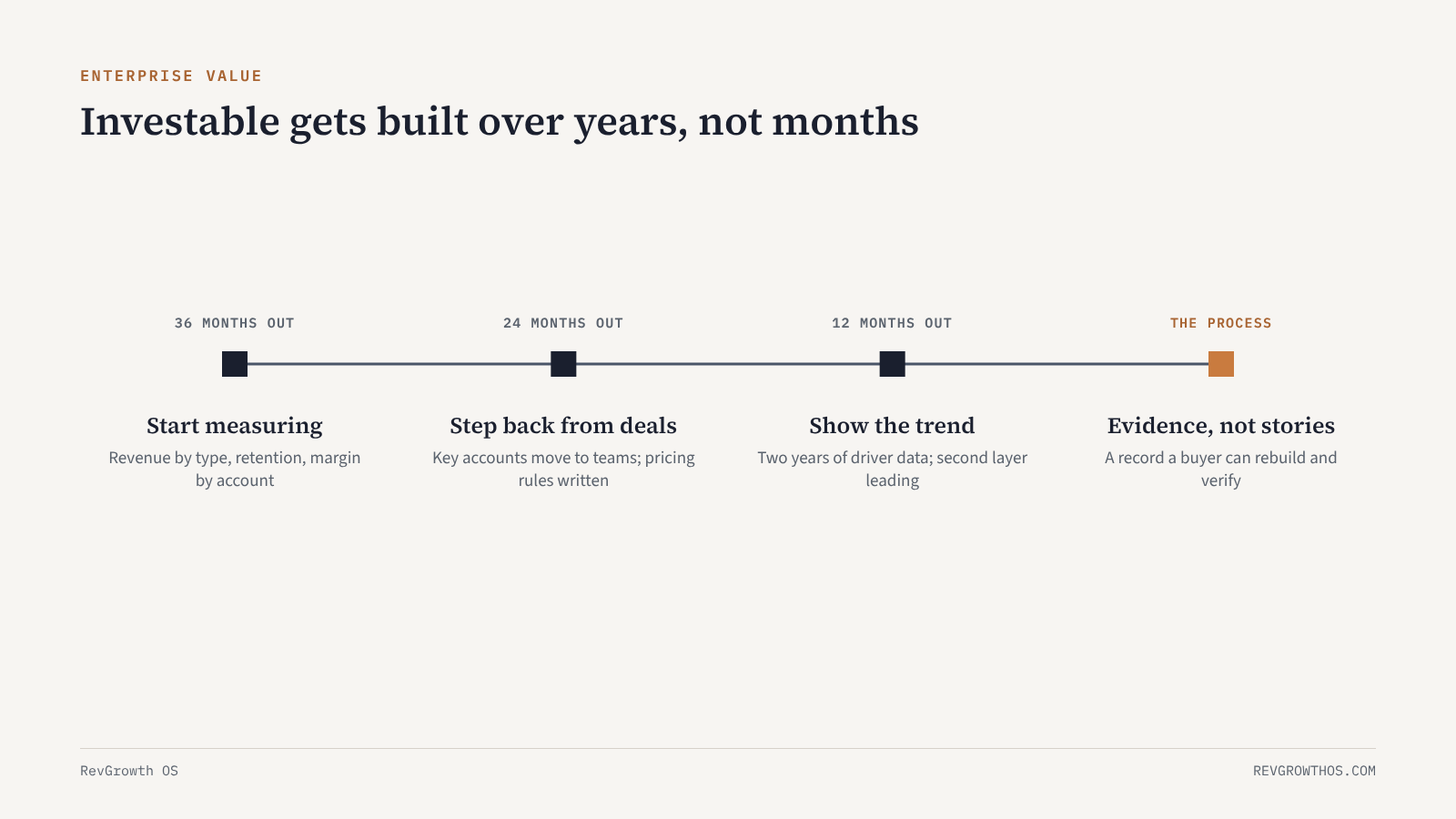
Investable gets built over years, not months.
You cannot fix these in the six months before a process. Buyers look back three years or more. They want trends: retention that improved, margins that held, forecasts that came true, and a second layer of leadership that has been running things.
Owners should start building investability two or three years before they think they will need it. Even if you never sell, the same work makes the company easier to run and less dependent on you.
Founder dependence takes time to show up in the data. A new org chart does not convince a buyer. They want to see a year or two of deals closed and accounts grown without the owner present.
Where to start.
Start with measurement. You cannot show evidence you do not collect. Set up a quarterly view of the drivers an investor will care about: revenue by type, retention by customer, margin by account, concentration, and forecast against actual.
Next, address founder dependence. Document how the biggest deals are won. Put key accounts under team coverage. Push pricing authority down a level with clear rules. Let someone else lead the next growth initiative while you coach.
Then, improve revenue quality. Convert one-time project customers into service or supply agreements. Spread revenue across more large accounts. Each shift makes the company easier to underwrite.
Finally, benchmark your company. Investors will compare you with other companies. You should know where you stand first.
Investable is not the same as for sale. It is a condition that gives you options: raise capital, bring in a partner, sell, or keep running a business that does not depend on you.
The free RevGrowth Simulation measures your company against 200-plus mid-market companies on the drivers investors look at and shows which gaps would cost you the most at the table.

Russ Holder
Founder & CEO, RevGrowth OS. 30 years in growth strategy, five published books.
More from the Revenue-to-Value Gap blog.
You've read what the data says. Now run your numbers through it.
A one-hour working session with your own data. We run it through the RevGrowth Benchmark live, so you see the method applied to your company before you spend a dollar.
One hour. Your data. Zero cost.