
Blog / Enterprise Value
The Chain of Custody on Your Growth Number
By Russ Holder
3-minute read
In a courtroom, evidence is only as good as its chain of custody. If nobody can show where it came from and who handled it, it doesn't count, no matter how convincing it looks.
Your growth number works the same way. The 14% in your board deck is only as credible as the path from that figure back to real transactions. Most mid-market companies can't trace that path cleanly. Buyers, lenders, and boards will try.
A growth number without a clean chain is unproven. Unproven numbers get discounted.
What the chain looks like.
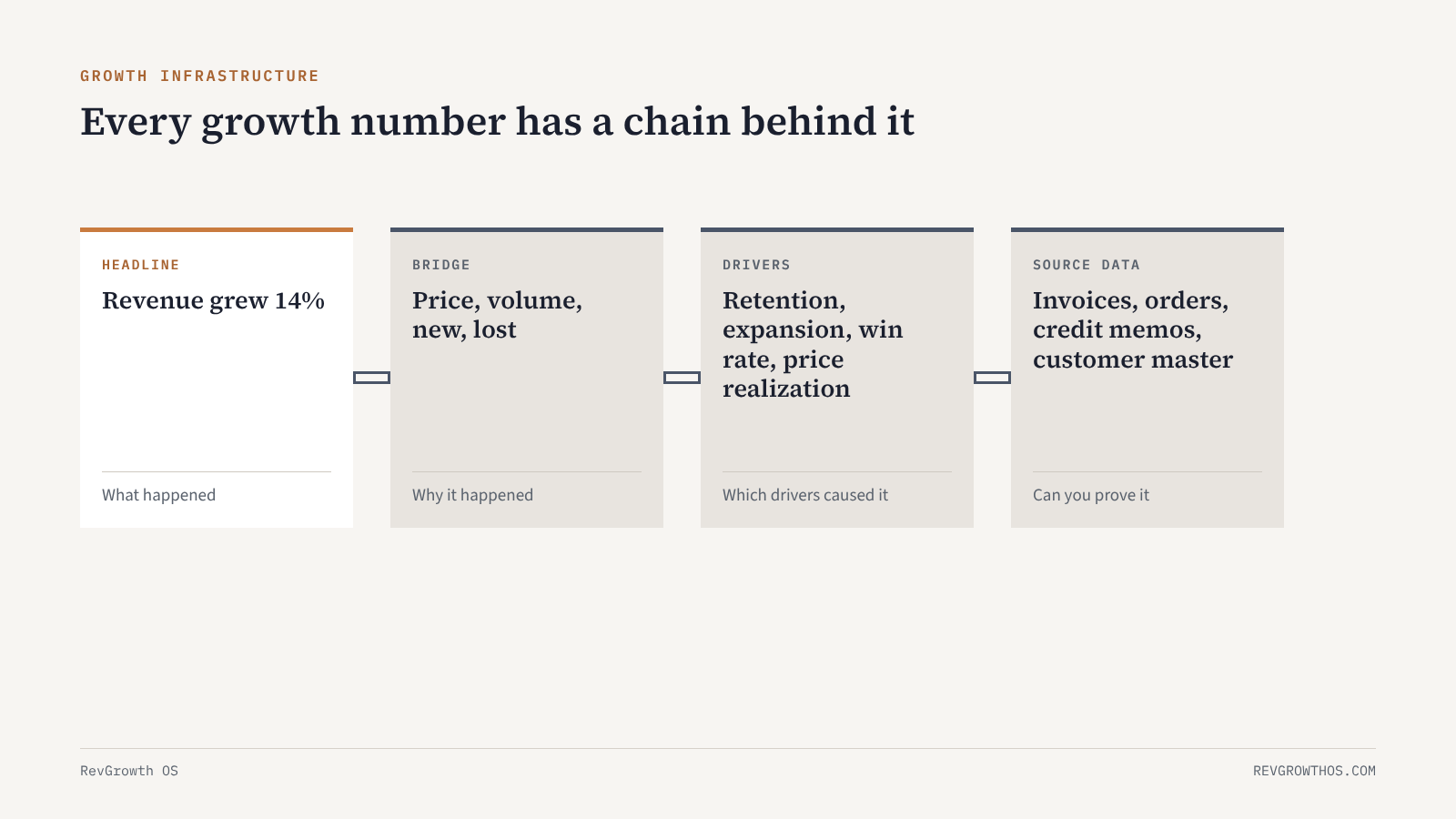
Every growth figure has a chain behind it. Most companies have not documented it.
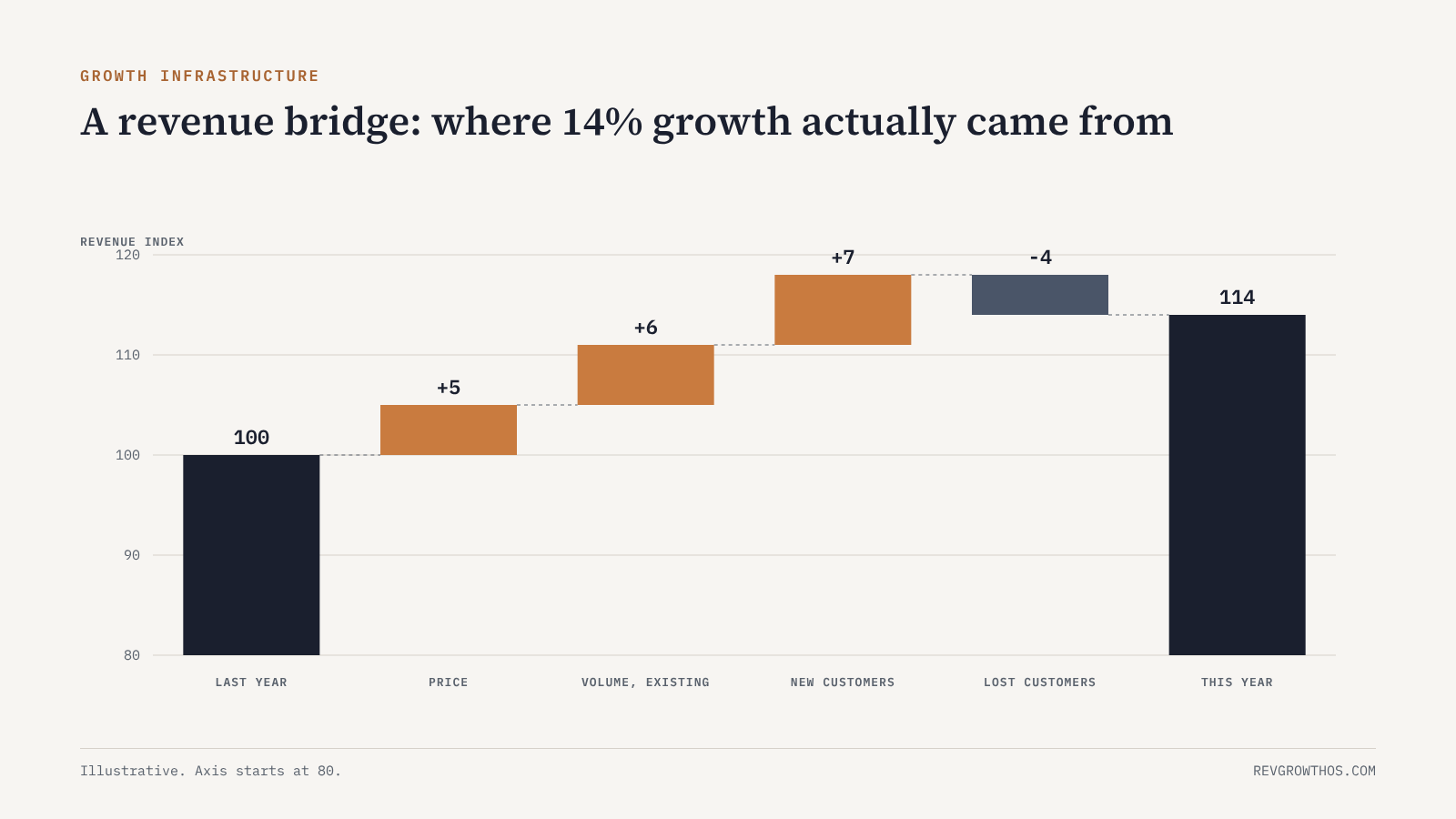
At the top is the headline: revenue grew 14%. Underneath is a bridge that explains it: so much from price, so much from more volume with existing customers, so much from new customers, minus what was lost. Underneath that are the drivers: retention, account expansion, win rates, price realization. At the bottom is the source data: invoices, orders, credit memos, and customer records in the ERP and CRM.
If each link connects, the number stands. If a link is missing, the number is only an assertion.
There are four layers. What happened. Why did it happen. Which drivers caused it. Can you prove it.
Where the chain usually breaks.
The bridge is missing. The company reports 14% revenue growth but cannot split it by price, volume, new customers, or existing customers.
Definitions are inconsistent. "New customer" means one thing in sales, another in finance. "Recurring" includes project work in one report and excludes it in another.
Manual adjustments accumulate. Revenue is reclassified in spreadsheets outside the ERP. The logic is lost within a year.
Customer records are inconsistent. The same customer appears under multiple names. Customer retention cannot be calculated without extensive cleanup.
Price and volume are often conflated. Without a clean price history in the ERP, price increases cannot be separated from mix shifts. Growth attributed to price may be misclassified as volume. Buyers will discount it when they discover the issue.
Each issue is fixable. None feels urgent until an external party asks a question the company cannot answer.
Why it matters at the table.
In a sales process, the buyer's diligence team will rebuild your growth number from the bottom up. If their version doesn't match yours, the emphasis shifts from growth to credibility. Once a buyer doubts one number, they will question the rest.
The same applies to lenders and PE boards. A growth number with a clean chain of custody is accepted. Without it, the number is discounted or triggers a quality-of-earnings review.
It matters internally. If you cannot separate growth by price or volume, you cannot evaluate pricing strategy or sales performance. Every planning decision depends on that split.
What would it take, today, to show a buyer how much of last year's growth came from price?
Build the chain before anyone asks.
Start with the bridge. Each quarter, split revenue change into price, volume from existing customers, new customers, and lost customers. The first cycle requires effort. After that, it becomes routine.
Lock the definitions. Document what counts as a new customer, lost customer, recurring revenue, and expansion. Use the same definitions in every report.
Assign ownership. In most companies, FP&A owns this process. Sales operations must be involved, since many definitions originate in the CRM.
Clean the customer master. One customer, one record, with parent-child relationships for multi-site accounts. This work pays back every time someone asks about retention.
Connect the bridge to the drivers. When retention rises, or price realization slips, the growth bridge should reflect it. At that point, the number becomes something you can manage.
A test for your next board meeting.
Select one growth claim from your last board deck. Trace it back to invoices. Record the time required and each judgment call made.
That is your chain of custody. If it takes more than an afternoon to trace, a buyer will notice. Find the weak links before they do. Start there.
When you're ready to compare your drivers against 200-plus mid-market companies, the free RevGrowth Simulation is a good next step.

Russ Holder
Founder & CEO, RevGrowth OS. 30 years in growth strategy, five published books.
You've read what the data says. Now run your numbers through it.
A one-hour working session with your own data. We run it through the RevGrowth Benchmark live, so you see the method applied to your company before you spend a dollar.
One hour. Your data. Zero cost.