
Blog / Benchmark Data
Why the Bottom Quartile Isn't Failing at Execution
By Russ Holder
3-minute read
Slow growth is often blamed on execution. The plan gets a pass. The team gets the blame. Leaders expect accountability to fix the numbers.
I hear this in nearly every bottom-quartile company. Most of the time, it is not true.
Our benchmark covers over 200 mid-market companies. The bottom quartile grows at 5.7% a year. The top quartile grows at 38.6%. Leaders see that gap and assume the slow growers are underperforming. That is not what I find. Bottom-quartile teams often work harder than anyone. They hit targets. They ship on time. They answer the phone on Saturday.
Execution is not the issue. The system itself limits growth.
Hard work inside a weak design.
Picture a $90 million distributor whose sales team makes its call numbers every week. Quotes go out. Orders come in. Operations runs a tight warehouse. Every function, measured on its own terms, looks fine.
The system tells a different story. Pricing is set deal by deal, so reps discount to close. Retention by account is not tracked, so long-time customers leave unnoticed. The founder approves every large quote, so big deals wait. The forecast relies on the sales VP's optimism.
These are not execution failures. They are design choices, often made by default years ago. They cap growth regardless of effort.
This wears good teams down. They sense the ceiling but cannot see the cause. They push harder on visible activities.
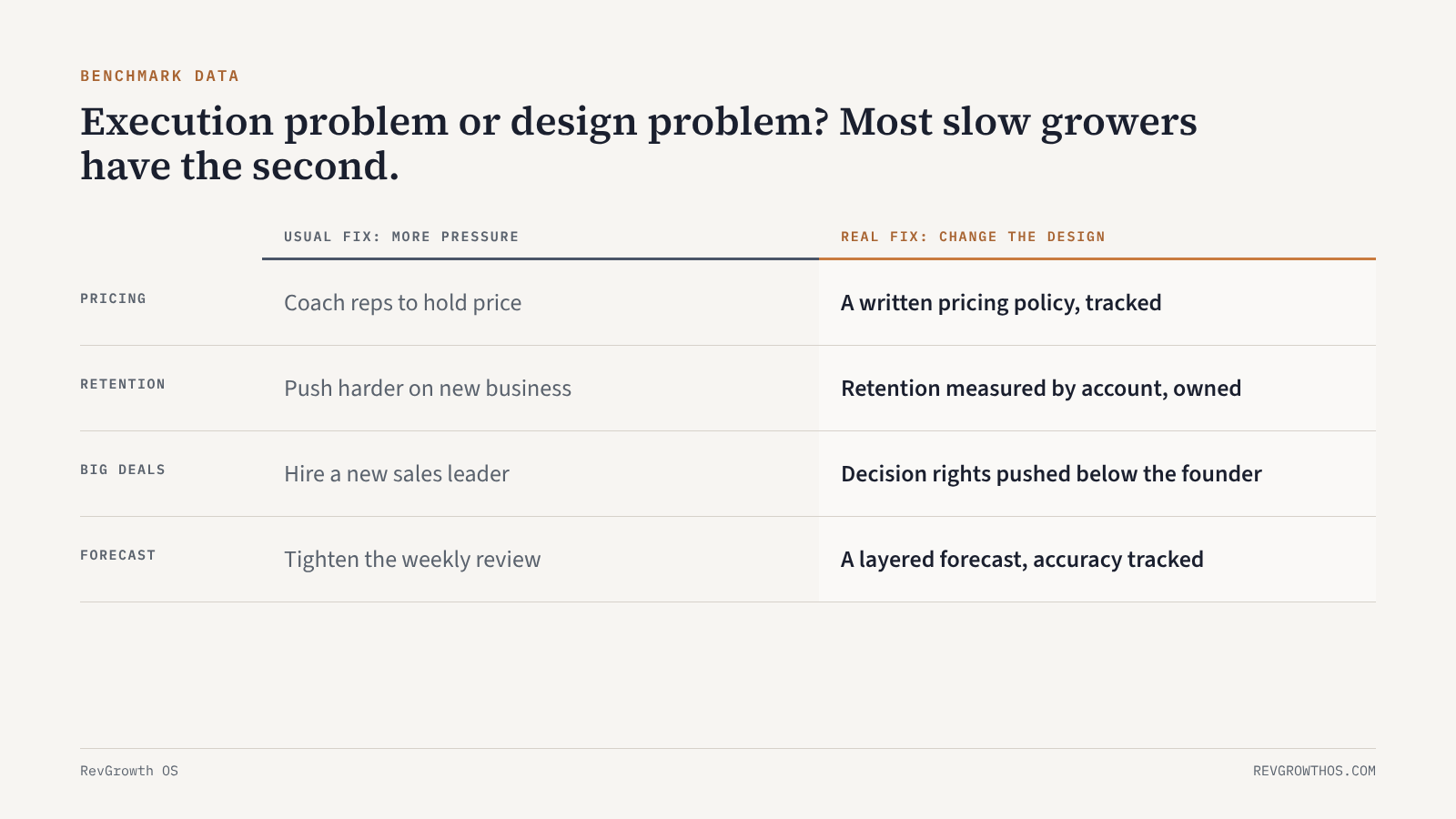
Why "execute better" doesn't work.
When growth stalls, leaders apply pressure. They set new targets, bring in a new sales leader, tighten reviews. Activity rises for a quarter or two, then numbers return to the old level.
Effort is not the constraint. If retention is leaking, more new business only fills a bucket with a hole. If pricing lacks discipline, more volume adds revenue but loses margin. If decisions bottleneck at the top, more activity just increases the wait for approvals.
I have seen companies replace three sales leaders in five years, each blamed for missing a target the system could not reach. This is costly and demoralizes teams who are doing their jobs well.
Is your team underperforming, or are they performing well inside a system that cannot go faster?
What the top quartile does differently.
Top-quartile companies do not have superhuman teams. Their people look much like those in the bottom quartile. The difference is what they execute.
They measure the drivers that produce revenue, not just activity. They know retention by customer, price realization, and how much of next year's revenue is secured. Pricing follows policy, not negotiation. Growth work is shared across the team, so it does not wait on one person. They review these drivers on a fixed schedule, so they catch issues early.
This is design. It is why their growth compounds. Acquisition, retention, and transaction multiply in the revenue engine. A company with all three healthy gets more from every hour of effort. A company with one weak driver can work twice as hard and still fall behind.
The better question for a bottom-quartile CEO.
If you are in the bottom half of the benchmark, do not ask how to get more from your people. Ask which part of the system is capping their output.
This is a more hopeful question. Execution problems are people problems and slow to fix. Design problems are usually narrower. They show up in pricing policy, missing retention measures, decisions that run through one desk, or untested forecasts. Fix the right one and the same team, working the same hours, produces more.
The benchmark shows the same pattern. The biggest jump is in the middle. Moving from the second to the third quartile adds 12.5 points of annual growth. Companies make that move by fixing one or two weak drivers, not by replacing the team.
Diagnose before you discipline.
Before establishing new targets or hiring, run a different review. Take your three weakest growth results from last year and trace each to its cause. For each, ask: did people do what the system asked?
If they did, the system asked for the wrong thing. That is where to focus.
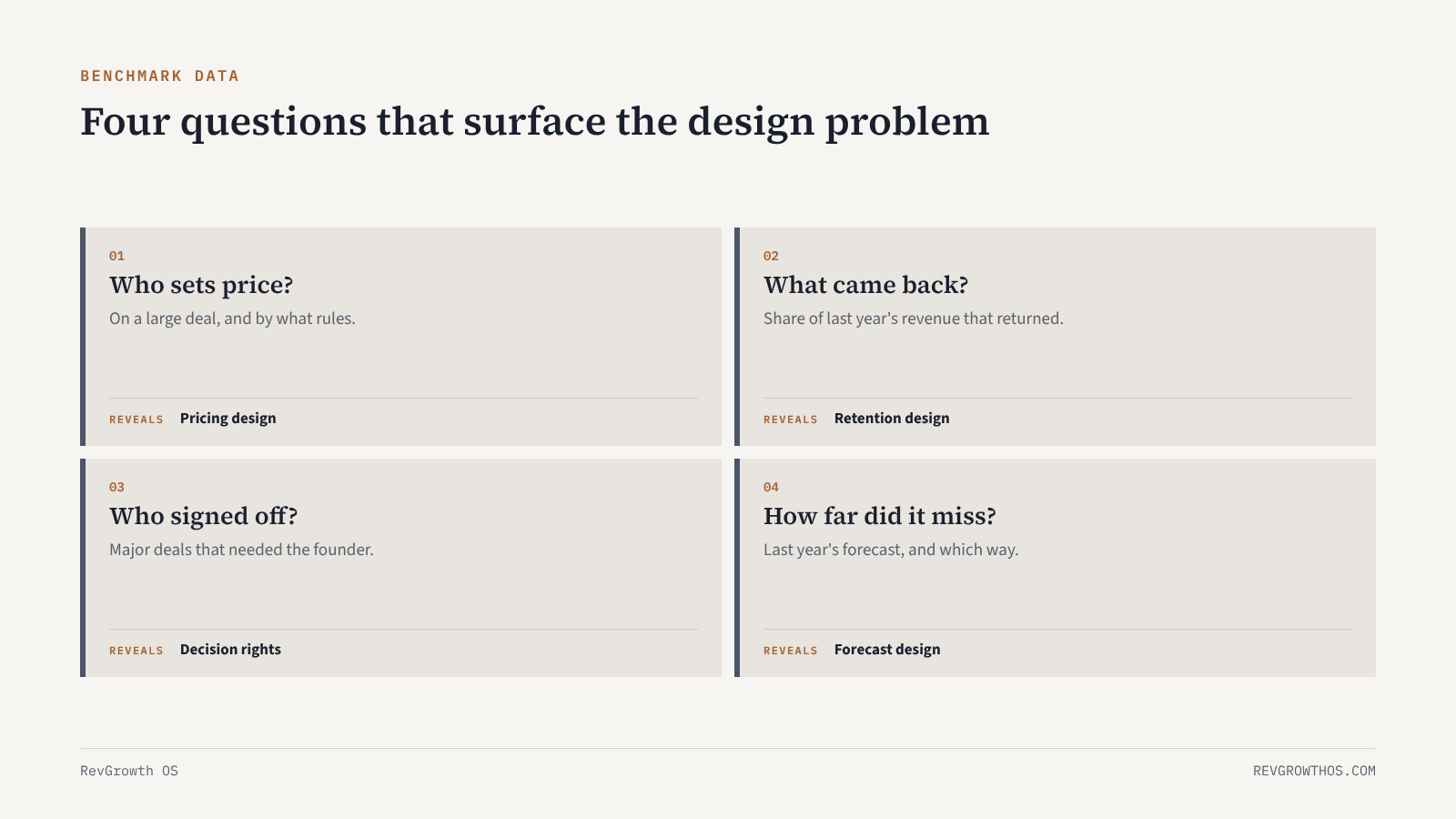
A few questions usually bring the design problem to the surface quickly. Who sets the price on a large deal, and what rules do they follow? What share of last year's revenue came back this year? How many major deals needed the founder's sign-off? How far did last year's forecast miss, and in which direction?
If those answers are unclear, this is not an execution problem. It is a measurement problem, likely hiding a design problem underneath.
The free RevGrowth Simulation scores your growth drivers against over 200 mid-market companies. In about an hour, it shows whether your team is fighting the system and which part to fix first.

Russ Holder
Founder & CEO, RevGrowth OS. 30 years in growth strategy, five published books.
More from the Revenue-to-Value Gap blog.
You've read what the data says. Now run your numbers through it.
A one-hour working session with your own data. We run it through the RevGrowth Benchmark live, so you see the method applied to your company before you spend a dollar.
One hour. Your data. Zero cost.