
Blog / Enterprise Value
Why Systematized Growth Earns a Higher Multiple
By Russ Holder
3-minute read
Two platforms come to market in the same year. Both have grown EBITDA around 15% a year through the hold. Both have clean financials and a credible management team.
One trades at a noticeably higher multiple than the other.
When you dig into why, the answer usually isn't in the growth rate. It's in how the growth was produced. One company grew because a handful of strong people pushed hard and a good market cooperated. The other grew because it built a system that would keep producing growth after the sale, with whoever was running it.
Buyers pay for the second kind. Here's why, and what it means for the way you run a hold.
A multiple is a bet on the future.
A buyer isn't paying for last year's EBITDA. They're paying for the stream of cash the business will produce over the next decade, discounted for how sure they are that it'll show up.
That makes the multiple a judgment about two things. How fast will earnings keep growing? And how much risk sits around that growth?
Systematized growth improves both answers. It makes continued growth more believable, and it makes the path less risky. That's why it earns a premium even when the trailing numbers look the same.
The arithmetic behind the premium.
A simple valuation model makes the point clearly. If a business produces steady cash flow that grows at a constant rate, its value is that cash flow divided by the gap between the buyer's required return and the growth rate. The multiple is one divided by that gap.
Take a buyer who requires a 14% return on a business they expect to grow 4% a year over the long run. The gap is 10 points, so the multiple is 10 times cash flow.
Now suppose the same buyer sees a business whose growth is governed, measured, and independent of any one person. The risk feels lower, so they'll accept a 12% return. The growth looks more durable, so they underwrite 5% instead of 4%. The gap shrinks to 7 points, and the multiple rises to about 14 times.
Same cash flow. Roughly 40% more value.
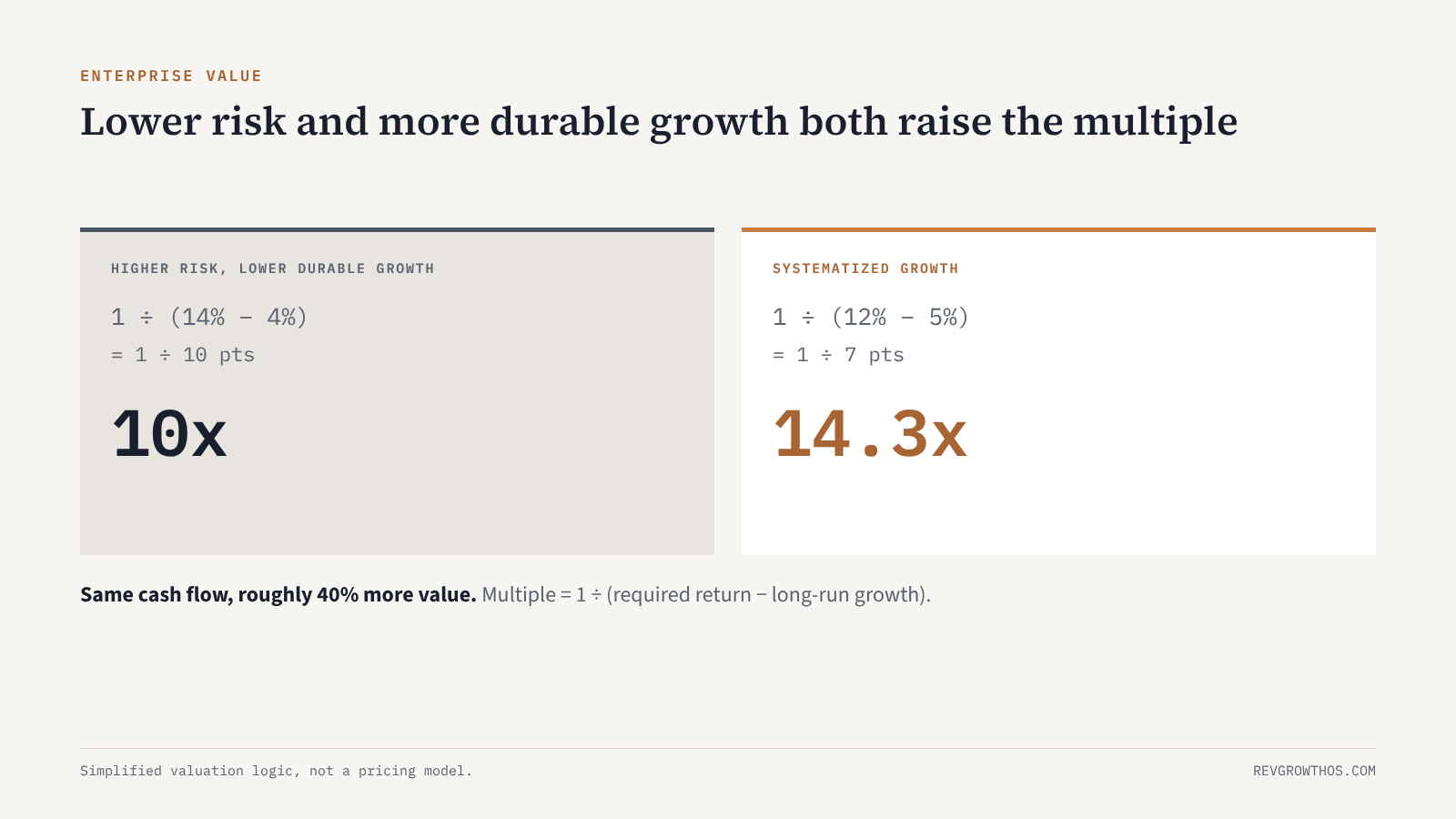
Real deals are priced on comps, competitive tension, and a dozen other factors, so treat this as logic rather than a pricing model. But the logic is how buyers think. Every point of perceived risk you remove, and every point of durable growth you can prove, compounds into the multiple.
What "systematized" means to a buyer.
Every seller claims their growth is repeatable. Buyers have learned to ask for evidence, and a few things separate real systems from good stories.
The drivers are measured, not just the results. The company can show retention by customer, price realization, account expansion, and forecast accuracy, quarter by quarter, for several years.
Growth doesn't depend on a few people. Major deals close without the founder. Key accounts have teams, not single relationships. The way the best people sell is written down and taught.
There's a governed cadence. Growth initiatives have owners, measures, and regular reviews, so gains held instead of fading after the project ended.
Revenue quality is improving. A rising share of contracted or recurring revenue, and falling customer concentration, show the system is making revenue more durable, not just bigger.
And the forecast lands. A management team that has hit its numbers within a few points for three years gets the benefit of the doubt in the model.
Heroic growth gets discounted.
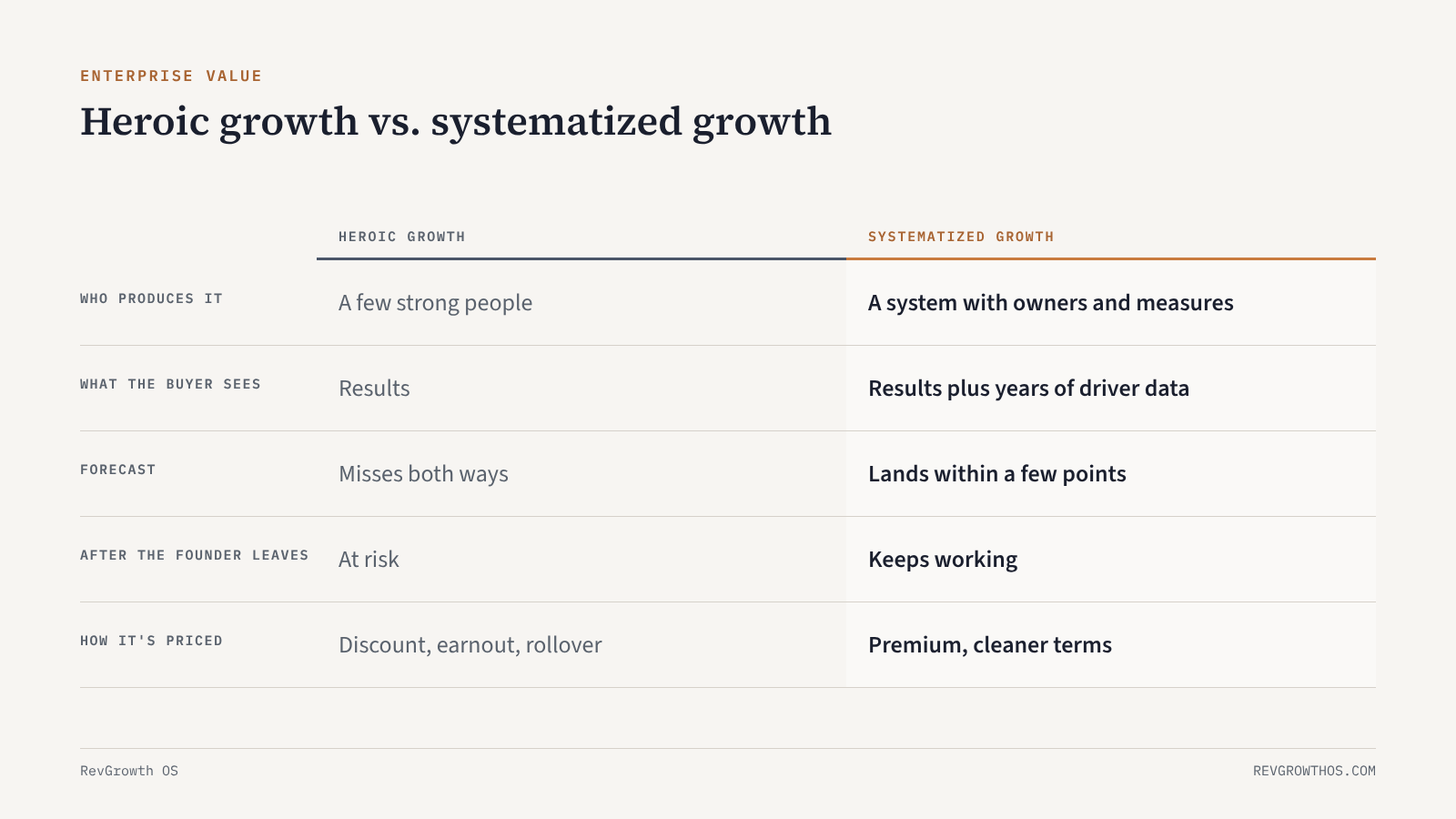
The opposite of systematized growth is heroic growth. It's real, and sometimes impressive. It just depends on specific people doing extraordinary things.
Buyers know heroes leave. They retire, they cash out at closing, or they lose interest once the earnout is done. So they price heroic growth as if some of it will walk out the door, through a lower multiple, a bigger earnout, a larger rollover, or tighter terms.
How much of your portfolio company's growth would survive if its top two people left the month after closing?
That's the question a buyer's diligence team is trying to answer. The more confidently you can answer it, the more of the value you created you'll actually get paid for.
The benchmark shows how wide the outcomes can be. Across 200-plus mid-market companies, the top quartile grows at 38.6% a year and the bottom quartile at 5.7%. In my experience, the companies at the top didn't get there on heroics. They got there by building a system that keeps producing growth regardless of who's in the room.
Build the system early in the hold.
The premium for systematized growth only gets paid on evidence, and evidence takes time to accumulate. A system installed in the last year of a hold produces one year of data, and buyers will read it as a pre-sale cleanup.
The better path is to build it in the first year. Benchmark the platform's growth drivers at entry. Install a governed cadence around the two or three weakest ones. Take the founder out of the critical path on major deals. Track the drivers every quarter alongside EBITDA.
By exit, you'll have three or four years of proof that the growth is real, repeatable, and independent of any one person. That's the story a buyer will pay a premium for, instead of discounting.
The free RevGrowth Simulation is a quick way to start. It benchmarks a portfolio company's growth drivers against 200-plus mid-market companies and shows where the system needs work.

Russ Holder
Founder & CEO, RevGrowth OS. 30 years in growth strategy, five published books.
You've read what the data says. Now run your numbers through it.
A one-hour working session with your own data. We run it through the RevGrowth Benchmark live, so you see the method applied to your company before you spend a dollar.
One hour. Your data. Zero cost.