
Blog / Benchmark Data
What RevGrowth Benchmark Data Can't Tell You
By Russ Holder
3-minute read
Every tool has an edge where it stops being useful. A torque wrench won't tell you whether the bolt was the right part. A benchmark is the same.
I run a benchmarking firm, so you might expect me to oversell what the data does. I'd rather tell you where it stops. A CFO who knows the limits of a tool uses it better, and trusts it more where it does work.
What the data is built to do.
The RevGrowth Benchmark scores a company on 25 drivers against 200-plus mid-market industrial and B2B companies. The output is a position on each driver, and a picture of which growth range the company's current system is built to produce.
That's useful for three things. It shows where you're strong and weak compared with real peers. It ranks your gaps by what they're worth to close. And it gives you a baseline, so next year you can tell whether anything moved.
All of that is about how your company is built. The limits start where questions move outside the company, or into the future.
I find it helps to think of the benchmark the way you'd think of an engineering inspection. It can tell you the condition of the machine, which parts are worn and which will fail first under load. It can't tell you what the machine will be asked to run next year.
It can't forecast your market.
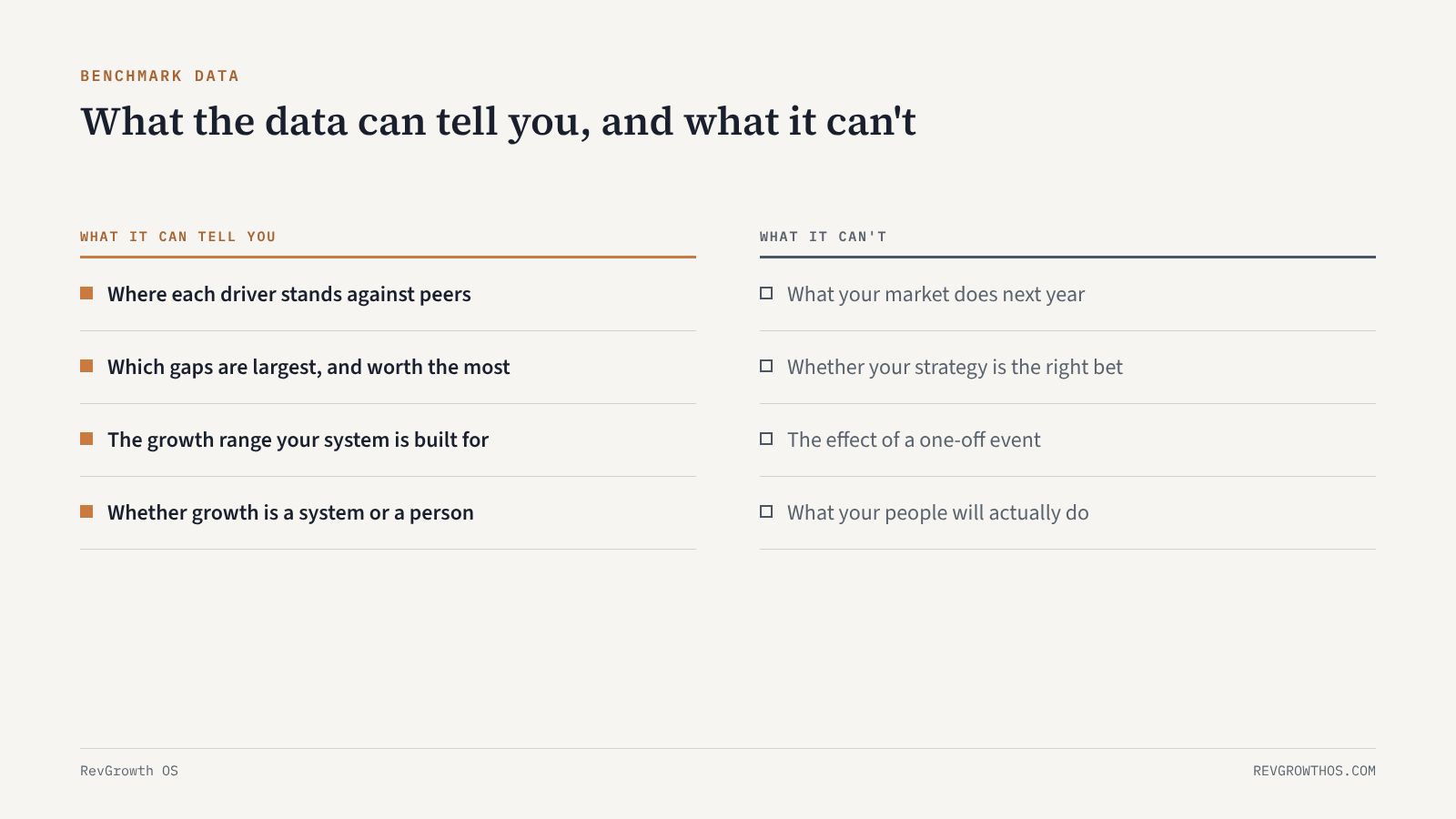
The benchmark doesn't know what your end markets will do next year. It can't predict a housing slowdown, a tariff change or a customer's plant closure.
What it can tell you is how exposed you are. A company with 30% of revenue in one customer is more fragile than one with its largest customer at 8%, whatever the market does. That's a measured fact about your structure. Whether the shock arrives is a different question, and nobody answers it reliably.
So if a board member asks, "What does the benchmark say we'll do next year?", the honest answer is that it says what your system is built to produce under normal conditions. It doesn't say what conditions you'll get.
It can't tell you whether your strategy is the right bet.
The benchmark can tell you whether a strategy exists. It can show whether you've chosen segments, whether the choice is written down, and whether the rest of the business is organized around it.
It can't tell you whether you picked the right market. If you've decided to grow in medical device components rather than agricultural equipment, the data can't judge that call. Two companies can score equally well on strategic clarity while one has bet on a growing market and the other on a shrinking one.
That judgment stays with leadership. The benchmark makes sure the judgment is made deliberately, rather than by default.
In practice, I've seen the benchmark surface strategy questions rather than answer them. When a company's drivers are strong but growth is slow, the market choice is often the reason. That's a useful finding, and it points the conversation toward the board rather than the sales team.
It can't predict a one-off event.
Some years include something that doesn't repeat. A large capital project. A competitor's recall that sent customers your way. A pandemic order spike.
The benchmark measures the system. It won't capture the effect of a single event, and it shouldn't. If last year's growth came mostly from one project, your driver scores may look ordinary while your revenue looked great. That's not a flaw in the data. It's the data telling you the growth was an event rather than a capability.
For a CFO building a plan, that distinction matters. Event-driven growth needs to come out of the baseline before you project anything forward.
It can't tell you what your people will do.
This is the biggest limit, and the one I'd underline for any CFO.
A benchmark can show that your pricing discipline sits in the bottom quartile and that closing half the gap would be worth a few points of margin. It can't make your sales team hold price. It can't make a regional manager follow up on lapsed accounts.
Execution is a people problem as much as a measurement problem. The benchmark tells you where to aim. Hitting the target takes owners, targets, a review cadence and someone willing to hold the line in the meeting where an exception gets requested.
It also can't see culture directly. A team that trusts its numbers and one that games them can produce similar scores in year one. The difference shows up in year two, when one team's gains hold and the other's quietly fade.
Is that a weakness of benchmarking? I'd call it a division of labor. Measurement removes the guessing about where to focus. It doesn't remove the work.
How to use it well, given the limits.
Treat the benchmark as a map of your system, not a forecast. Use it to decide where effort and money should go, and in what order.
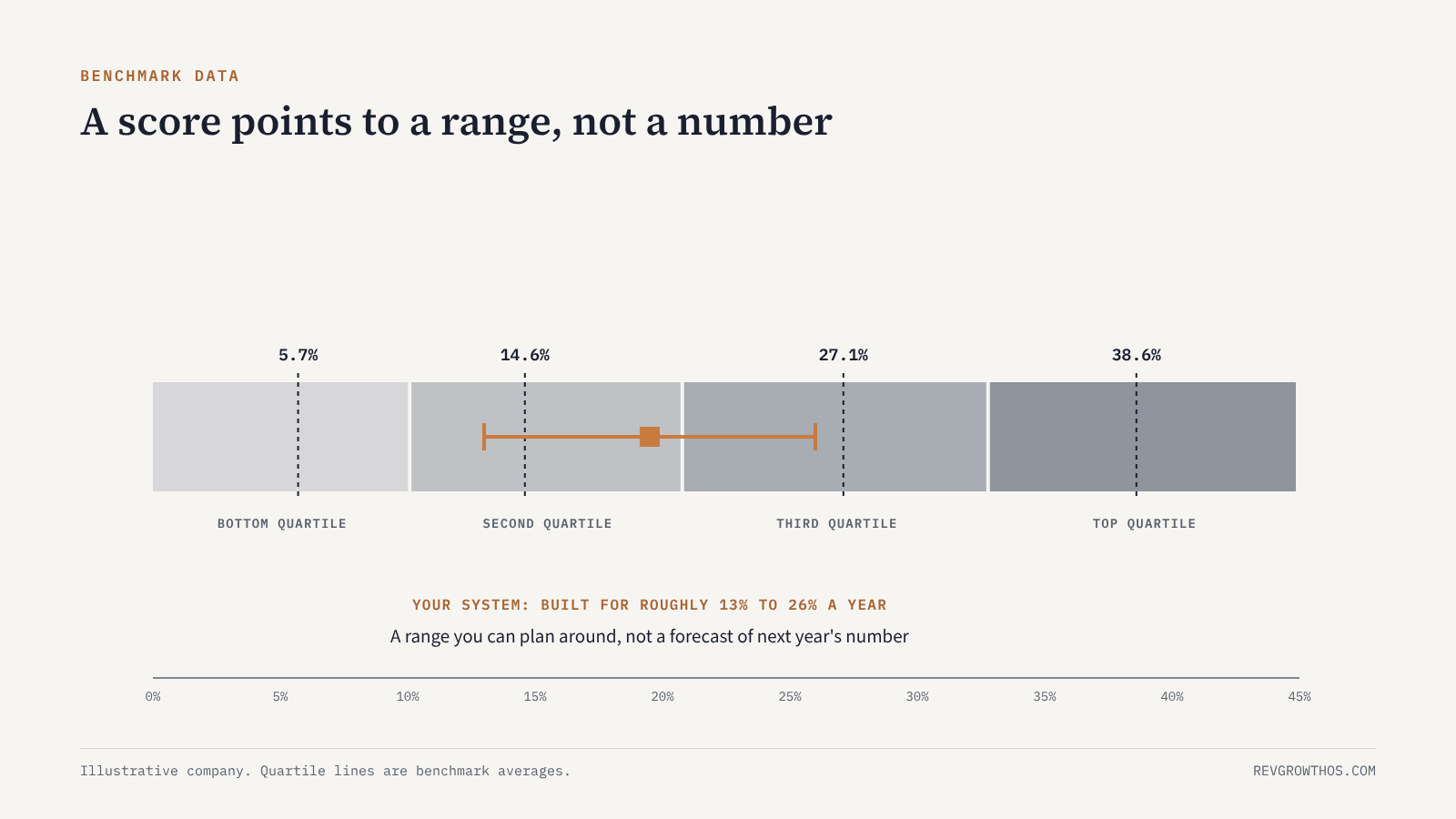
Use the growth range as a planning band. If your system is built for something like 13% to 26% a year, a plan that assumes 35% needs a specific reason, and the reason should show up in the drivers.
Pair it with your own judgment on markets and strategy. And measure again in twelve months, because a position only becomes useful once you can see it change.
If you'd like to see your own position and the range your system supports, the free RevGrowth Simulation takes about an hour and shows where your largest gaps are.

Russ Holder
Founder & CEO, RevGrowth OS. 30 years in growth strategy, five published books.
More from the Revenue-to-Value Gap blog.
You've read what the data says. Now run your numbers through it.
A one-hour working session with your own data. We run it through the RevGrowth Benchmark live, so you see the method applied to your company before you spend a dollar.
One hour. Your data. Zero cost.