
Blog / Growth Strategy
Growth Strategy vs. Growth Tactics
By Russ Holder
3-minute read
Ask a leadership team to describe its growth strategy and you'll often get a list. Launch a new product line. Add two salespeople in Texas. Redesign the website. Attend three more trade shows. Raise prices 4%.
Every item on that list might be a good idea. None of them is a strategy. They're tactics, and a company running only on tactics tends to work hard, spend steadily and grow less than it should.
The difference isn't academic. Mixing the two up is one of the most common reasons I see mid-market companies stall.
What a strategy decides.
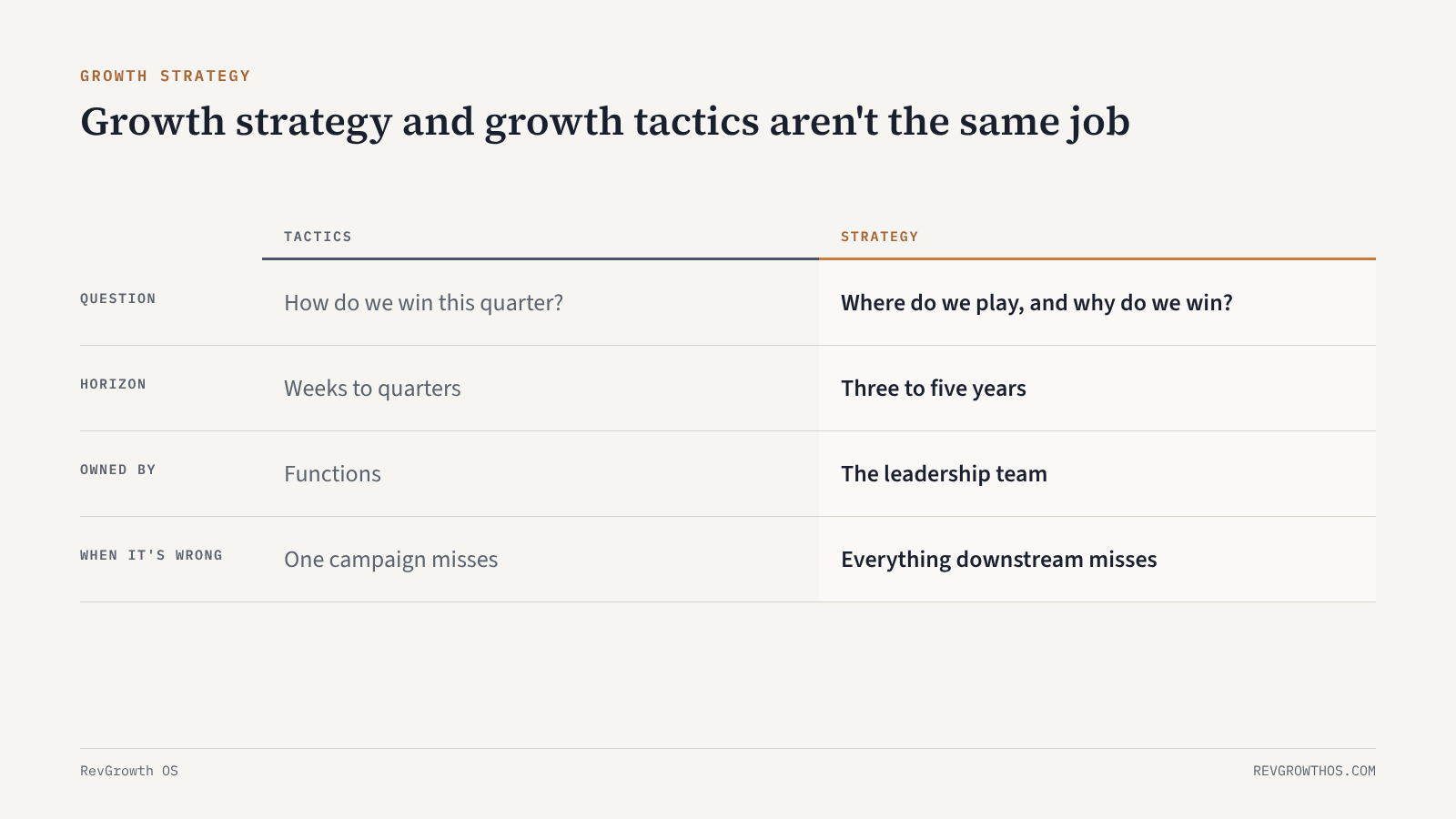
A growth strategy answers a small number of big questions. Where will we compete? Which customers do we want most? Why will they choose us over the alternatives? What are we going to stop doing? How fast do we intend to grow, and what has to be true for that to happen?
Those decisions have a long horizon, usually three to five years. They're owned by the leadership team, not any one function. And when they're wrong, everything downstream misses, no matter how well it's executed.
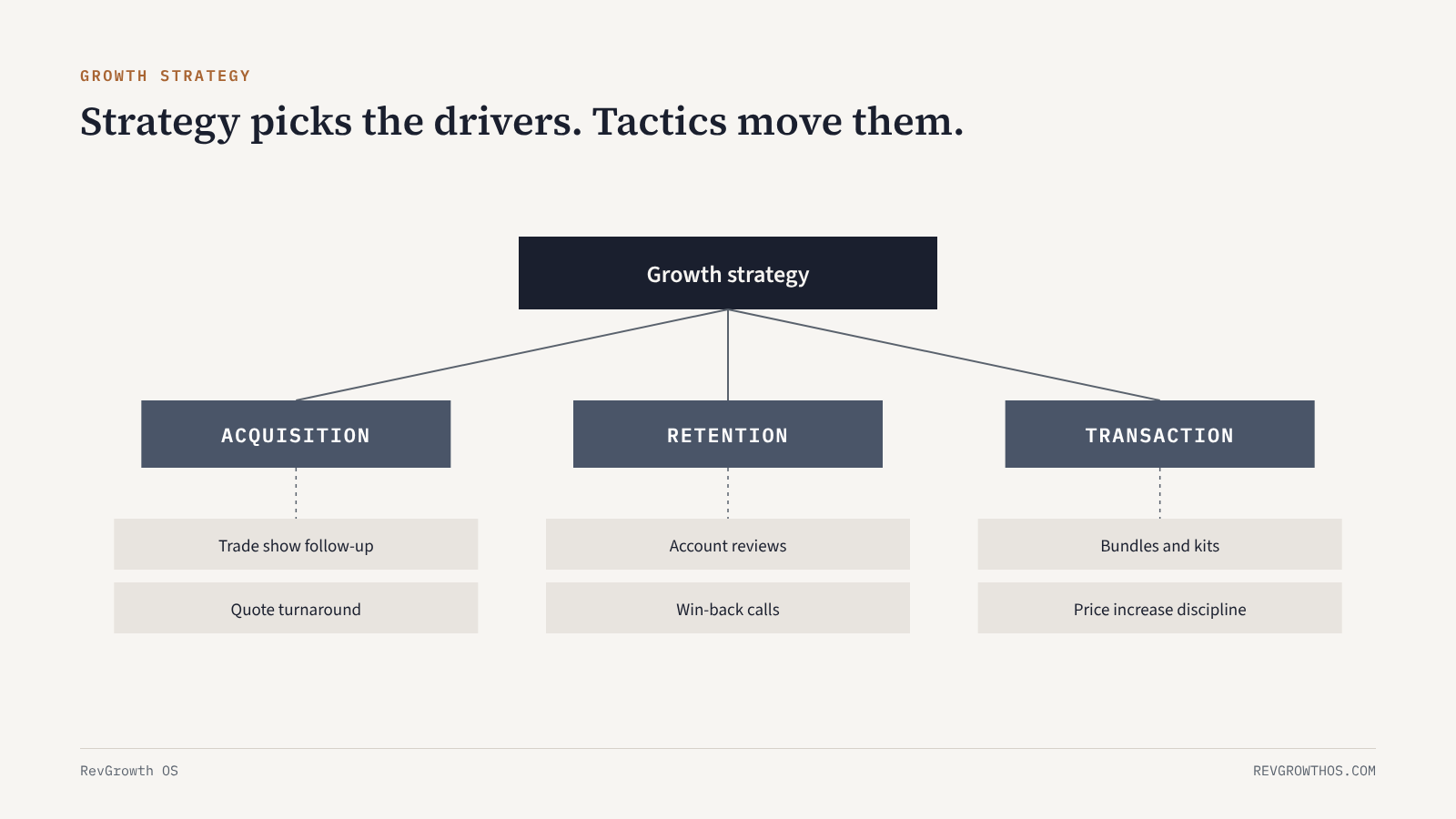
A strategy also decides which parts of the revenue engine matter most. Revenue comes from nine drivers across Acquisition, Retention and Transaction. A company whose strategy depends on deeper relationships with fewer, larger customers should care most about retention and share of wallet. A company built to win many small accounts quickly cares more about lead generation and conversion.
What tactics do.
Tactics are the specific actions that move those drivers. Follow up every trade show lead within 48 hours. Cut quote turnaround from eight days to five. Hold quarterly reviews with the top 50 accounts. Call every customer whose order frequency drops by a third. Bundle related items into kits.
Tactics have short horizons, weeks to quarters. Individual functions own them. When one fails, you change it and try another, and the damage is limited to that one effort.
Good tactics matter a great deal. A strategy with weak execution goes nowhere. But tactics without a strategy above them tend to pull in different directions. Marketing chases one audience, sales chases another and operations builds capacity for a third.
You can usually spot this in the budget. Look at where last year's growth spending went and try to connect each line to a strategic choice. In companies running on tactics alone, the money is spread thin across many efforts, each defended by its own department, none large enough to change a driver.
How to tell which one you're looking at.
There's a simple test. Take any item on your growth plan and ask, "Which driver does this move, and why does that driver matter to our strategy?"
If the answer is clear, you're looking at a tactic in service of a strategy. If the answer is "it should help sales" or "everyone else is doing it," you're looking at a tactic in search of one.
Another test: look at what would happen if the item failed. If a failed tactic changes your whole growth outlook, it was carrying more weight than a tactic should. That usually means a strategic decision got made by default inside it.
Why companies end up with tactics only.
Most mid-market companies don't skip strategy on purpose. They inherit a set of habits that worked when the company was smaller.
At $10 million, the founder is the strategy. They know which customers matter and which work to turn down, and they make those calls daily. The tactics follow their judgment.
At $50 million, that judgment no longer reaches every decision. Without a written strategy, each function fills the gap with its own priorities. The annual plan becomes a collection of departmental tactics, stapled together and called a strategy.
It also feels more productive. Tactics produce visible activity: a new campaign, a new hire, a new piece of software. Strategy produces a few decisions on a page. In a busy company, activity often wins.
There's also a comfort in tactics. Nobody gets blamed for a trade show that underperformed. Choosing to exit a market, or to stop serving a type of customer, puts a name on a decision that might be wrong. Many leadership teams avoid that risk without realizing they've avoided the strategy along with it.
Getting the order right.
Start with the strategy, and keep it short. A page or two that names your target segments, why you win, what you won't do and the growth you're aiming for. Make the choices specific enough that someone could disagree with them.
Then translate the strategy into driver targets. If retention matters most, set a target for revenue retention by customer and give it an owner. If conversion is the weak spot in your chosen segment, set a target for win rate there.
Only then pick tactics. Each one should name the driver it's meant to move and the measure that will show whether it worked. Small targets help here. A 1% improvement per driver per quarter is achievable, and because the drivers multiply, the gains compound.
Review the tactics often and the strategy rarely. Tactics should change every quarter based on what the drivers show. The strategy should hold for years, revisited once a year or when something big changes in the market. Companies that swap the two, reworking strategy every quarter and never retiring a tactic, end up busy and stuck.
A quick way to see which drivers matter.
If you're not sure which drivers your strategy depends on most, or where they're weakest, measure them first. The free RevGrowth Simulation scores your nine revenue drivers against 200-plus mid-market companies in about an hour. It's a useful bridge between the strategy you've chosen and the tactics that will move it.

Russ Holder
Founder & CEO, RevGrowth OS. 30 years in growth strategy, five published books.
More from the Revenue-to-Value Gap blog.
You've read what the data says. Now run your numbers through it.
A one-hour working session with your own data. We run it through the RevGrowth Benchmark live, so you see the method applied to your company before you spend a dollar.
One hour. Your data. Zero cost.