
Blog / Enterprise Value
Exit Readiness: What to Build Three Years Before a Sale
By Russ Holder
3-minute read
Most owners start preparing for a sale about six months before they want to close. They hire a banker, clean up the financials and put together a story about growth.
By then, most of the value has already been decided. Buyers will diligence what exists. The things that move a valuation most, like how predictable the growth is, how concentrated the customers are and how much depends on the owner, take years to change. Six months isn't enough.
If you're thinking about a sale in the next few years, the best time to prepare is three years out. Here's what I'd build, and in what order.
Three years out: baseline and fix.
Three years before a sale, the job is to find out where you stand and fix the biggest gaps.
Start by measuring the growth system. Score the nine revenue drivers: lead generation, conversion and referrals; attrition, buying lifetime and reactivation; order size, frequency and price. Compare them with companies like yours. Find the two or three weakest.
Then fix those first. If retention is weak, build early-warning systems and account reviews. If pricing leaks, measure price realization and tighten the rules for exceptions. These improvements take a year or two to show up in the numbers, which is exactly why they need to start now.
Three years out is also when to set a target for customer concentration. If your largest customer is 25% of revenue, bringing that down to 15% takes years of adding customers around them. Starting late means walking into diligence with the same number you have today.
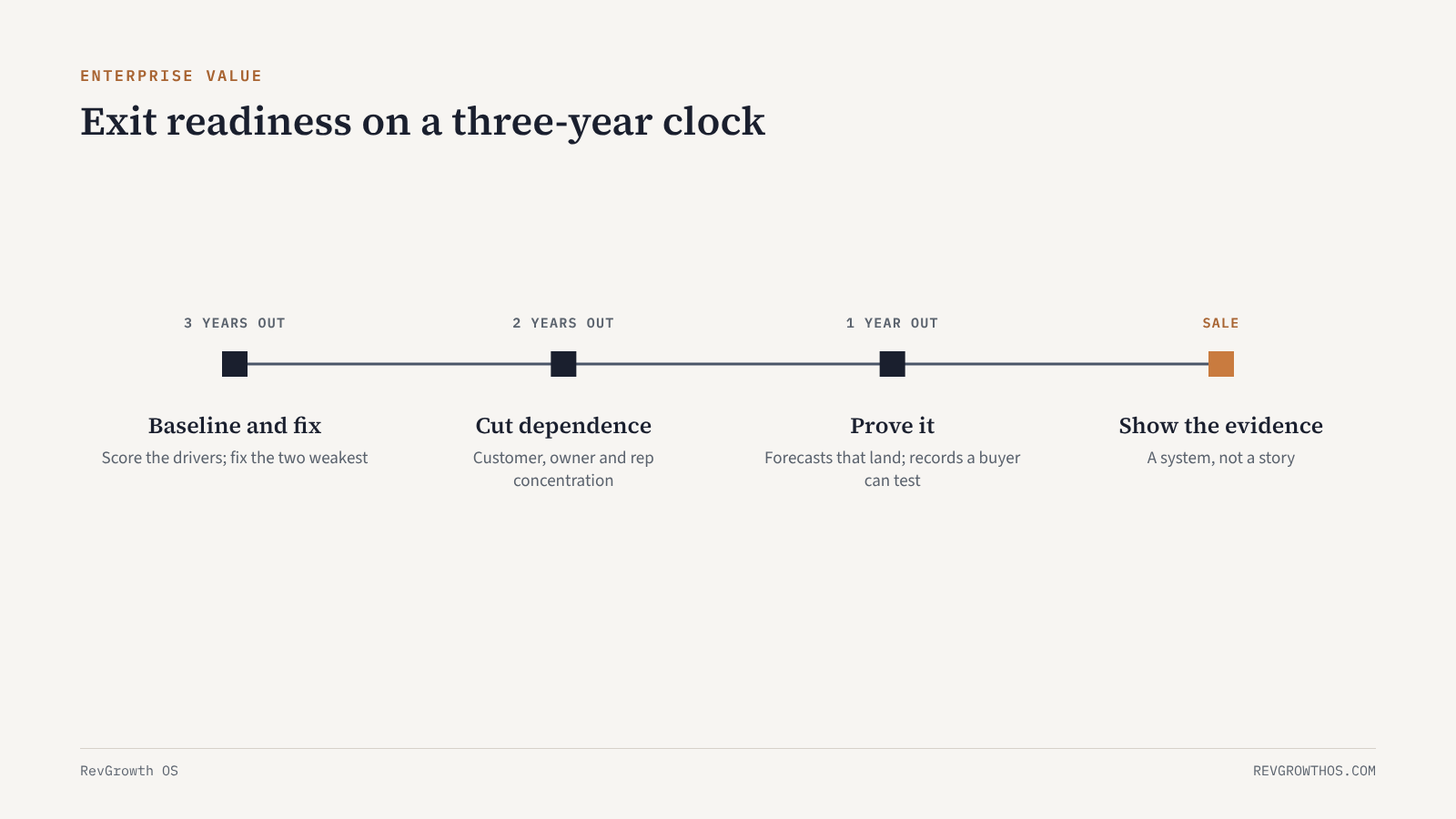
Two years out: reduce dependence.
The second year is about making growth independent of any one person.
Buyers will ask who holds the key customer relationships, who makes pricing decisions and who closes the large deals. If the answer to all three is the owner, they'll assume some of the revenue leaves when the owner does. They'll price that in, or they'll ask the owner to stay for years after the sale.
So use this year to move growth from a person to a system. Write down how pricing and large deals work. Hand named accounts to other people and introduce them to customers. Make sure every key account has at least two relationships at your company. Build a sales leader or management team that can run growth without the owner in every meeting.
The same applies to your top salespeople. If one rep holds a third of the revenue, that's a risk a buyer will see.
Give this year enough time. Customers need to meet and trust the people who'll serve them after the owner steps back, and that trust builds through several orders, a few problems solved and at least one hard conversation handled well. Buyers can tell the difference between a handoff that happened two years ago and one arranged for the sale.
One year out: prove it.
By the final year before a sale, the work shifts from building to proving.
Buyers pay for evidence. A company that says its growth is predictable needs eight quarters of forecasts that landed close to actual. A company that says retention is strong needs revenue retention by customer, measured consistently over several years. A company that says the owner has stepped back needs a track record of growth without the owner's direct involvement.
This is also the year to get the records in order. Clean revenue data by customer and product line. Organic growth separated from acquisitions and price. Margin by account. A documented sales process. When a buyer's team starts asking questions, the answers should already exist, in a form they can test.
What would a buyer find today if they rebuilt your growth number from the ground up?
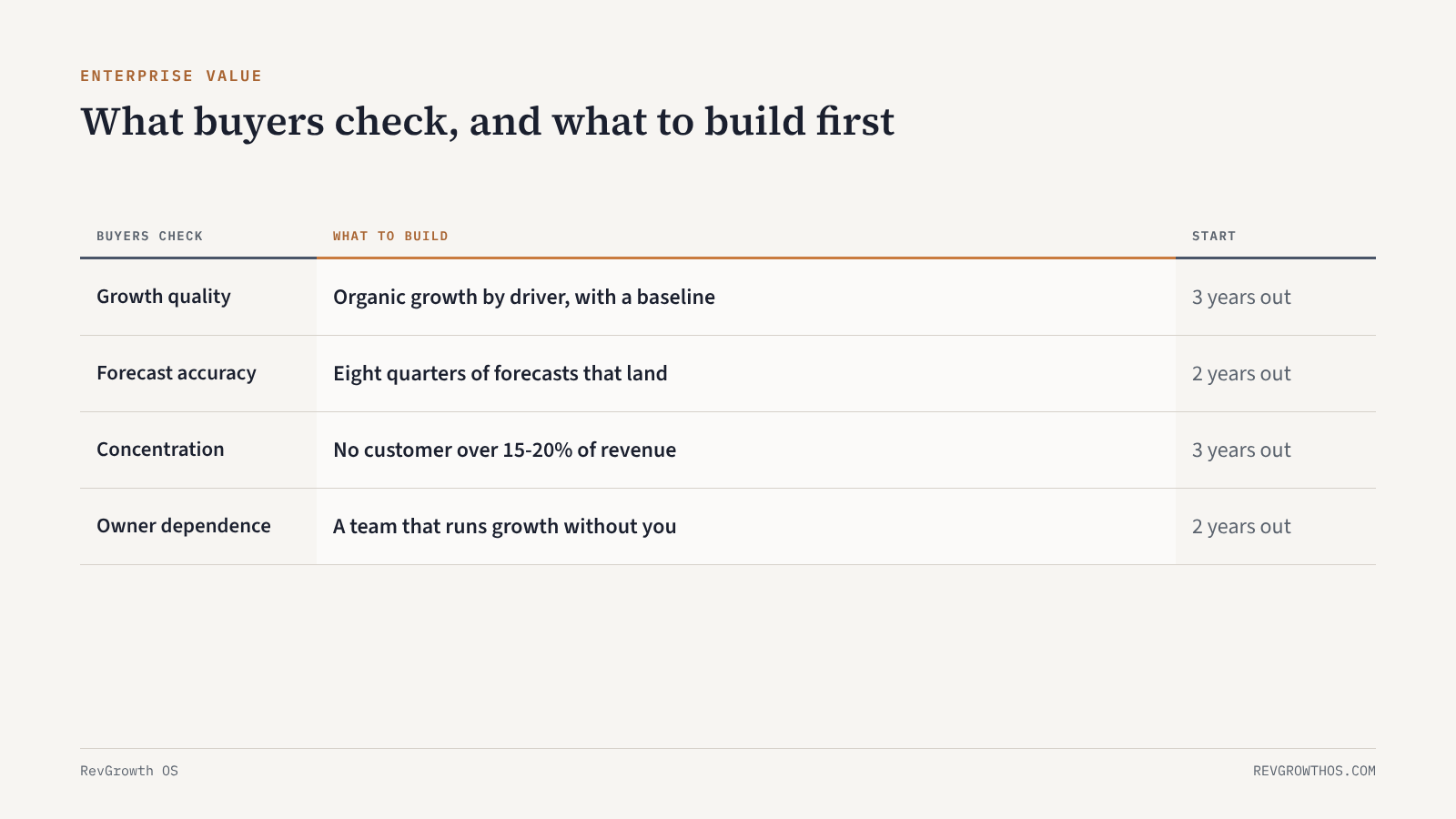
What buyers actually check.
Every buyer is different, but a few questions come up in almost every deal involving a mid-market industrial company.
How much of the growth is organic, and where did it come from? How accurate have the forecasts been? How concentrated is the customer base? How dependent is the business on the owner and a few key people? How consistent are margins by customer and product?
Each of these maps to something you can build. Organic growth by driver, with a baseline. Eight quarters of forecasts that land. No customer over 15% to 20% of revenue. A management team that runs growth without the owner. Margin tracked by account, with pricing rules that hold.
None of these can be faked in the last six months. All of them can be built in three years.
It also helps to run a mock diligence about eighteen months out. Ask your CFO, or an outside adviser, to rebuild the growth story the way a buyer's team would. Where the evidence is thin, you still have time to fix it. Where it's strong, you'll know what to lead with when the real process starts.
Even if you don't sell.
Here's the part owners sometimes miss. Everything on this list makes the company better whether you sell or not.
A business with predictable growth, a spread-out customer base and a team that runs without the owner is easier to run, less stressful to own and more resilient in a downturn. It also gives the owner real options: sell, recapitalize, pass it to a successor or keep running it on their own terms.
Exit readiness is really just a well-built growth system with a deadline attached.
Start with where you stand.
The first step three years out is a clear baseline. The free RevGrowth Simulation scores your revenue drivers against 200-plus mid-market companies in about an hour. It shows which gaps a buyer would likely find, while there's still time to close them.

Russ Holder
Founder & CEO, RevGrowth OS. 30 years in growth strategy, five published books.
You've read what the data says. Now run your numbers through it.
A one-hour working session with your own data. We run it through the RevGrowth Benchmark live, so you see the method applied to your company before you spend a dollar.
One hour. Your data. Zero cost.