
Blog / Enterprise Value
How Mid-Market Industrial Companies Are Valued
By Russ Holder
3-minute read

Ask a mid-market owner what their company is worth and you'll usually hear a multiple. "Companies like ours sell for six or seven times EBITDA." It's a reasonable starting point. It's also where most valuation conversations go wrong, because it treats the multiple as a fact about the industry rather than a judgment about the company.
Two industrial companies with the same EBITDA can sell for sharply different prices. The reason is almost always the multiple, and the multiple depends on things a CFO can measure and influence years before a sale.
The basic formula.
Most mid-market industrial companies are valued on a multiple of earnings, usually EBITDA. Enterprise value equals EBITDA times a multiple.
EBITDA is the easier half. Buyers will adjust it, removing one-time costs, normalizing owner compensation and questioning anything unusual, but the result is a number both sides can examine. A quality-of-earnings review exists to test it.
The multiple is where the judgment comes in. It reflects how much a buyer believes those earnings will grow, how confident they are in that growth and how much risk they see in the business. Market conditions, interest rates, industry and company size all play a part. Within any given market, though, the company's own characteristics move the multiple a great deal.
Size alone matters more than many owners expect. Larger companies tend to command higher multiples, partly because they're less fragile and partly because more buyers can pursue them. That's one reason a company growing from $5 million to $10 million of EBITDA often gains more value than the earnings increase alone would suggest.
What one turn is worth.
It's worth putting numbers on this, because the scale surprises people.
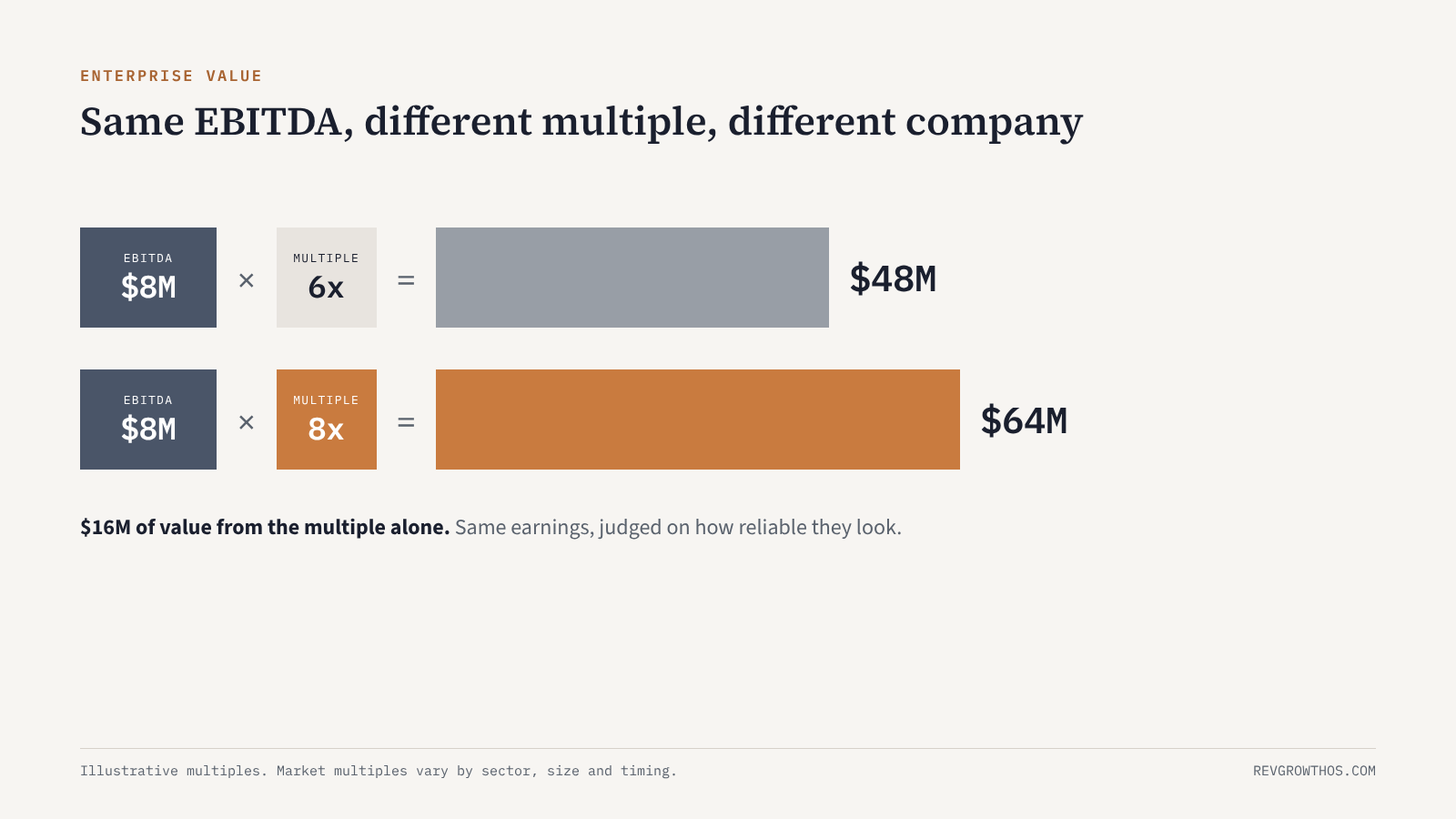
Take a company with $8 million of EBITDA. At six times, it's worth $48 million. At eight times, it's worth $64 million. Same earnings, same year, $16 million of difference from the multiple alone.
For most owners, that's more value than several years of profit growth would add. Raising EBITDA from $8 million to $9 million at a six-times multiple adds $6 million of value. Moving the multiple from six to seven on the original $8 million adds $8 million.
That doesn't mean earnings don't matter. They matter enormously. It means the multiple deserves at least as much attention, and most companies give it almost none until a banker starts asking questions.
What pushes the multiple up?
Buyers pay higher multiples for earnings they can trust to continue and grow. In my experience, a handful of characteristics do most of the work.
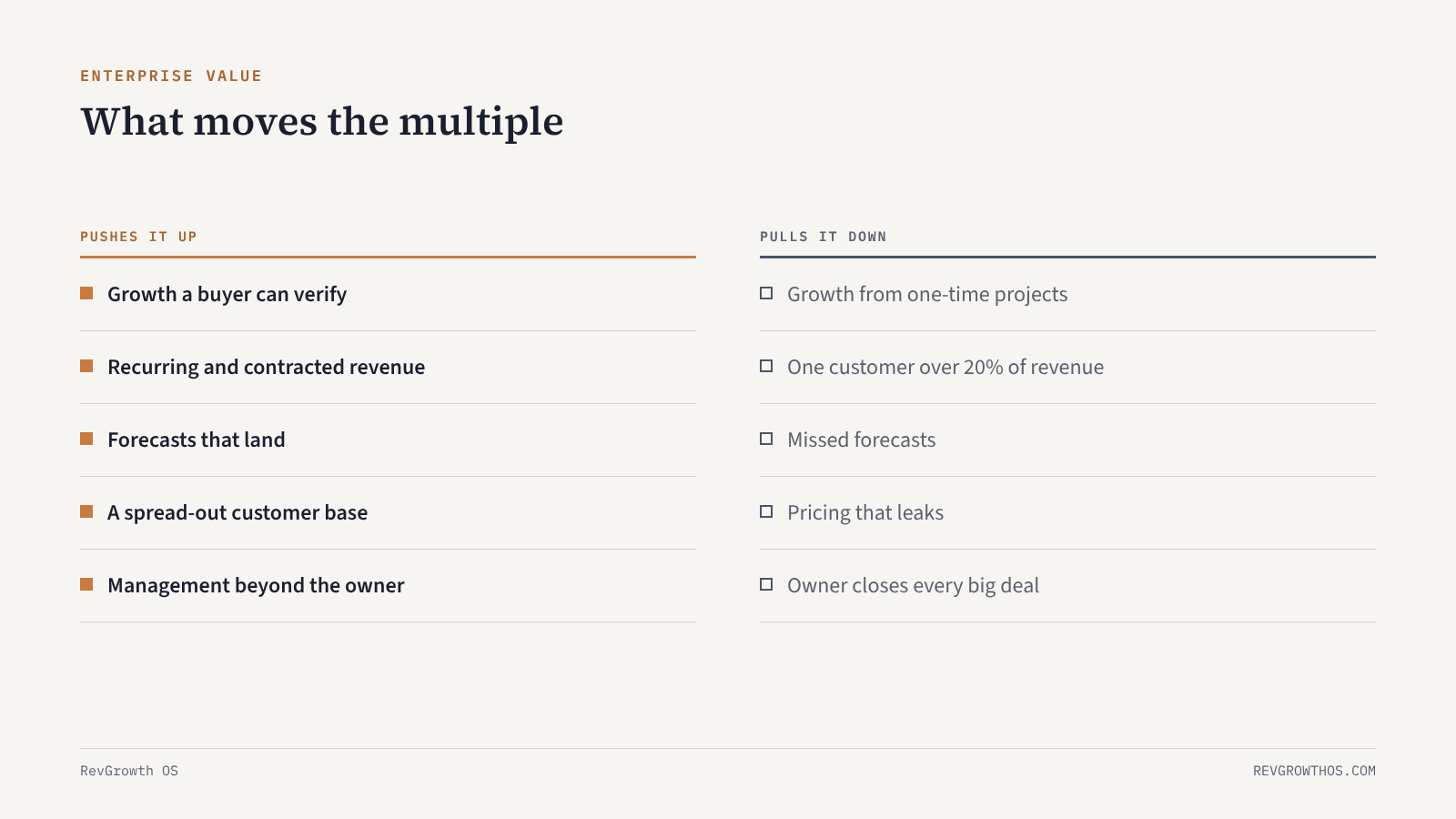
Growth a buyer can verify. Not just a high growth rate, but organic growth with a clear source. Growth that can be traced to specific drivers, measured over several years, is worth more than a strong year that nobody can explain.
Recurring and contracted revenue. Service agreements, consumables, multi-year supply contracts and repeat business from long-tenured customers all give a buyer confidence that revenue will be there after the sale.
Forecasts that land. A company whose forecasts have been accurate for eight quarters is telling the buyer it understands its own business.
A spread-out customer base. No single customer large enough to change the outlook if they left.
Management beyond the owner. A team that runs growth, pricing and key relationships without the owner in every decision.
What pulls it down?
The opposite characteristics pull the multiple down, often more sharply than the positives push it up. Buyers are paid to find risk.
Growth that came from one-time projects or a single large customer. One customer above 20% of revenue. Forecasts that missed, especially in both directions. Pricing that leaks through discounts and exceptions, so margin varies widely by account. An owner who still closes every large deal.
Each of these gives a buyer a reason to lower the multiple, add an earnout or require the owner to stay on. Several together can shrink the pool of interested buyers.
Deal structure tells you how a buyer really sees the risk. A clean, mostly cash offer means they trust the earnings. A large earnout, a long seller note or a requirement that the owner stay for three years means they don't, and they're asking you to carry the risk they see. The price on the letter of intent isn't the whole story.
Which of these would a buyer find in your business today?
Why a CFO should care now.
For a CFO, the practical point is that most of what moves the multiple is measurable, and most of it takes time to change.
Revenue retention by customer, forecast accuracy, concentration, price realization and the share of revenue that's recurring can all be tracked quarterly. They can be improved through ordinary management work: account reviews, pricing discipline, a better forecasting process and deliberate effort to grow customers outside the largest few.
Tracked over three years, they also become evidence. A buyer who sees steady improvement in all of them is looking at a company that's getting more valuable every quarter, and that's exactly what they pay for.
Measure what buyers will measure.
Start by tracking the same things a buyer will look at, years before a buyer arrives.
The free RevGrowth Simulation scores your revenue drivers against 200-plus mid-market companies in about an hour. It's a useful way to see which characteristics are likely to support your multiple, and which are likely to pull it down.

Russ Holder
Founder & CEO, RevGrowth OS. 30 years in growth strategy, five published books.
You've read what the data says. Now run your numbers through it.
A one-hour working session with your own data. We run it through the RevGrowth Benchmark live, so you see the method applied to your company before you spend a dollar.
One hour. Your data. Zero cost.