
Blog / Growth Risk
Why Growth That Can't Survive Pressure Isn't Sustainable
By Russ Holder
3-minute read
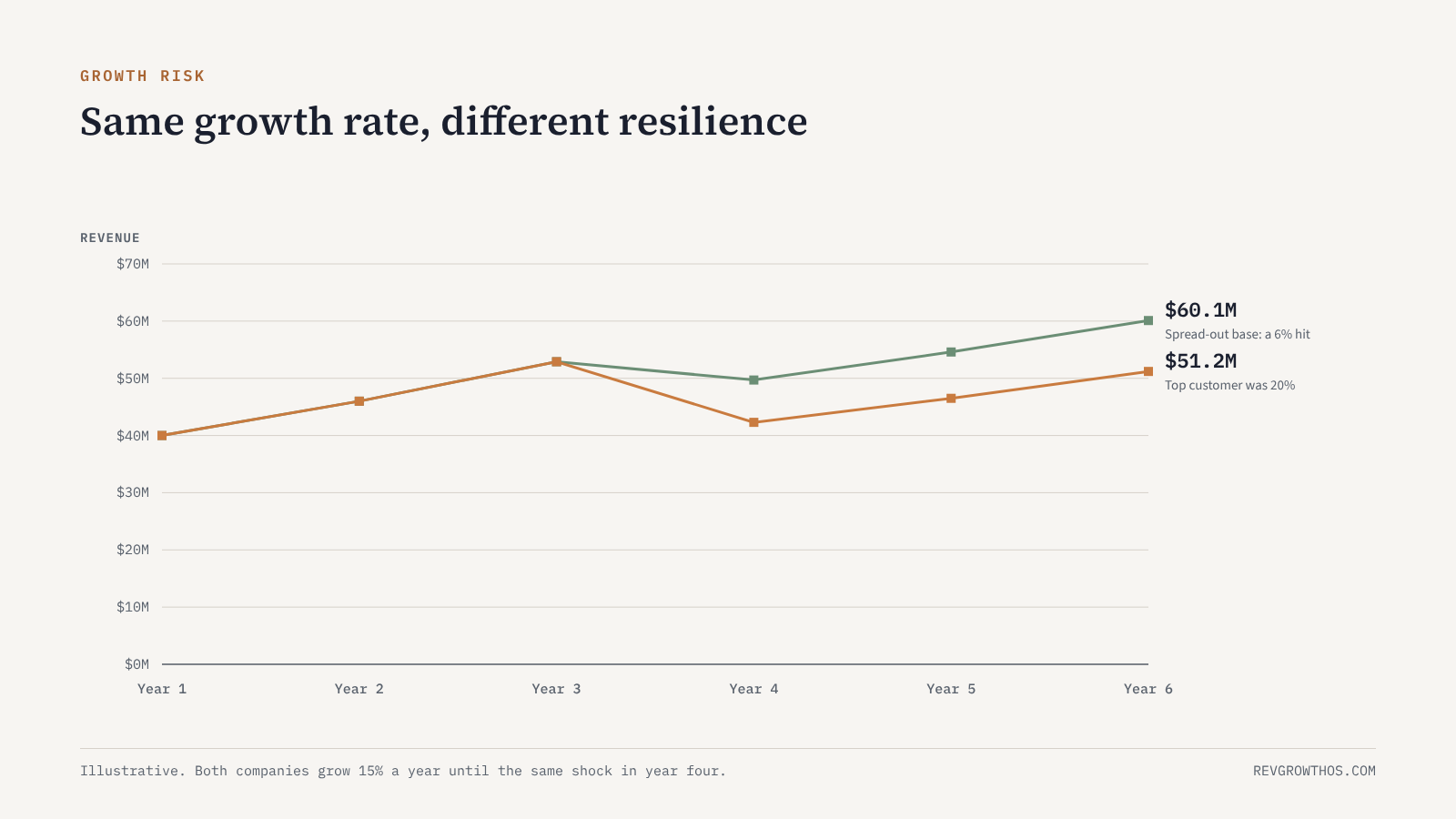
Two companies grow 15% a year for three straight years. On paper, they look the same. Same growth rate, similar margins, similar size.
Then the same shock hits both. A large customer consolidates suppliers. One company loses 6% of its revenue and recovers within a year. The other loses 20%, spends two years rebuilding and never quite gets back on its old trajectory.
The difference wasn't the growth rate. It was whether the growth could survive pressure. That's what we call the Resilience Core, and it's the part of the growth system most companies don't measure until it fails.
Growth and resilience aren't the same thing.
Fast growth can be fragile. A company can grow quickly because one customer kept ordering more, or because one salesperson carried most of the new business, or because a strong market lifted everyone. None of that means the company can keep growing when conditions change.
Resilient growth is spread out. It comes from many customers, many relationships and a system that works regardless of who's in the seat. It's less exciting to describe, and much more valuable to own.
The Resilience Core is the third of the four levels in the RevGrowth Architecture, after the Strategic Foundation and the Revenue Drivers. It covers the parts of the business that decide whether growth holds up: customer concentration, dependence on key people, pricing discipline under pressure and the ability to keep selling through disruption.
Where growth usually breaks.
In my experience, growth breaks in a small number of predictable places.
One customer. When a single customer is 20% or more of revenue, the company's growth is tied to that customer's decisions. A supplier consolidation, a plant closure or a new purchasing manager can erase years of progress.
One salesperson. When a top rep holds most of the key relationships, their departure takes accounts with them. Customers follow people, especially when nobody else at the company has called them in years.
One owner. When the founder still sets prices, closes large deals and manages key suppliers, growth stops whenever the founder's attention goes elsewhere. And it stops for good when the founder steps back.
Pricing that bends. When a large customer pushes and the company has no clear reason customers should pay more, margin gives way. Growth continues, but each dollar is worth less.
One supplier or channel. When one supplier, distributor or channel carries most of the volume, their decisions become your growth plan.
Stress-test before the stress arrives.
The useful thing about these failure points is that you can test for them in advance.
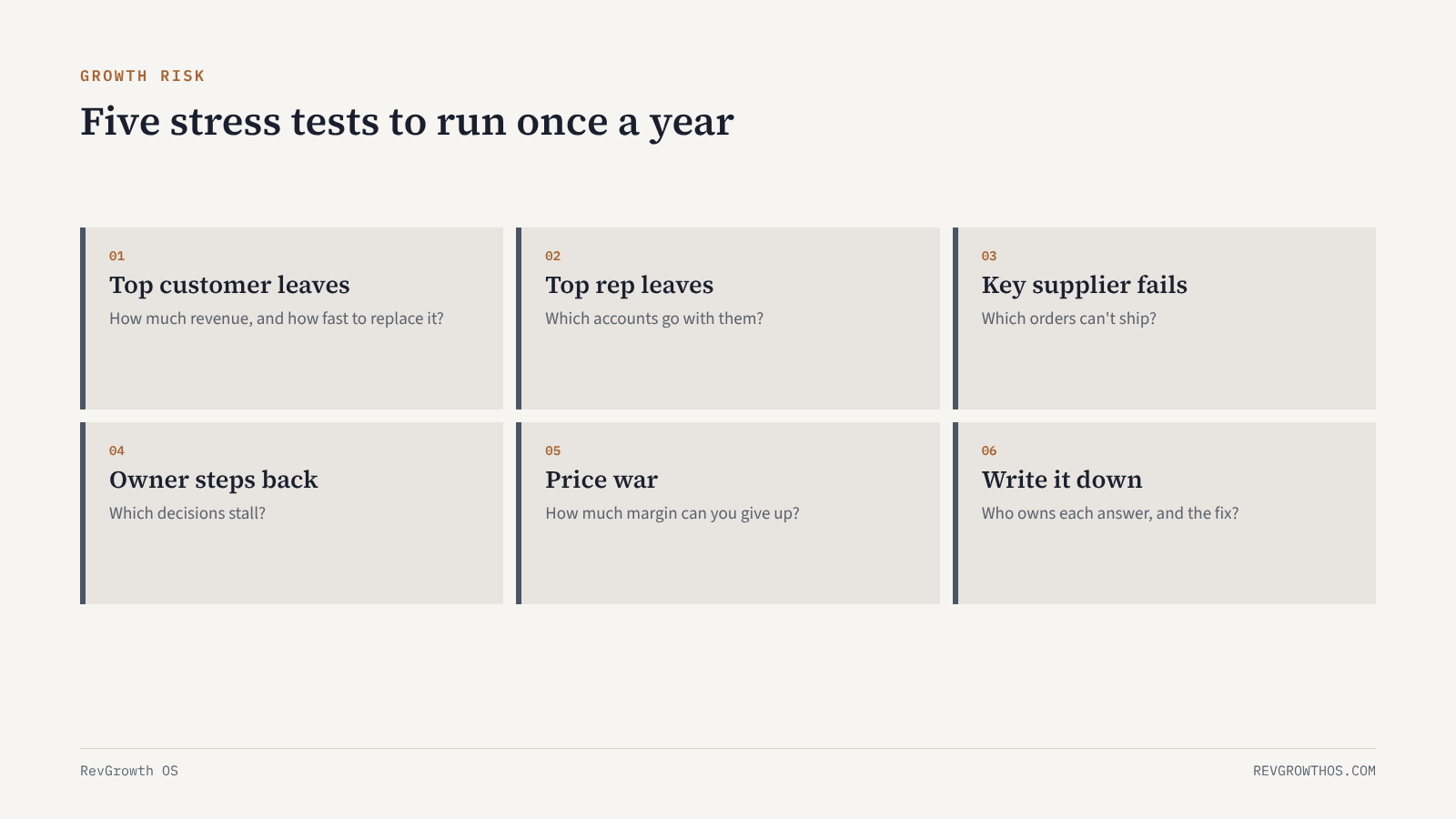
Once a year, run five questions. If our largest customer left tomorrow, how much revenue would we lose, and how long would it take to replace? If our top salesperson resigned, which accounts would be at risk? If a key supplier failed, which orders couldn't ship? If the owner stepped back for three months, which decisions would stall? If a competitor cut prices 10%, how much margin could we give up before we were in trouble?
Write the answers down. Put a number on each one. Then give each risk an owner and a plan to reduce it over the next year or two.
The answers will be uncomfortable in places. That's the point. A risk with a number attached can be managed. A risk that lives only as a vague worry tends to stay exactly where it is until the day it's tested.
Has your leadership team ever answered those five questions together, with numbers?
Building resilience without slowing growth.
Some leaders worry that working on resilience means slowing down. It doesn't have to.
Reducing customer concentration usually means adding customers, not losing the big one. Reducing dependence on a top salesperson means bringing a second person into each key relationship and recording what they know in the CRM. Reducing owner dependence means writing down how pricing decisions get made and handing named accounts to other people.
Each of these makes growth more repeatable. A company where several people can close a large deal can pursue more large deals at once. A company with documented pricing rules can quote faster. Resilience and growth tend to support each other once the system is in place.
Pace matters. Bringing a top customer from 30% of revenue to 15% usually takes three to five years of adding customers in chosen segments. Spreading key relationships takes a year or two of deliberate introductions. These aren't quick fixes, which is why the best time to start is during a strong year, when there's cash and attention to spare.
Why buyers care so much.
Resilience also shows up in valuation. When a buyer looks at a company, they're trying to work out how much of the revenue will still be there in five years.
Customer concentration, key-person dependence and pricing that bends all reduce that confidence. Buyers respond with lower multiples, earnouts or extra protections in the deal. A company that can show its growth survived a lost customer or a departed salesperson is worth more, because it has already proven what others can only claim.
Measure it before it's tested.
You don't need a crisis to learn how resilient your growth is. You need the right questions and an honest look at the answers.
The free RevGrowth Simulation scores your revenue drivers against 200-plus mid-market companies in about an hour. It's a useful starting point for seeing where your growth is strong, and where it depends on things going your way.

Russ Holder
Founder & CEO, RevGrowth OS. 30 years in growth strategy, five published books.
You've read what the data says. Now run your numbers through it.
A one-hour working session with your own data. We run it through the RevGrowth Benchmark live, so you see the method applied to your company before you spend a dollar.
One hour. Your data. Zero cost.