
Blog / Growth Risk
Why Growth Gains Decay, and How to Make Them Stick
By Russ Holder
3-minute read
Most companies have a graveyard of growth efforts that worked.
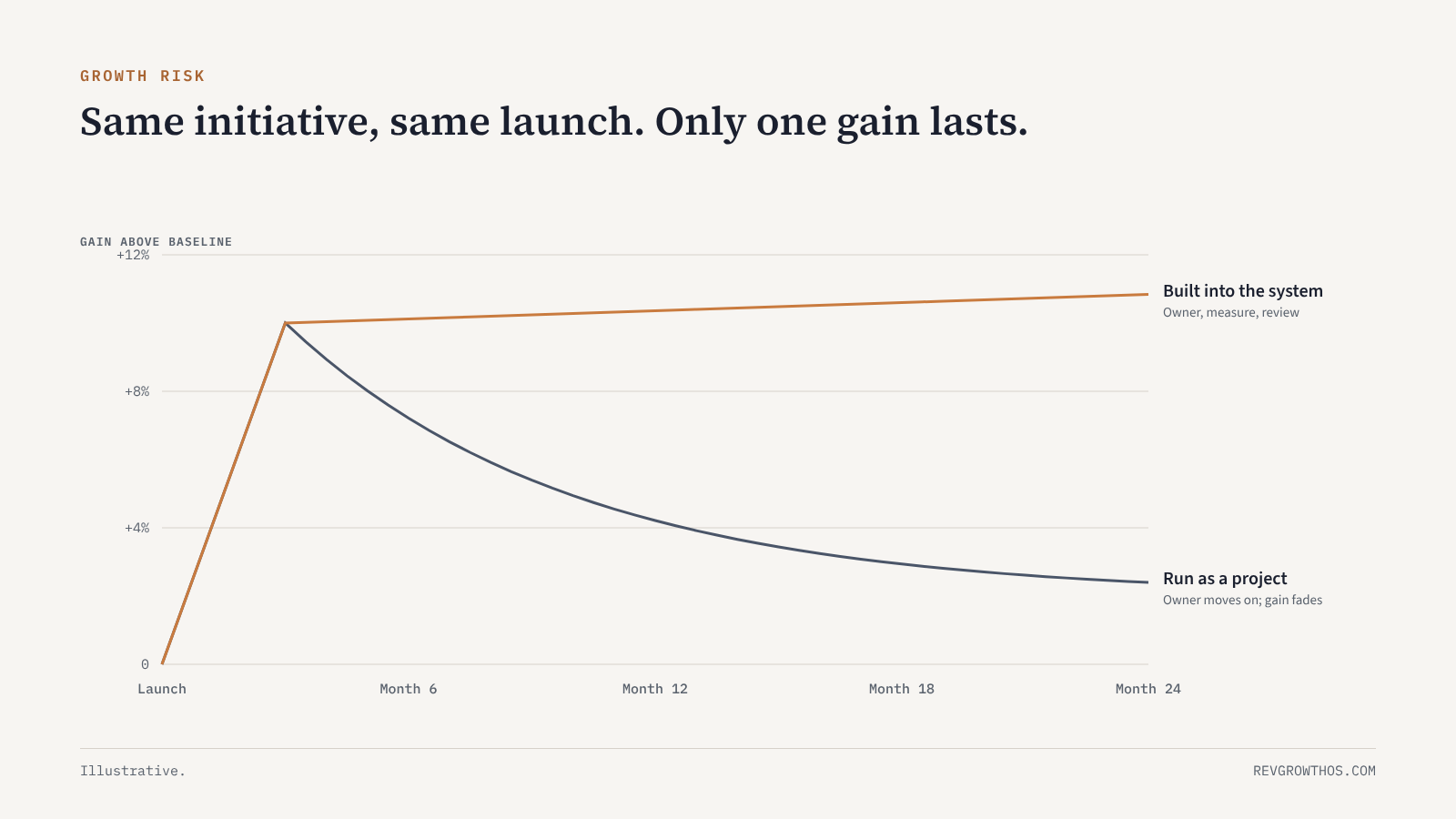
A pricing project added two points of margin. A key-account program grew the top twenty customers. A sales training push lifted win rates for a few quarters. Each produced real results. A year or two later, the numbers returned to baseline.
No one ended those initiatives. They decayed.
Decay is quiet. It does not look like failure, so nobody investigates. It looks like the business returning to normal.
Gains decay when they are installed as projects.
A project has a start date, an end date, and a team that moves on when finished. That works for building a warehouse. It does not work for changing how a company grows.
When the project team disbands, the new behavior loses its owner. The dashboard stops getting updated. The weekly review gets skipped once, then again. Within a few quarters, people return to old habits, because the system still rewards them.
Consultants frequently make this worse. An outside team arrives, drives the change, reports the results, and leaves. The results are real. The capability to sustain them leaves with the team.
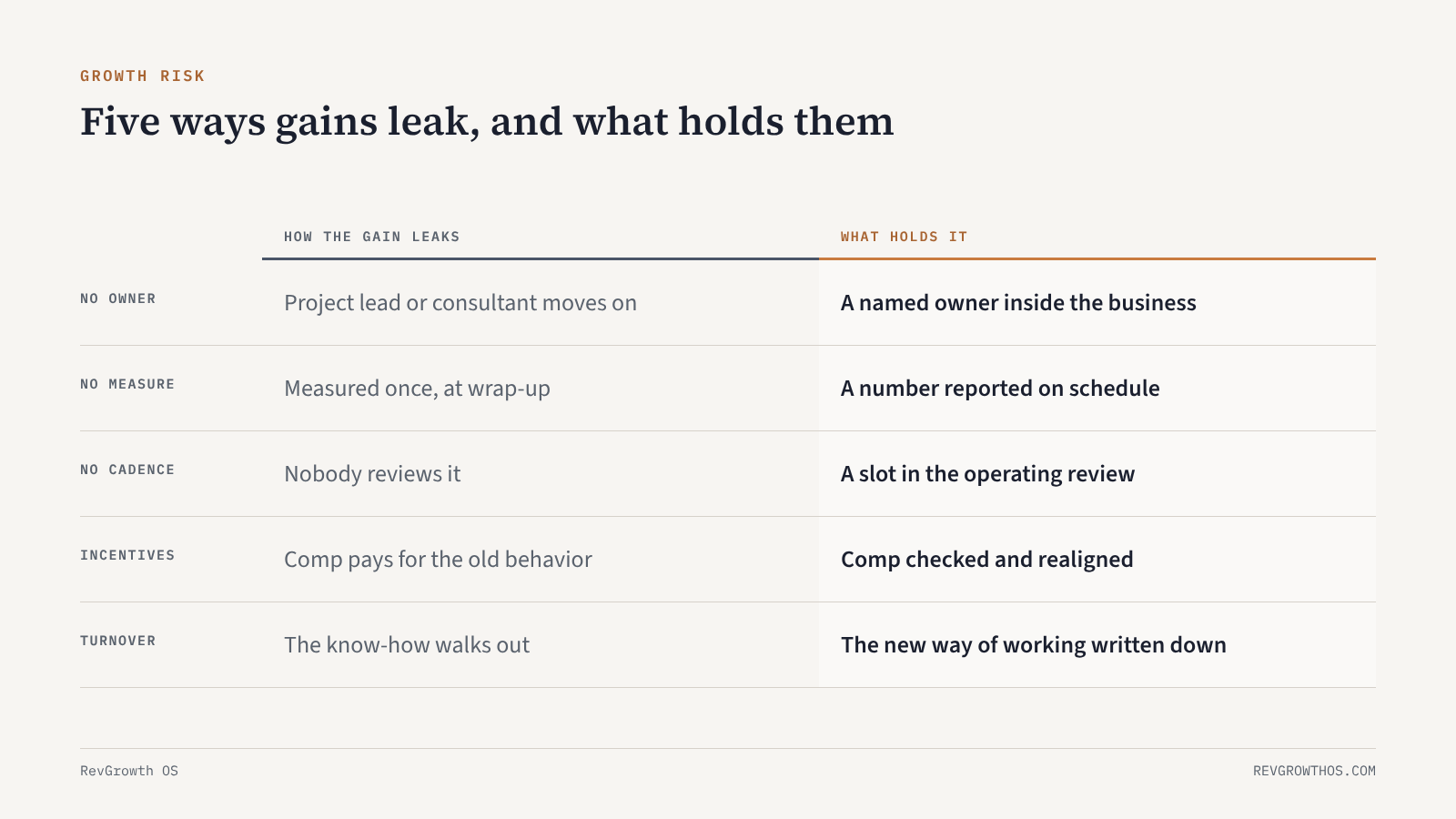
Five ways gains leak away.
No owner. The initiative belonged to a project lead or an outside consultant. When they moved on, nobody inside the business was accountable for keeping the number.
No measure. The gain was measured once, at project wrap-up, and never again. A number nobody watches will drift.
No cadence. There is no regular meeting for reviewing the driver, so nobody notices the slide until it appears in annual results.
Turnover. The person who knew the new process got promoted, retired, or left—the knowledge left with them.
Incentives pull the other way. A pricing project raises realization, but sales compensation still pays on bookings. Within a year, discounts return, because that is what the compensation plan rewards.
Price increases are the textbook example.
This pattern is common. A company announces a 5 percent price increase. The first month, realization looks strong. By month six, exceptions accumulate. A big customer is grandfathered. A rep matches a competitor's quote. A distributor negotiates a special rebate. By year-end, the company collects about half of what it announced.
The price increase was not a bad idea. It was installed as an event, not as a policy with an owner, a measure, and a review.
Multiply that across every initiative from the past five years and the lost value adds up quickly.
Make gains stick by building them into the system.
The fix is to treat every gain as a change to the operating system, not a project.
Every improved driver gets a named owner who keeps it after the project ends. It gets a measure reported on a schedule, the same way you report cash. It gets a slot in a regular operating review, monthly or quarterly, where someone explains any slide. Incentives are checked, so the compensation plan pays for the behavior you want to keep.
Document the new way of working. If the improved quoting process lives in one estimator's head, it leaves when she does.
None of that is complicated. It is discipline applied after the excitement fades. That is when most companies stop.
How many of your last five growth efforts still have an owner and a monthly number assigned?
For anyone considering a sale, decay has a second cost. Buyers look at trends, not snapshots. A margin gain that holds for three years is evidence. A gain that spikes and fades is a story, and buyers discount stories.
In our benchmark of over 200 mid-market companies, the top quartile grows at 38.6 percent a year. What separates those companies is not better ideas. They keep the gains from the ideas they have already had.
Audit your last three wins.
Pick the three best growth efforts from the past three years. For each, ask four questions. Who owns it now? What is the number today? When was it last reviewed? Does compensation still support it?
If you get blank looks, you have found gains that are decaying now. Those are cheaper to recover than any new initiative.
Start with the one that has the biggest gap between its peak and its current state. Assign an owner this week and put its number on the next operating review agenda.
The free RevGrowth Simulation can show which of your drivers have slipped against the benchmark, including the ones you thought you'd already fixed.

Russ Holder
Founder & CEO, RevGrowth OS. 30 years in growth strategy, five published books.
More from the Revenue-to-Value Gap blog.
You've read what the data says. Now run your numbers through it.
A one-hour working session with your own data. We run it through the RevGrowth Benchmark live, so you see the method applied to your company before you spend a dollar.
One hour. Your data. Zero cost.