
Blog / Foundational
The Revenue-to-Value Gap
A manifesto from RevGrowth OS
By Russ Holder
November 5, 2026
4-minute read
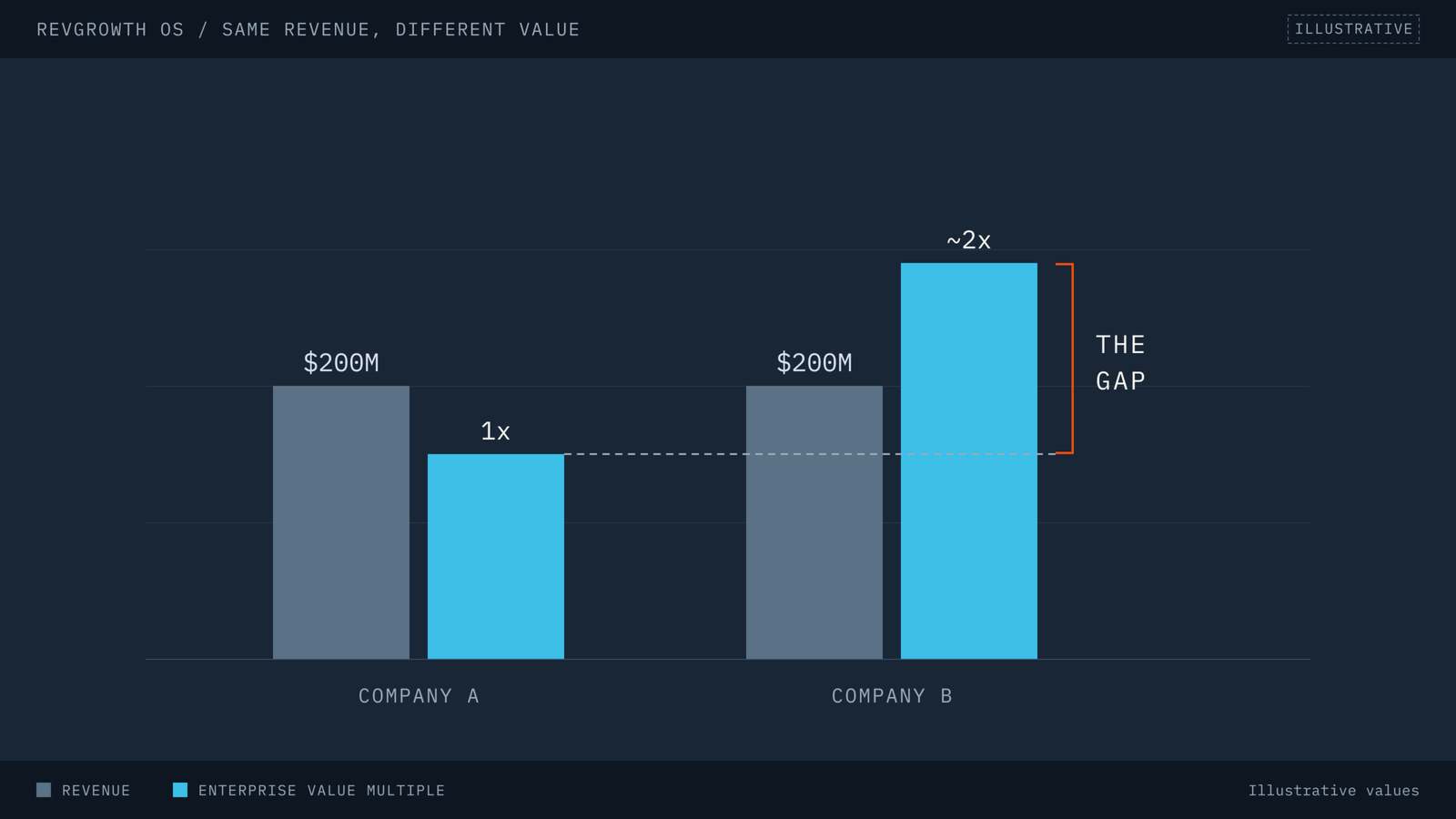
Picture two companies that both finished last year at $100 million in revenue. Same industry. Similar margins on paper. Both had a good year by the numbers the board watches.
When they go to market, one draws a multiple close to twice the other's.
The buyer didn't pay for revenue. The buyer paid for what that revenue says about next year, and the year after that. One company showed contracts that renew, margins that hold, and a sales process that doesn't live in the owner's head. The other showed a big year.
That difference has a name. We call it the Revenue-to-Value Gap. After 30 years of working on growth with mid-market companies, I've come to think it's the most expensive number nobody tracks.
Revenue is the wrong scoreboard
Most leadership teams measure growth by the top line. It's the number in the board deck, the press release, the sales kickoff. Bonuses ride on it. Budgets get built around it.
It's also the wrong number. Revenue tells you how much business you did. It doesn't tell you what that business is worth.
That sounds like a fine distinction until you sit across the table from a buyer. They don't spend much time admiring last year's top line. They pull apart the customer list, the renewal history, margin by account, and how close your forecasts came to reality. They're pricing durability and risk. Most companies have never measured either one.
The scoreboard you choose shapes the game you play. Keep score on revenue and you'll get more revenue, whether or not it builds anything.
Not every dollar is worth the same
A dollar of revenue can be worth ten cents or ten dollars. It depends on what kind of business it builds.
Recurring revenue is worth more than one-time revenue. Profitable revenue beats subsidized revenue. A contract that renews on schedule is worth more than a big order nobody saw coming and nobody can forecast. And revenue protected by a real advantage, like a specification you own or a service relationship a competitor can't copy, is worth far more than revenue that dries up the month the ad budget stops.
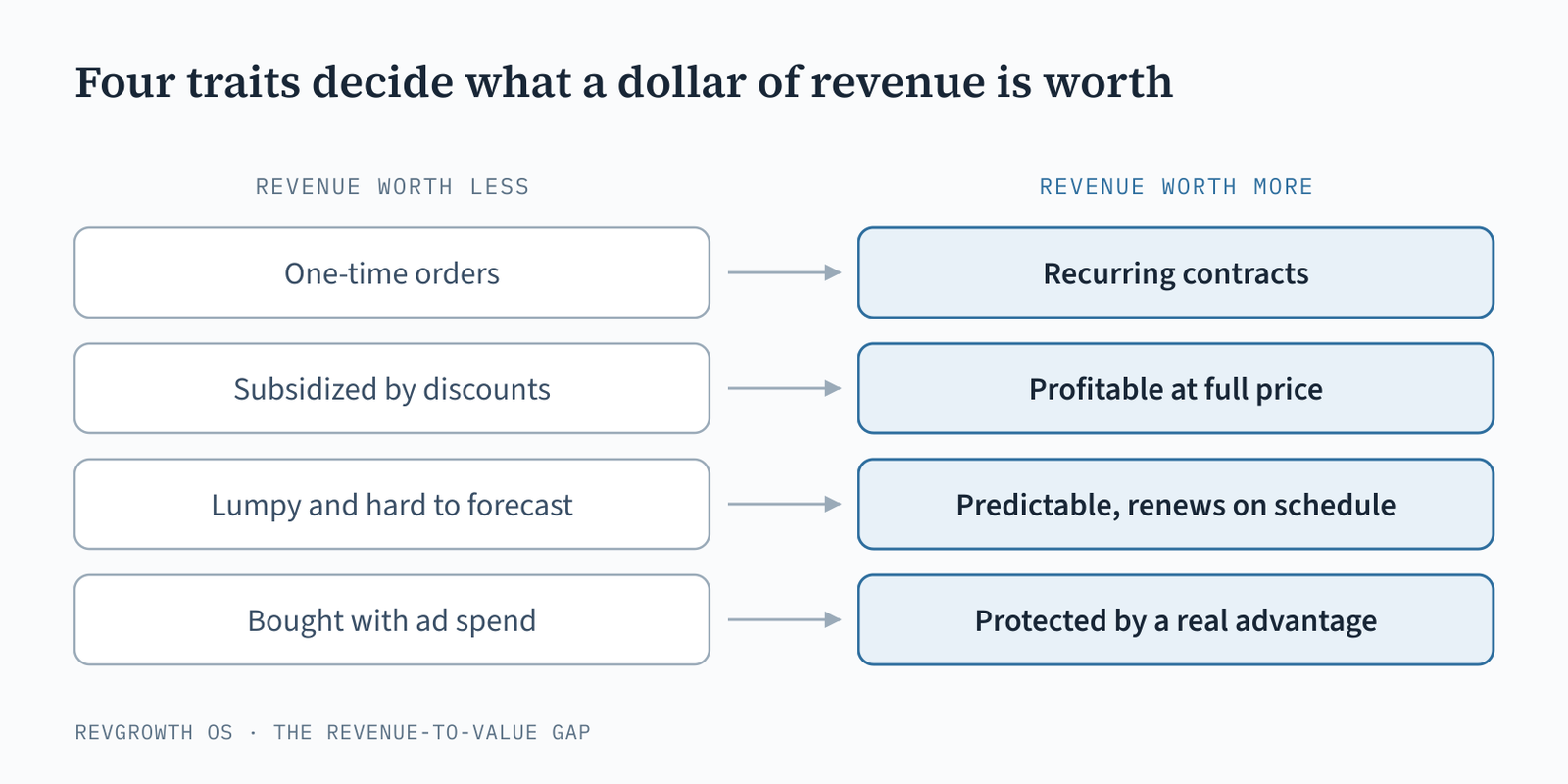
Take two ways to add $5 million. One is a single capital project won on price. The other is a service agreement across forty existing customers that renews every year. On the income statement they look identical. A buyer will value them nothing alike.
Buyers know this. Lenders know it. Your best people know it, even if nobody's said it out loud.
The gap nobody puts on the dashboard
The Revenue-to-Value Gap is the distance between the revenue a company generates and the long-term enterprise value it actually captures.
Most companies can't see it, because nothing in their reporting measures it. The P&L shows revenue and margin. The balance sheet shows assets. Neither one shows how transferable your growth is, or how much of it would walk out the door with one customer or one salesperson.
So they do what they've always done. They push for a bigger quarter. They add reps, raise the marketing budget, bolt on another service line. Revenue goes up.
Then the valuation comes back and it doesn't match the effort. What happened?
The growth was real. It just wasn't built to last, and the market priced it that way. Every dollar spent chasing low-quality revenue widened the gap a little more. Nobody noticed, because the scoreboard said they were winning.
This is an operating system problem
It's tempting to hand the gap to sales or marketing. That rarely works, because the gap doesn't live in one department.
It lives in how the company decides which customers to chase, how it prices, how it keeps what it wins, and whether growth keeps happening when a key person leaves. That's the operating system. Build it for volume and you get volume. Build it for value and you get value.
I've watched companies hire a new sales leader to fix a problem that started in pricing policy. I've watched others launch a marketing push to cover for churn they never measured. Eighteen months later the new hire is gone. The gap is still there.
You can't fix a system problem one function at a time. You have to see how the parts work together, and you have to measure them against companies that are getting it right.
Companies that close the gap grow differently
The companies with the best revenue-to-value ratio aren't always the fastest growers. They grow differently.
They engineer revenue to compound instead of chasing it one quarter at a time. They measure the drivers that build enterprise value, not only the ones that fill the pipeline. And they run on systems that keep working when the founder, the top salesperson, or the biggest customer isn't in the room.
Even on growth alone, the spread between companies is wide. In our benchmark of 212 mid-market companies, the top quartile grows at 38.6% a year and the bottom quartile at 5.7%.
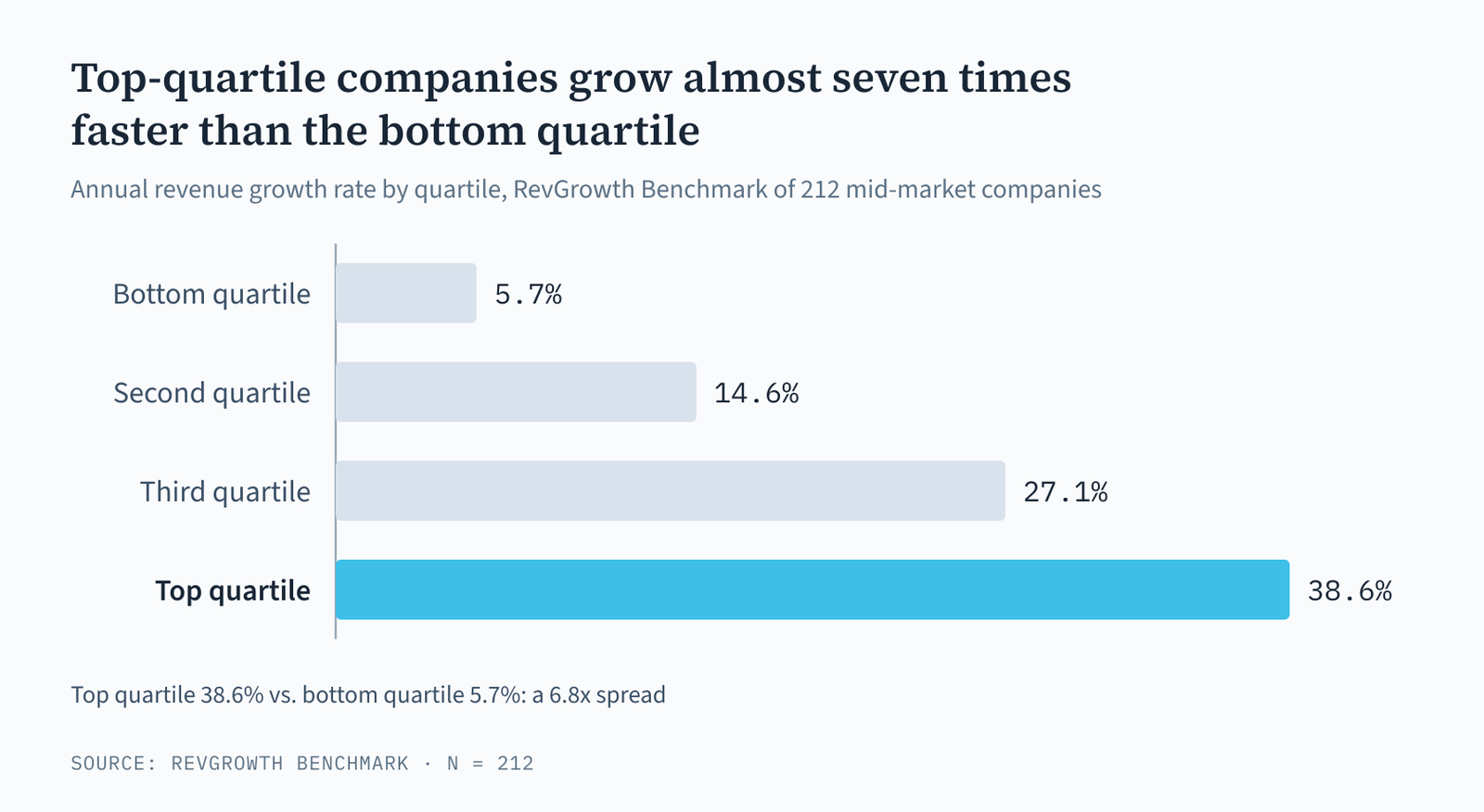
In my experience that difference shows up in how growth is built, far more than in how hard people work or how lucky the market was. The top-quartile companies aren't staffed with better people. They're running a better system.
The payoff is simple to state. These companies become worth more per dollar of revenue than their competitors. They draw better capital, better buyers, and better people. Growth becomes an asset on the balance sheet instead of a cost on the P&L.
What RevGrowth OS does
RevGrowth OS is Growth Infrastructure for mid-market industrial and B2B companies, and for the private equity firms that own them.
We start with the RevGrowth Benchmark. We measure your company against 212 others on the drivers that turn revenue into value, and we find the fastest, highest-confidence moves to close your gap. You see where you stand, driver by driver, against companies like yours.
Then we install the operating system so the gap stays closed. Four layers: Strategic Foundation, Revenue Engine, Resilience Core, and Value Expansion. Each one is built to make the next dollar of revenue worth more than the last.
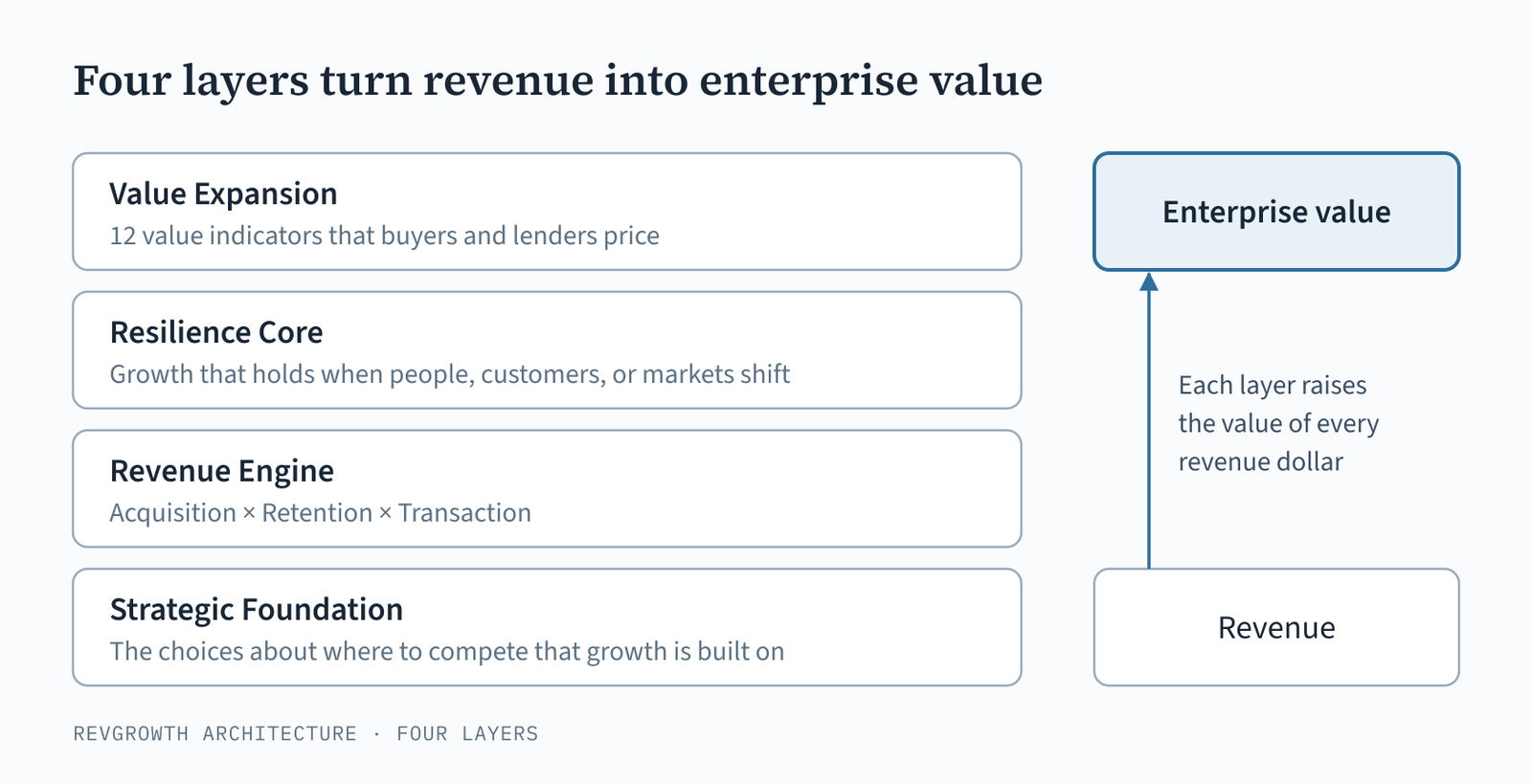
What that means depends on your seat. For a CEO, it's growth you can plan around. For a CFO, it's revenue you can forecast and margin you can defend. For a PE sponsor, it's a value creation story a buyer can verify at exit, instead of one they discount.
What we believe
These are the convictions behind every benchmark we run and every system we install.
- Revenue is a result. Value is the goal.
- A bigger quarter isn't the same as a better company.
- Growth that depends on one person, one customer, or one channel is borrowed.
- Predictability is worth paying for. Buyers already do.
- A customer you keep is worth more at exit than a customer you chase.
- The gap closes through systems, not heroics.
- What gets benchmarked gets built.
Close the gap
If you measure growth by revenue alone, you're leaving enterprise value on the table. Probably more than you think.
The good news is that the gap can be measured. Once you can measure it, you can close it, one driver at a time.
Start by finding out where yours is. The free RevGrowth Simulation shows where your Revenue-to-Value Gap is hiding and which moves would close it fastest.
Then decide what kind of growth you want next year. More revenue, or more value from every dollar of it.

Russ Holder
Founder & CEO, RevGrowth OS. 30 years in growth strategy, five published books.
More from the Revenue-to-Value Gap blog.
01
Blog post title
02
Blog post title
03
Blog post title
04
Blog post title
05
Blog post title
You've read what the data says. Now run your numbers through it.
A one-hour working session with your own data. We run it through the RevGrowth Benchmark live, so you see the method applied to your company before you spend a dollar.
One hour. Your data. Zero cost.