RevGrowth Architecture · Map It
Every company has growth architecture. Most were never designed.
The RevGrowth Architecture is the blueprint underneath predictable growth. Four levels, supporting one another, that turn a handful of 1% improvements into 20–40% annual growth in revenue, profits, and enterprise value.
Not a strategy. A structure.
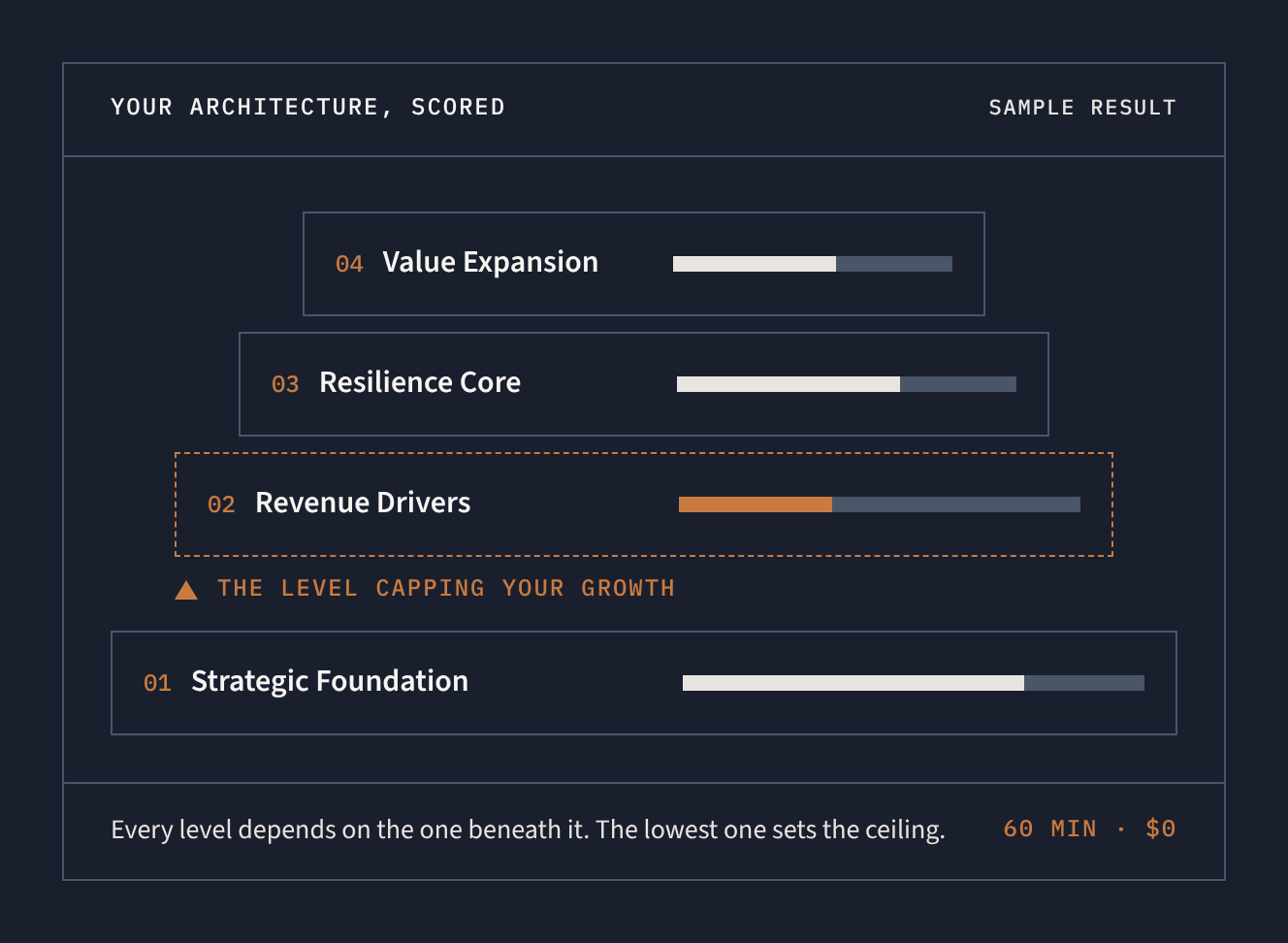
The RevGrowth Architecture is built bottom-up so that revenue compounds into value, not just a bigger top line.
Your growth strategy isn't failing. It has nowhere to land.
You have run the offsite. You have set the number. You have hired the rep, bought the tool, rebuilt the website.
Some of it worked. None of it held.
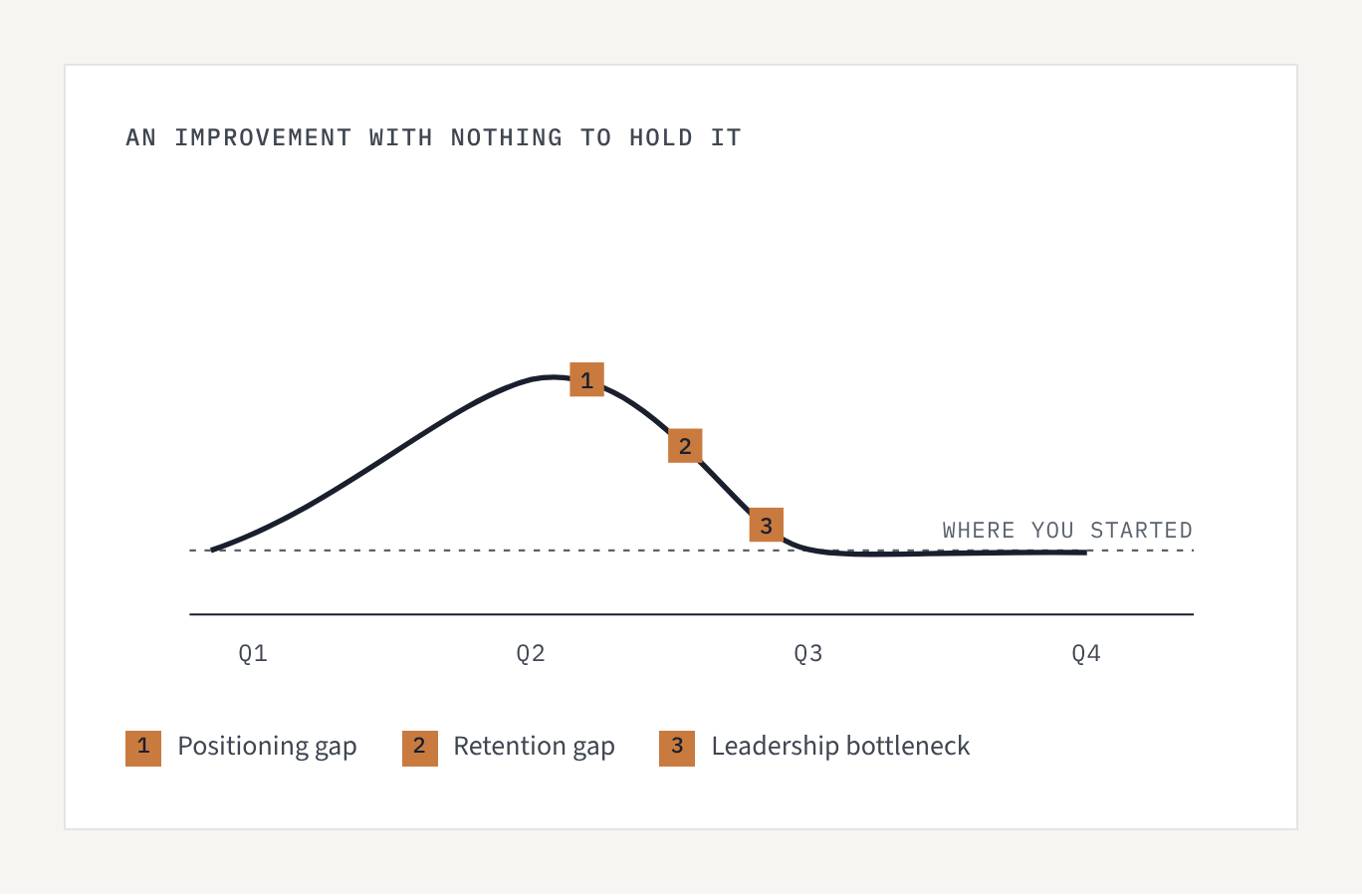
That is not an execution problem. It is a structural one. Improvements do not compound when there is nothing built to hold them. They leak out through a positioning gap, a retention gap, a leadership bottleneck, and land back where they started by Q3.
Four levels. Built bottom-up. Each one load-bearing.

Level 01
Strategic Foundation
The positioning and economics everything else rests on.
Most growth problems get diagnosed at the top of the stack and fixed at the bottom.
The Strategic Foundation answers two questions. Why should a buyer choose you? And does the math work when they do?
Build a revenue engine on a weak foundation and you will spend more to sell something the market values less. The engine works. It is just pushing uphill.

Level 02
Revenue Drivers
Where the compounding 1% improvements live.
Revenue comes from three places and only three. Acquiring customers, keeping them, and what happens in each transaction.
Revenue = Acquisition x Retention x Transaction
Build a revenue engine on a weak foundation and you will spend more to sell something the market values less. The engine works. It is just pushing uphill.

Level 03
Resilience Core
How the organization grows and adapts capability.
A revenue engine produces growth. It does not protect it.
Resilience = Ability x Agility
Resilience is two things multiplied. Ability is what your organization can do. Agility is how fast it can learn to do something else.

Level 04
Value Expansion
What the business is worth when growth is predictable.
Growth and value are not the same thing. You can grow revenue and destroy multiple.
The multiple is a judgment about durability. A buyer, a board, or a lender is asking one question.
"Does this keep happening without the current owner in the room?"
Level 04 is not an exit strategy. It is the scoreboard for whether the first three levels were built or improvised.
Every level depends on the one beneath it.
Most companies work top-down. Valuation goal, then revenue target, then tactics. The Architecture is built bottom-up.
Skip Level 01 · Strategic Foundation
Optimize the revenue engine on a weak Strategic Foundation and you scale a positioning problem.
Skip Level 02 · Revenue Drivers
Build resilience around an engine that does not compound and you have made a plateau durable.
Skip Level 01 to 03
Chase valuation without the three levels underneath and you are pricing a story.
That is the ceiling you keep hitting. It's not the market. It's the level you skipped.
The Architecture is the first of three components.
Step 01: Map It
RevGrowth Architecture
The structure to be built, in the order it has to be built.
Step 02: Measure It
RevGrowth Benchmark
Where you stand against 200-plus mid-market companies across four non-negotiables, seven critical factors, and 25 measurable drivers.
Step 03: Move It
RevGrowth Engine
The operating rhythm that keeps 1% improvements accumulating instead of resetting.
The Architecture tells you what to build. The Benchmark tells you what each level and driver is costing you.
Why two sets of four?
RevGrowth Architecture has four levels. That is what we build.
Those four levels are the Four Non-Negotiables of the RevGrowth Benchmark. That is what we measure.
The Benchmark scores how effectively your Architecture creates short-term revenue and compounds it into long-term business value.
As you build and strengthen the levels of your Architecture, your benchmark scores improve. And as you work to increase your benchmark scores, you strengthen your levels and your financial performance improves predictably.
Two days to the blueprint. Then the build.
Step 01 · Start Here
1 hour · no cost
RevGrowth Simulation
One hour. Your data. No cost. We run your numbers through the model and show you which level is capping your growth.
Step 02 · Leadership Team
2 days
RevGrowth Installation
A two-day intensive with your leadership team. You leave with:
Step 03 · 90-Day Cycles
Ongoing · As Needed
RevGrowth Co-Pilot
Ongoing support while the build happens. Because the failure mode is not a bad plan. It is a good plan with no one holding the sequence.
Your strategy isn't broken. Just un-architected.
The RevGrowth Architecture is built for mid-market industrial and B2B companies. Manufacturers, distributors, and services firms between $10M and $500M in revenue.
It is the right fit if
Common questions
How is this different from a growth strategy?
A strategy tells you what to pursue. An architecture tells you what has to exist for the pursuit to hold. Most strategies fail at Level 02 or 03 — not because the strategy was wrong, but because nothing was built to carry it.
Do we have to build all four levels?
No. You build where you're weakest and where it will help you achieve your objectives. The benchmark identifies constraint levels and opportunities; most companies work on one or two at a time.
How long does this take?
It takes two days to complete the RevGrowth Benchmark and RevGrowth Engine. After that, you'll have a prioritized, quantified action plan tailored to your business and needs. Foundation work is usually slower than engine work. We'll tell you which you're facing before you commit to anything.
We already have a strategic plan. Does this replace it?
Usually, it explains it. Most plans contain the right intentions distributed across all four levels with no sequence. The Architecture puts them in build order.
What size company is this for?
Mid-market industrials and B2B - roughly $10M to $500M in revenue. Manufacturers, distributors, and services firms.
One hour. Your data. Zero cost.
The fastest way to see which level of your architecture is capping your growth.