
Blog / Growth Risk
What the Resilience Core Is, and Why It Matters So Much
By Russ Holder
3-minute read
A company growing 25% a year looks great on a board slide. Then its largest customer moves a product line to a competitor, the top salesperson retires, and a key supplier misses three months of deliveries. All in the same year.
The growth rate was real. It just couldn't take a hit.
That's the problem the Resilience Core is built to solve. Of the four layers in the RevGrowth Architecture, it's the one that gets the least attention in growth planning and does the most to decide what the growth is actually worth.
Growth that can't take a hit is borrowed.
The RevGrowth Architecture has four layers. The Strategic Foundation decides where you play and why you win. The Revenue Engine produces revenue through Acquisition, Retention, and Transaction. Value Expansion turns that growth into something a buyer can see and will pay for.
The Resilience Core sits between them. It decides whether the growth the Revenue Engine produces will survive the things that inevitably go wrong: a lost customer, a departed leader, a downturn, a supply shock.
Our manifesto puts it bluntly: growth that depends on one person, one customer, or one channel is borrowed. It's real today. It can leave in a single phone call. The Resilience Core is the part of the system that turns borrowed growth into owned growth.
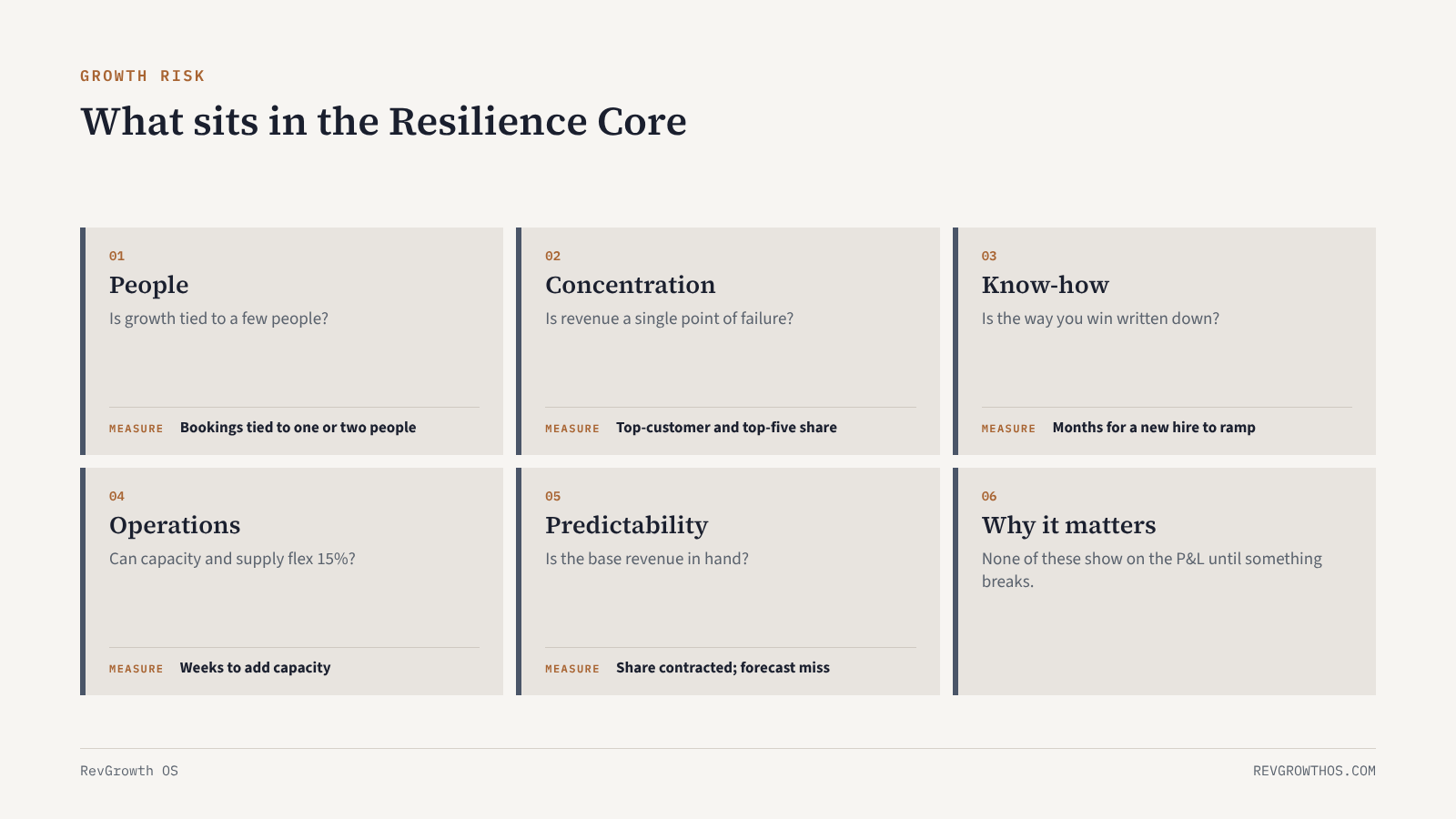
What sits in the Resilience Core?
Resilience isn't one thing. In practice, it comes down to a handful of questions a CFO can measure.
How dependent is growth on a few people? If the founder closes the big deals and one account manager holds the top relationships, growth walks out the door with them. The measure is the share of major bookings and top-account revenue tied to one or two people.
How concentrated is revenue? One customer at 22% of sales, or one distributor carrying a region, is a single point of failure. Top-customer and top-five shares tell you how exposed you are.
Is the know-how written down? If the way your best people win and keep business lives in their heads, it leaves when they do. A process a new hire can learn in six months is resilience you can count on.
Can operations flex? When demand jumps or drops 15%, can capacity, staffing, and supply adjust without wrecking margin or delivery? Companies that can't flex lose customers in the upswing and cash in the downswing.
How predictable is the base? A large share of contracted or recurring revenue, and a forecast that lands within a few points, gives a company room to absorb a shock without panicking.
None of these show up on the P&L until something breaks. That's exactly why they get ignored.
Why a CFO should care most.
CEOs tend to think about resilience in terms of risk. CFOs should think about it in terms of value, because that's how the market prices it.
A buyer or lender looking at two companies with the same EBITDA will ask what could make that EBITDA disappear. The company with a single customer at 20% of sales, a founder who closes every deal, and a forecast that misses by 15% in both directions carries more risk. More risk means a higher discount rate, which means a lower multiple. It also means tighter covenants and less patience from the bank.
Resilience also changes how the company behaves in a downturn. A resilient company can keep investing in its drivers when demand softens, because it isn't scrambling to replace a lost customer or rebuild a sales team. That's often when the gap between strong and weak companies widens most.
The benchmark gives a sense of the spread. Across 200-plus mid-market companies, the top quartile grows at 38.6% a year and the bottom quartile at 5.7%. Fast growth without resilience can still land a company in trouble. Resilience is what lets fast growth keep going.
Which is worth more to a buyer: 25% growth that could stop with one phone call, or 18% growth that keeps coming no matter who leaves?
Stress-test your growth.
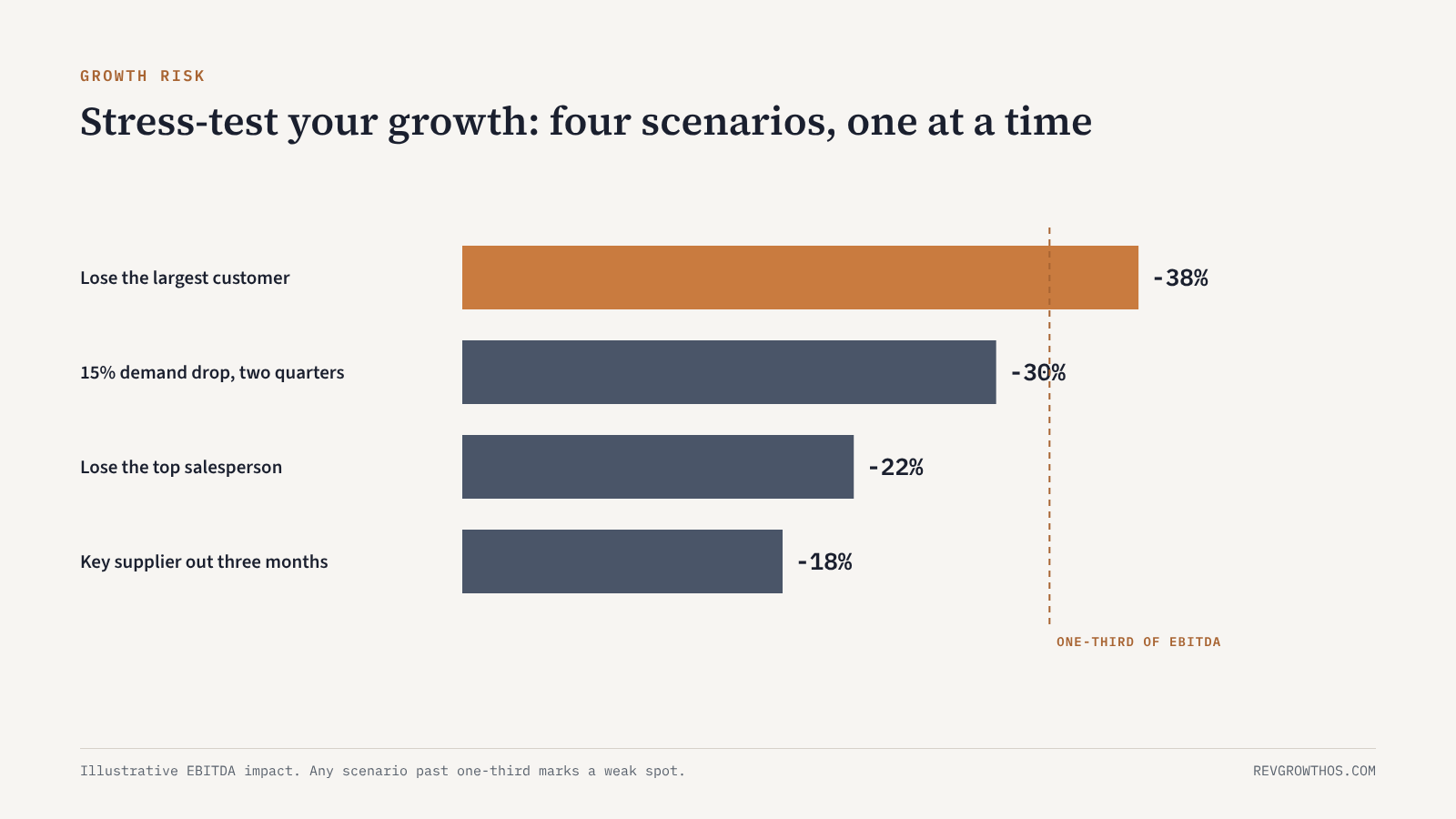
Here's an exercise I'd run with any finance team. Take next year's plan and model four scenarios, one at a time.
First, lose your largest customer. Not a slowdown, a full loss. What happens to revenue, margin, and cash?
Second, lose your top salesperson or the founder's direct involvement in sales. Which accounts and deals go with them?
Third, take 15% out of demand for two quarters. Can the cost base and capacity adjust in time, or does margin collapse?
Fourth, lose a critical supplier for three months. What can you still ship, and to whom?
If any scenario cuts EBITDA by more than a third, you've found a weak spot in your Resilience Core. Most companies find at least one. The useful part is seeing which one, and how much it would cost.
Build resilience before you need it.
Resilience is cheapest to build when nothing is wrong. Once a key customer is leaving or a downturn has started, the options narrow fast.
Start with the biggest single exposure the stress test revealed. If it's concentration, build a second and third tier of large accounts. If it's people, put teams around key accounts and get the founder out of the critical path on major deals. If it's undocumented know-how, write down how your best people actually win. If it's operations, build flexible capacity and second sources for critical inputs.
Then track it. Add top-customer share, founder-closed bookings, share of contracted revenue, and forecast accuracy to the quarterly board pack, next to EBITDA. Resilience that's measured gets built. Resilience that isn't measured gets talked about.
The free RevGrowth Simulation scores your Resilience Core alongside the other three layers, against 200-plus mid-market companies. It takes about an hour and shows where your growth is most exposed.

Russ Holder
Founder & CEO, RevGrowth OS. 30 years in growth strategy, five published books.
More from the Revenue-to-Value Gap blog.
You've read what the data says. Now run your numbers through it.
A one-hour working session with your own data. We run it through the RevGrowth Benchmark live, so you see the method applied to your company before you spend a dollar.
One hour. Your data. Zero cost.