
Blog / Growth Strategy
The New CEO's First Growth Question
By Russ Holder
3-minute read

Every new CEO inherits a growth number. It's in the board deck, the budget and the investor presentation. Usually it's a target for next year, built on last year's result plus a reasonable increase.
What the new CEO doesn't inherit is an explanation. Where did last year's growth actually come from? Who produced it? Will it repeat?
In my experience, the most useful thing a new CEO can do in the first 90 days is ask that question before accepting the target. The answer shapes everything that follows, including whether the target is realistic at all.
Start with where last year's growth came from.
Start by splitting last year's revenue growth into its parts. Three buckets cover most of it: new customers, existing customers buying more, and price.
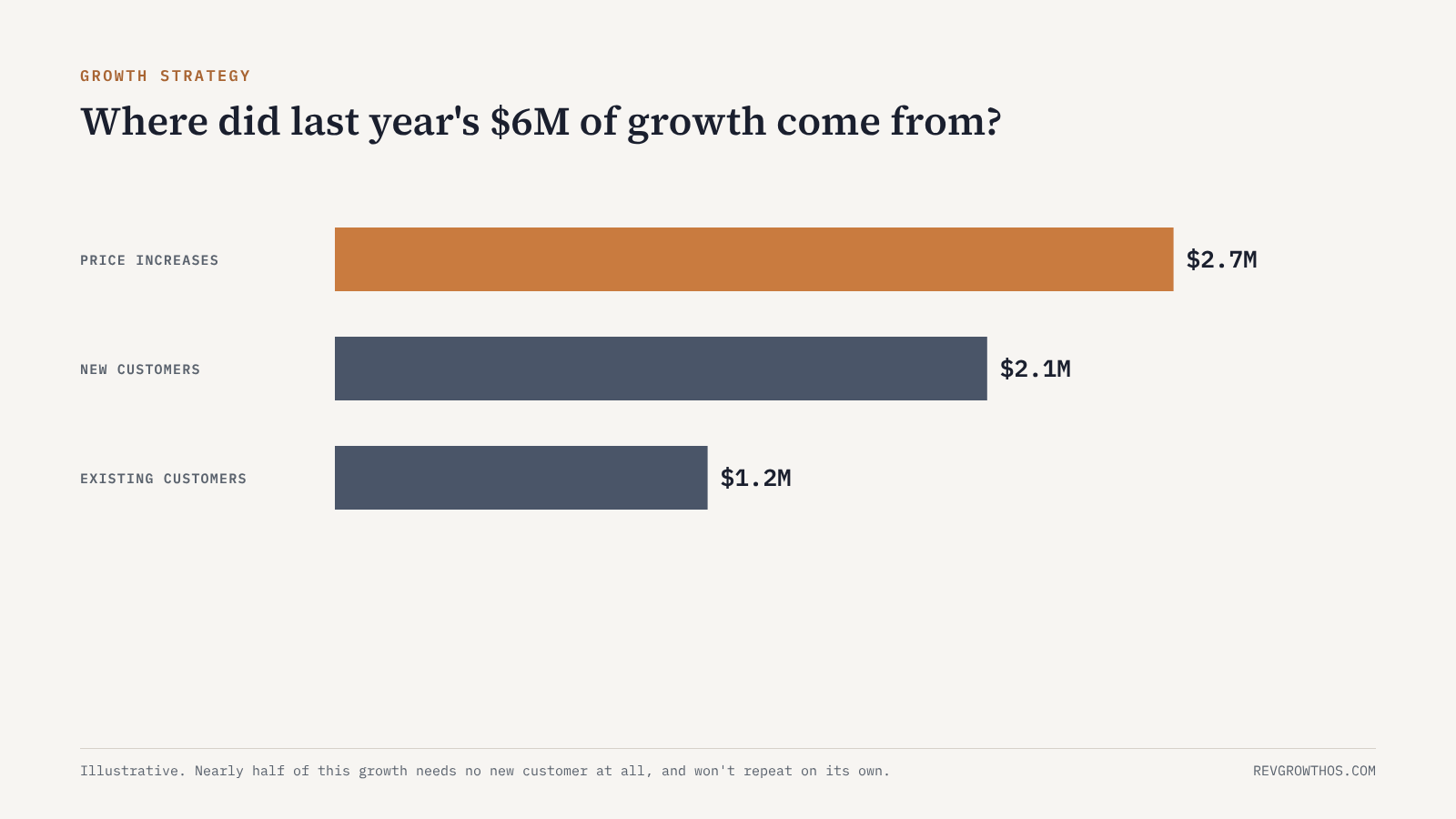
Take a company that grew $6 million last year. Split it and you might find $2.7 million came from price increases, $2.1 million from new customers and $1.2 million from existing customers buying more.
That breakdown changes the conversation. Nearly half the growth needed no new customer at all. Price increases have a limit. If inflation cools, that $2.7 million doesn't repeat, and next year's plan has a hole in it nobody has named yet.
Add a fourth line if the company made an acquisition. Acquired revenue needs to come out before you can say anything about the company's ability to grow on its own.
Most new CEOs are surprised by this split. Most leadership teams have never seen it.
Find out whether growth is a system or a person.
The second part of the question is about who produced the growth.
In many mid-market companies, a few people carry most of it. A founder who still closes the large deals. A sales leader with twenty years of relationships. A product manager who knows how to price the complicated quotes. Their judgment is valuable, and often undocumented.
A new CEO needs to know how much of the growth depends on those people. Ask simple questions. Which accounts would be at risk if this person left? Who approves price exceptions, and by what rules? If the top salesperson took a month off, which deals would stall?
The answers tell you how fragile the growth is. They also tell you what to protect in the first year, because leadership transitions are exactly when key people start reconsidering their own futures.
Talk to customers, too. A new CEO has a short window where customers will speak candidly, because they assume the new leader wants to hear it. Visit the ten largest accounts in the first two months. Ask why they buy, what almost made them leave and who at your company they'd call with a problem. Their answers will tell you more about where growth comes from than any internal report.
Find the weakest driver.
Once you know where growth came from and who produced it, look at the engine underneath.
Revenue comes from nine drivers, grouped into Acquisition, Retention and Transaction. Lead generation, conversion and referrals bring customers in. Lower attrition, longer buying lifetimes and reactivation keep them. Order size, purchase frequency and price set how much each relationship is worth.
Score each one. Better, score each one against companies like yours, so you know whether your 85% revenue retention is strong or weak for your industry.
You'll usually find one or two drivers well behind the rest. Because the drivers multiply, a weak one costs more than it looks. A company running three drivers at 90% of top-quartile levels and one at 50% isn't slightly behind. It's running well under half its potential on that part of the engine.
Why this beats starting with a new plan.
New CEOs feel pressure to act. The board hired them to change something, and a new strategy feels like the visible proof.
The risk is acting on the wrong diagnosis. A CEO who assumes the problem is sales will hire salespeople. If the real issue is retention, that spending makes the numbers look better for a year and then worse. A CEO who launches a new product line may be adding complexity to a company whose real constraint was pricing discipline.
Ninety days of diagnosis isn't delay. It's how you make sure the first big decisions hit the right target. Would you rather spend three months finding the constraint, or two years fixing the wrong one?
What to bring to the board at day 90.
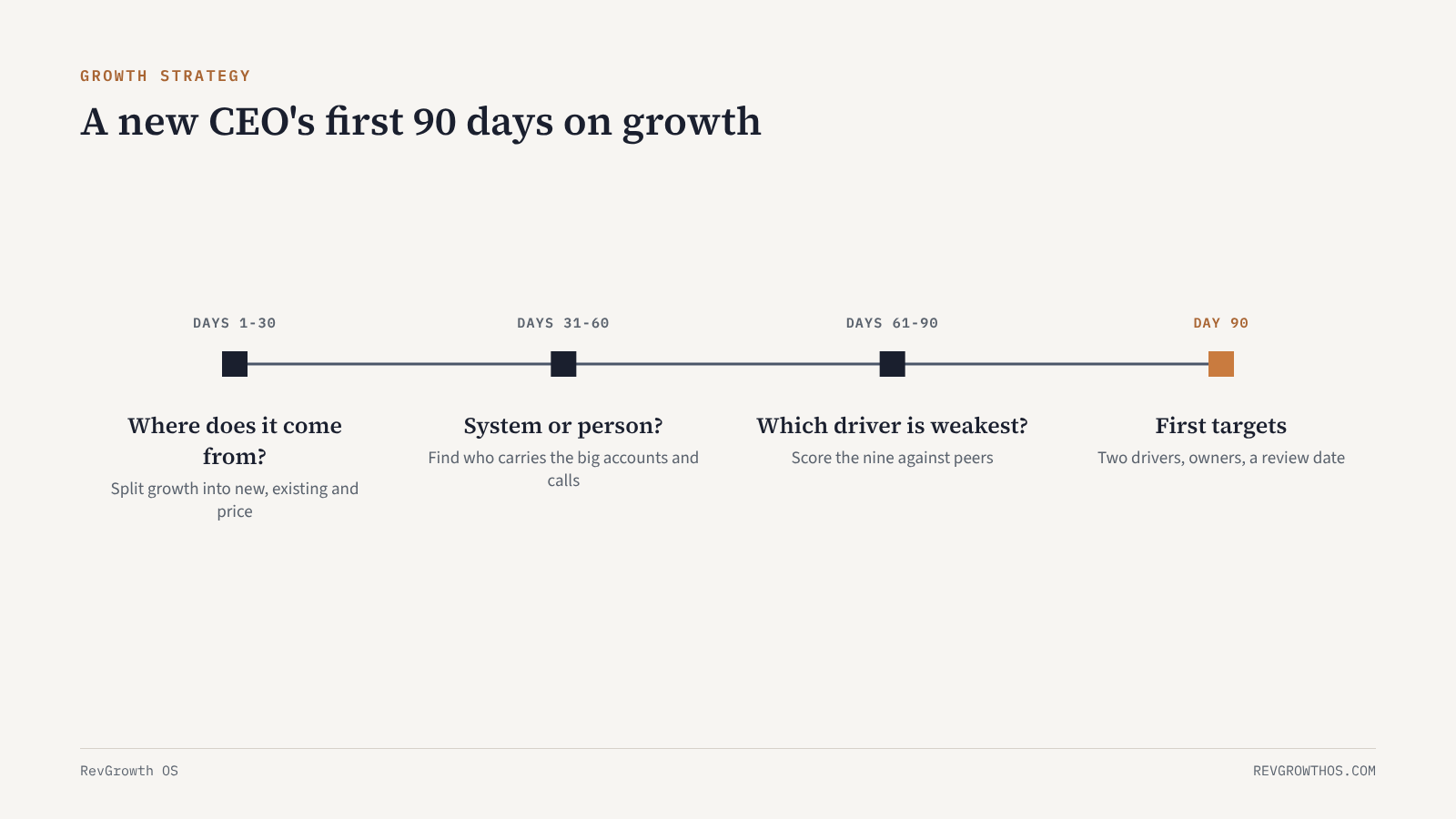
By the end of the first quarter, a new CEO can usually bring the board something more useful than a strategy deck.
First, a clean view of where last year's growth came from, split by source. Second, a map of where growth depends on specific people, and a plan to reduce that dependence. Third, a scored position on the nine drivers, with the weakest two or three highlighted. And fourth, a revised growth target built from those drivers, with owners and quarterly milestones.
That last piece matters most. A target built from the drivers can be checked every quarter. A target built from last year's number plus a few points can only be checked at year-end, when it's too late to adjust.
A faster way to find the answer.
You can do all of this with internal data and a lot of conversations. It takes time, and it's hard to tell whether your numbers are good or bad without something to compare them against.
The free RevGrowth Simulation shortens the process. In about an hour, it scores your revenue drivers against 200-plus mid-market companies and shows which gaps are worth the most to close. For a new CEO, it's a quick way to start the first 90 days with evidence rather than assumptions.

Russ Holder
Founder & CEO, RevGrowth OS. 30 years in growth strategy, five published books.
More from the Revenue-to-Value Gap blog.
You've read what the data says. Now run your numbers through it.
A one-hour working session with your own data. We run it through the RevGrowth Benchmark live, so you see the method applied to your company before you spend a dollar.
One hour. Your data. Zero cost.