
Blog / Growth Strategy
What the RevGrowth Engine Is: The Governed Cadence Behind Every Growth Initiative
By Russ Holder
3-minute read

Most growth strategies don't fail in the boardroom. They fail on an ordinary Tuesday, about four months after the offsite.
The plan was sound. The initiatives were sensible. Then the quarter got busy. The pricing project lost its owner to a customer escalation. The account-review meeting got skipped twice. The dashboard someone built in February stopped being updated in May. By the fourth quarter, nobody could say which initiatives were working, and next year's plan started from scratch.
That gap between plan and Monday morning is what the RevGrowth Engine exists to close.
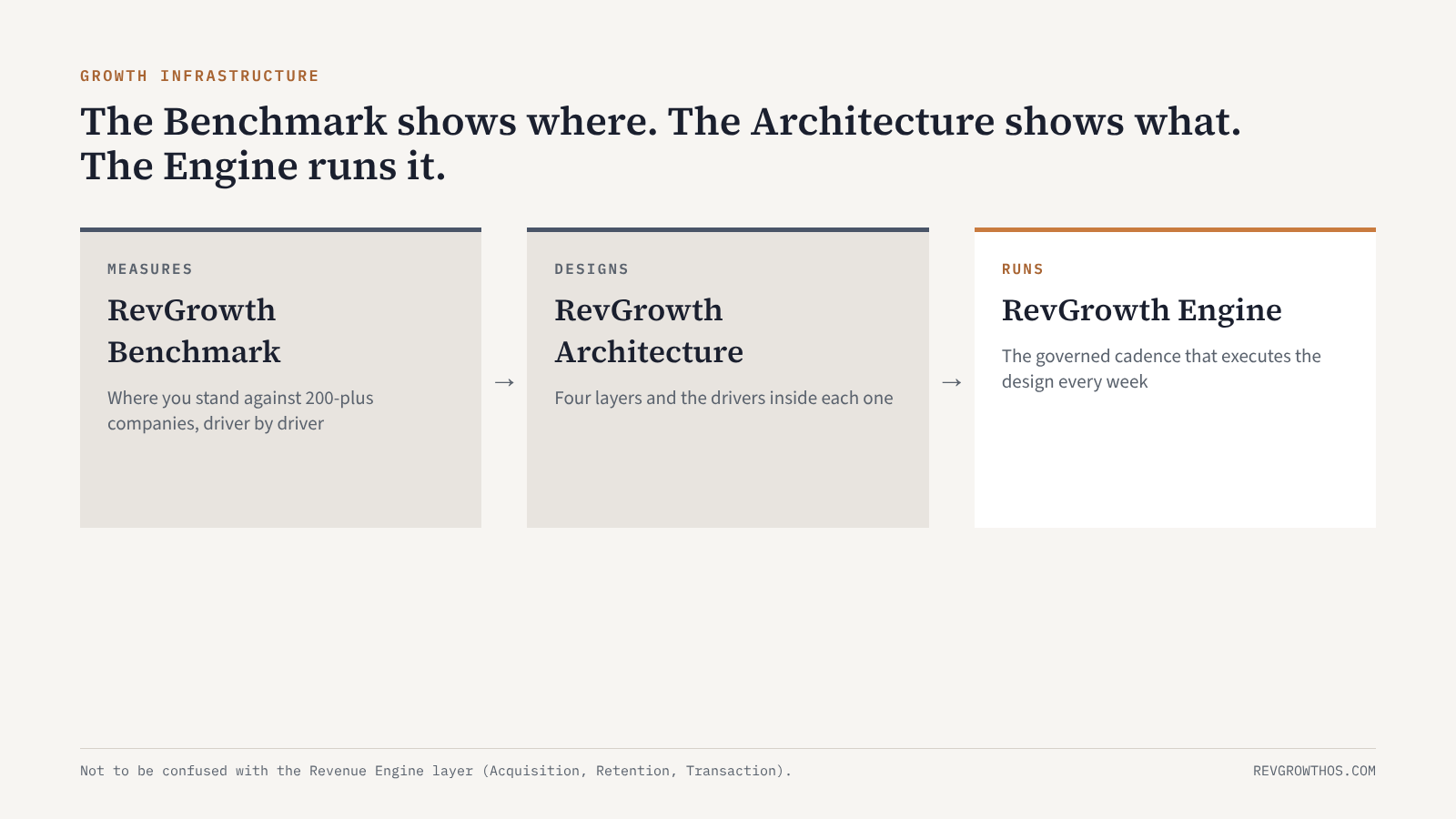
The Architecture designs it. The Engine runs it.
RevGrowth OS has three parts that work together. The RevGrowth Benchmark measures where a company stands against 200-plus mid-market companies, driver by driver. The RevGrowth Architecture is the design: the four layers of Strategic Foundation, Revenue Engine, Resilience Core, and Value Expansion, and the drivers inside each one. The RevGrowth Engine is how that design gets executed, week after week, year after year.
A quick note on names, because they're close. The Revenue Engine is one of the four layers of the Architecture. It's where Acquisition, Retention, and Transaction live. The RevGrowth Engine is different. It's the operating rhythm that runs across all four layers.
Put simply, the Benchmark tells you where to work, the Architecture tells you what to build, and the Engine makes sure it actually gets built and stays built.
What "governed" means in practice.
A governed cadence sounds bureaucratic. It isn't, or at least it shouldn't be. It's a small set of rules that every growth initiative has to follow before it gets time, money, or a slot on the agenda.
Every initiative is tied to a specific driver. Not "grow the Southeast," but "raise gross revenue retention in our top 100 accounts from 88% to 92%." If nobody can name the driver it moves, it doesn't get funded.
Every initiative has one owner inside the business. Not a committee, and not an outside advisor who'll leave when the engagement ends.
Every initiative has a measure and a baseline. You know where the number started, so you'll know whether it moved.
And every initiative has a rule for what happens next. Scale it if it hits its mark by a set date. Fix it if it's close. Stop it if it isn't working, and move the people to something that will.
That last rule is the one most companies skip. Without it, initiatives never end. They just fade, and the organization carries a dozen half-alive projects that soak up attention.
The rhythm I'd install.
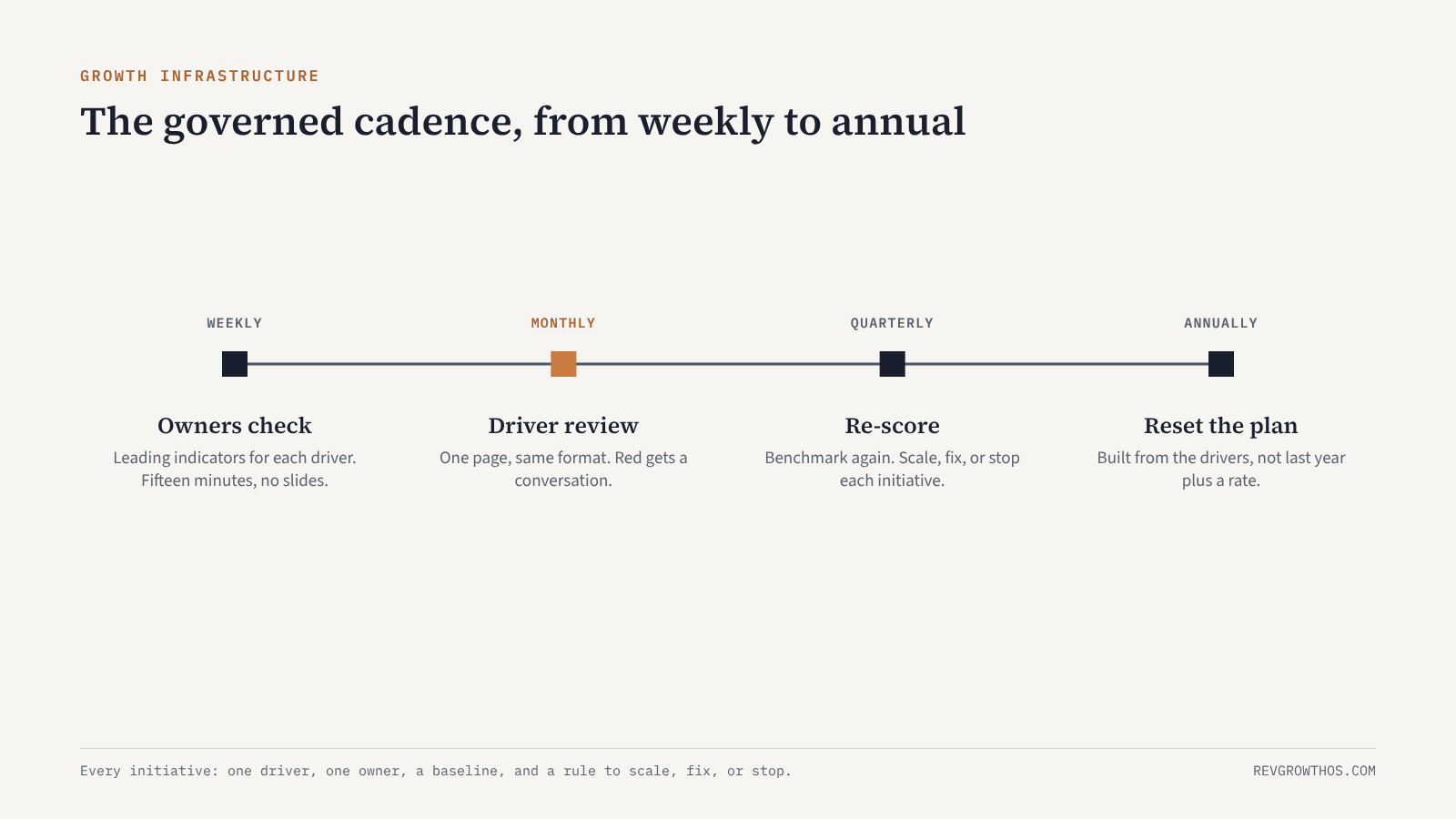
The cadence matters as much as the rules. Here's the rhythm I'd put in place in a typical mid-market company.
Weekly, each owner looks at the leading indicators for their driver: quotes out, quote turnaround, accounts at risk, price exceptions approved. Fifteen minutes. No slides.
Monthly, the leadership team holds a driver review. One page, the same format every month, showing each driver against its baseline and target. Red items get a specific conversation. Green items get thirty seconds.
Quarterly, the company re-scores its drivers against the benchmark and reallocates. Which initiatives earned more resources? Which ones get stopped? Where did a new constraint show up?
Annually, the plan resets from the drivers, not from last year's revenue plus a growth rate.
None of that is exotic. The difference is that it happens every time, with the same format and the same questions, whether the quarter is going well or badly.
Why cadence beats a list of initiatives.
Most companies don't lack ideas. They lack a way to keep good ideas alive long enough to compound.
Growth gains decay when they're installed as projects. A price increase leaks back through exceptions. An account program fades when its champion gets promoted. A sales process slips once the training is over. In my experience, more growth is lost to decay than to bad strategy.
A governed cadence is what stops the leak. When a driver has an owner, a number, and a monthly review, a slide gets noticed in weeks. When it doesn't, the slide shows up a year later as a missed plan with no clear cause.
There's a compounding effect, too. Acquisition, Retention, and Transaction multiply, so small gains held across all three add up faster than any single big push. But only if they hold. Is a 1% gain that fades by next summer really a gain at all?
The benchmark shows what's at stake. The top quartile of our 200-plus companies grows at 38.6% a year. The bottom quartile grows at 5.7%. The top-quartile companies I've seen aren't necessarily the ones with the best ideas. They're the ones that keep the gains from the ideas they've had.
What the first 90 days look like.
Installing the RevGrowth Engine doesn't require a reorganization. It usually starts small.
In the first month, you benchmark the drivers and pick the two or three weakest ones. You name an owner for each, set a baseline, and agree what good looks like in twelve months.
In the second month, you hold the first monthly driver review and set up the weekly check-ins. The first few reviews are clumsy. That's normal.
By the third month, the format settles. The team knows what will be asked, so they come with answers. Initiatives that aren't tied to a driver start to look out of place, and some quietly get dropped.
That's usually when leaders notice the real change. Growth stops being something the company talks about at the offsite and starts being something it runs.
If you want to see which drivers your Engine should run on first, the free RevGrowth Simulation benchmarks them against 200-plus mid-market companies in about an hour.

Russ Holder
Founder & CEO, RevGrowth OS. 30 years in growth strategy, five published books.
You've read what the data says. Now run your numbers through it.
A one-hour working session with your own data. We run it through the RevGrowth Benchmark live, so you see the method applied to your company before you spend a dollar.
One hour. Your data. Zero cost.