
Blog / Growth Strategy
The Real Bottleneck to Growth Isn't Sales
By Russ Holder
3-minute read

Anyone who has spent time around Lean knows the first lesson of the theory of constraints. An hour lost at the bottleneck is an hour lost for the whole system. An hour saved anywhere else is a mirage.
Most plant managers would not add capacity to a machine that is not the constraint. Yet many companies add sales capacity without first confirming the real bottleneck. When revenue falls short, leadership often assumes sales is the issue and hires more salespeople.
Sometimes sales really is the constraint. Far more often, it's somewhere else.
Growth moves through a process, just like a product.
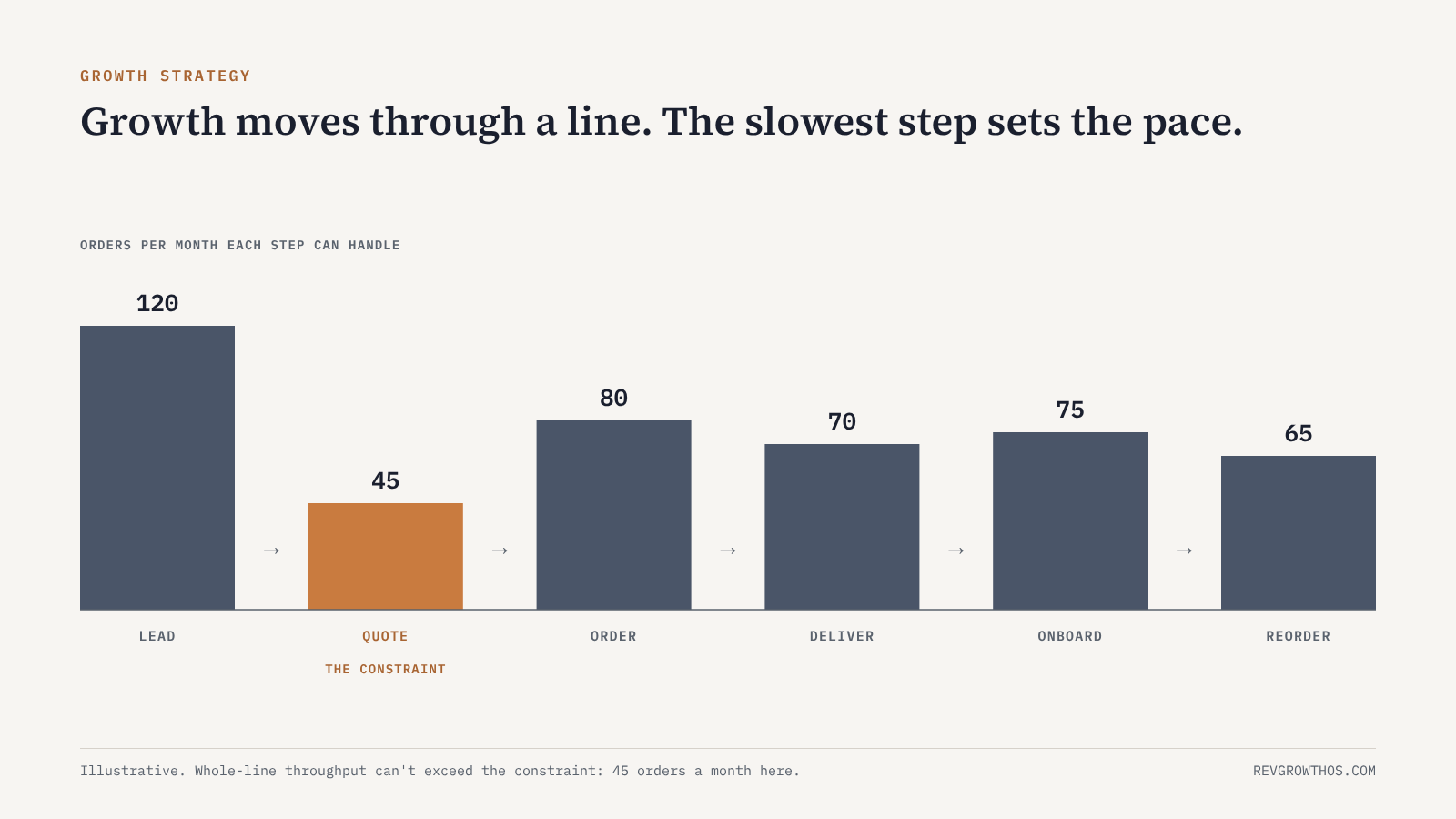
Think of revenue as a flow. A lead becomes a quote. A quote becomes an order. The order gets engineered, built, or sourced, and delivered. The customer gets onboarded and served, and if things go well, orders again.
Every one of those steps has a capacity. The slowest one sets the pace for the whole line, no matter how fast the others run.
When leadership teams map that flow, the bottleneck is rarely in front of the customer. It is usually behind the sales team, in areas not traditionally viewed as part of growth.
Operations would not accept a plant where the constraint is unknown. Yet most leadership teams cannot quantify where orders wait the longest between first contact and invoice.
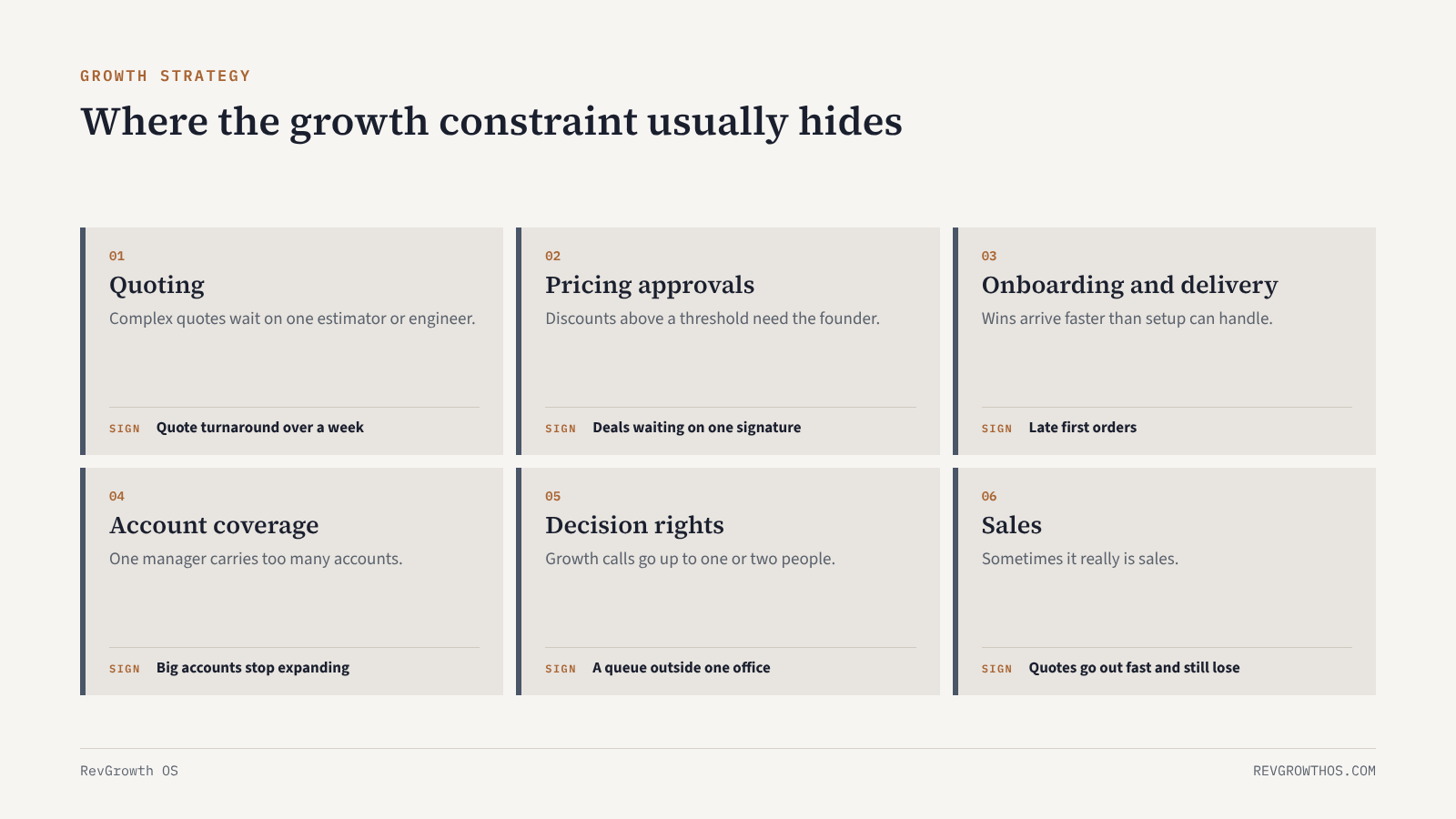
Where the constraint usually hides.
Quoting. In many industrial companies, a complex quote takes a week or more because it depends on one estimator or one engineer. Buyers don't wait. They go with whoever answers first.
Pricing approvals. If every discount over a threshold requires executive approval, the approval process becomes the bottleneck.
Onboarding and delivery. Some companies win business faster than they can set it up. The first order ships late, the customer's first impression is a missed date, and the second order never comes.
Account coverage. One account manager carrying eighty accounts can't grow any of them. The accounts don't leave. They stop expanding.
Decision rights. When growth decisions require approval from one or two people, that approval queue becomes the company's constraint.
Only one of those sits near the sales team, and even that one isn't really a sales problem.
Why more salespeople can make it worse.
Adding more sales reps in front of a quoting bottleneck increases the volume of requests in the same queue. Win rates decline as quotes slow down. New hires become frustrated and often leave within a year. Leadership may conclude the hires were ineffective.
They weren't bad hires. They were put in front of the wrong constraint.
There is a less visible cost as well. When sales is held responsible for a constraint outside its control, top performers often leave first. The team becomes weaker while the bottleneck remains.
Effort without diagnosis increases costs. Each time a qualified buyer waits a week for a price, there is a measurable impact.
Find the constraint, then feed it.
The method is the same one your operations team already uses. Map the sequence from first contact to second order. Measure time and volume at each step. Find where work waits.
Then apply Lean principles. Protect the constraint, support it, and remove unnecessary tasks. If quoting is the bottleneck, provide estimators with templates and pricing rules to standardize the process. If approvals are the issue, document discount authority and delegate it. If account coverage is the constraint, segment accounts and assign a team to the largest ones.
Once you break one constraint, another will show up. That's normal. Growth capacity gets built one constraint at a time.
Measure results after each change. If quote turnaround improves but win rates don't, quoting wasn't the true constraint. Continue testing. The process is simple: form a hypothesis, make a change, measure the outcome.
Start with ten orders.
A consultant is not required to identify the first bottleneck. Select ten recent orders and trace each step. Record when the lead arrived, when the quote was sent, when the order was placed, shipped, and invoiced, and when the customer ordered again.
The longest gap is likely the constraint. It is rarely where the organizational chart suggests.
Do the exercise with your operations leader in the room. Ops people find bottlenecks for a living, and they'll often spot the constraint faster than anyone in sales or finance.
When you want to see how your growth drivers compare with companies like yours, the free RevGrowth Simulation measures them against 200-plus mid-market companies and points to the constraint worth breaking first.

Russ Holder
Founder & CEO, RevGrowth OS. 30 years in growth strategy, five published books.
More from the Revenue-to-Value Gap blog.
You've read what the data says. Now run your numbers through it.
A one-hour working session with your own data. We run it through the RevGrowth Benchmark live, so you see the method applied to your company before you spend a dollar.
One hour. Your data. Zero cost.