
Blog / Growth Strategy
Why Organic Growth Beats Acquisitions for Most Mid-Market Industrials
By Russ Holder
3-minute read

Acquisitions add revenue quickly. A deal signed in March shows up on the top line by summer. Organic growth takes longer and does not deliver immediate results.
Many growth plans rely on M&A. A platform acquires two or three add-ons, revenue increases, and the strategy appears successful.
Acquisitions can create significant value when chosen well. For most mid-market industrials, organic growth is the stronger first move. Companies that skip this step often run into challenges later.
Acquired revenue comes with the seller's problems.
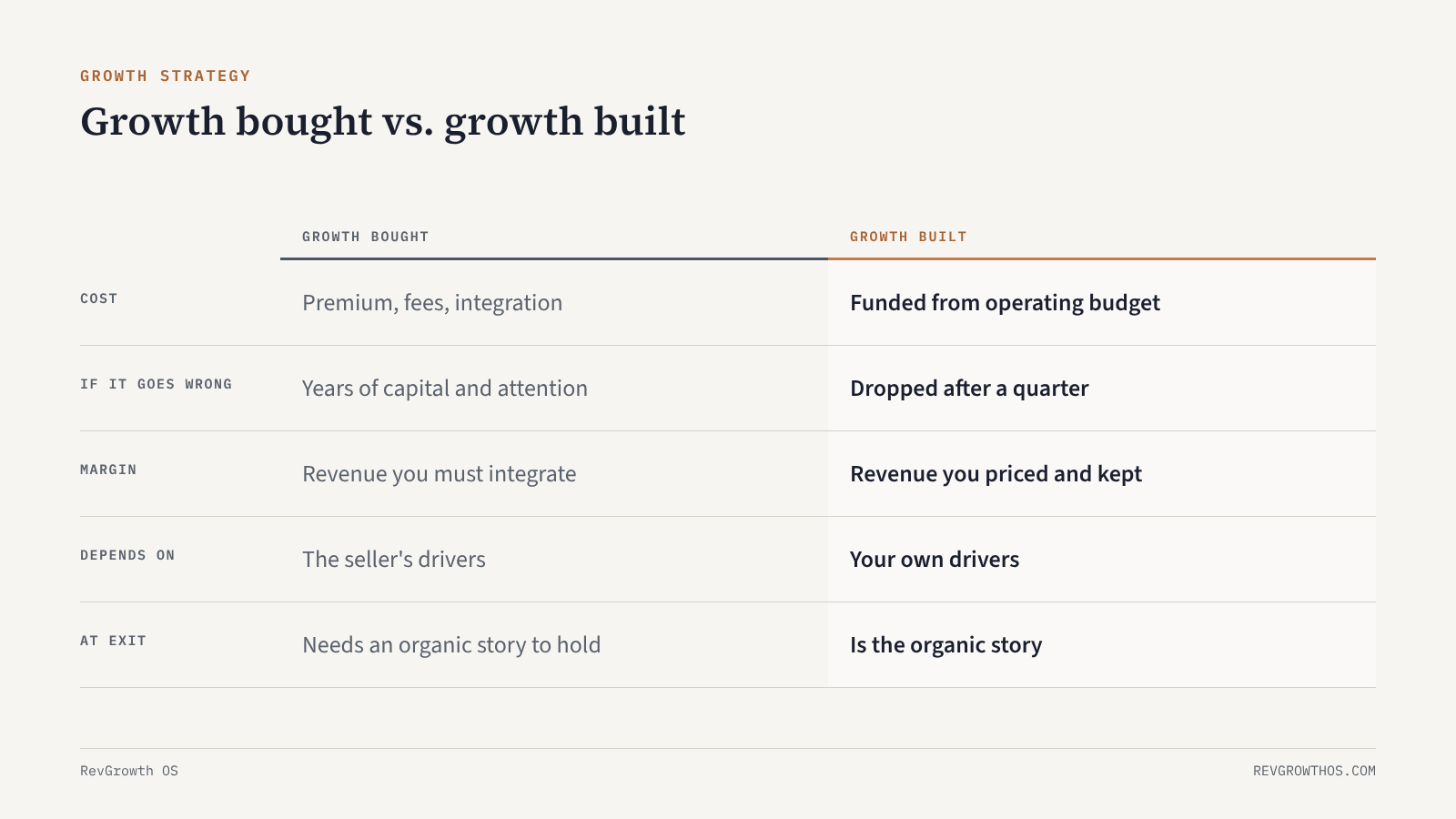
An acquisition brings not only revenue but also its underlying drivers: retention, pricing habits, customer concentration, and dependence on previous leadership. Weak drivers do not improve simply because ownership changes.
Integration can weaken these drivers further. Key salespeople may leave after the earnout. Customers loyal to the previous owner may look elsewhere. Conflicting pricing structures often lead to discounting. After a year, acquired revenue often falls below projections.
Due diligence identifies some risks but rarely all. Critical issues, such as a founder's personal relationships with key accounts, frequently remain hidden from standard reports.
Organic revenue is earned through your own system, at your prices, from customers who selected your business. When drivers are strong, this revenue is more stable.
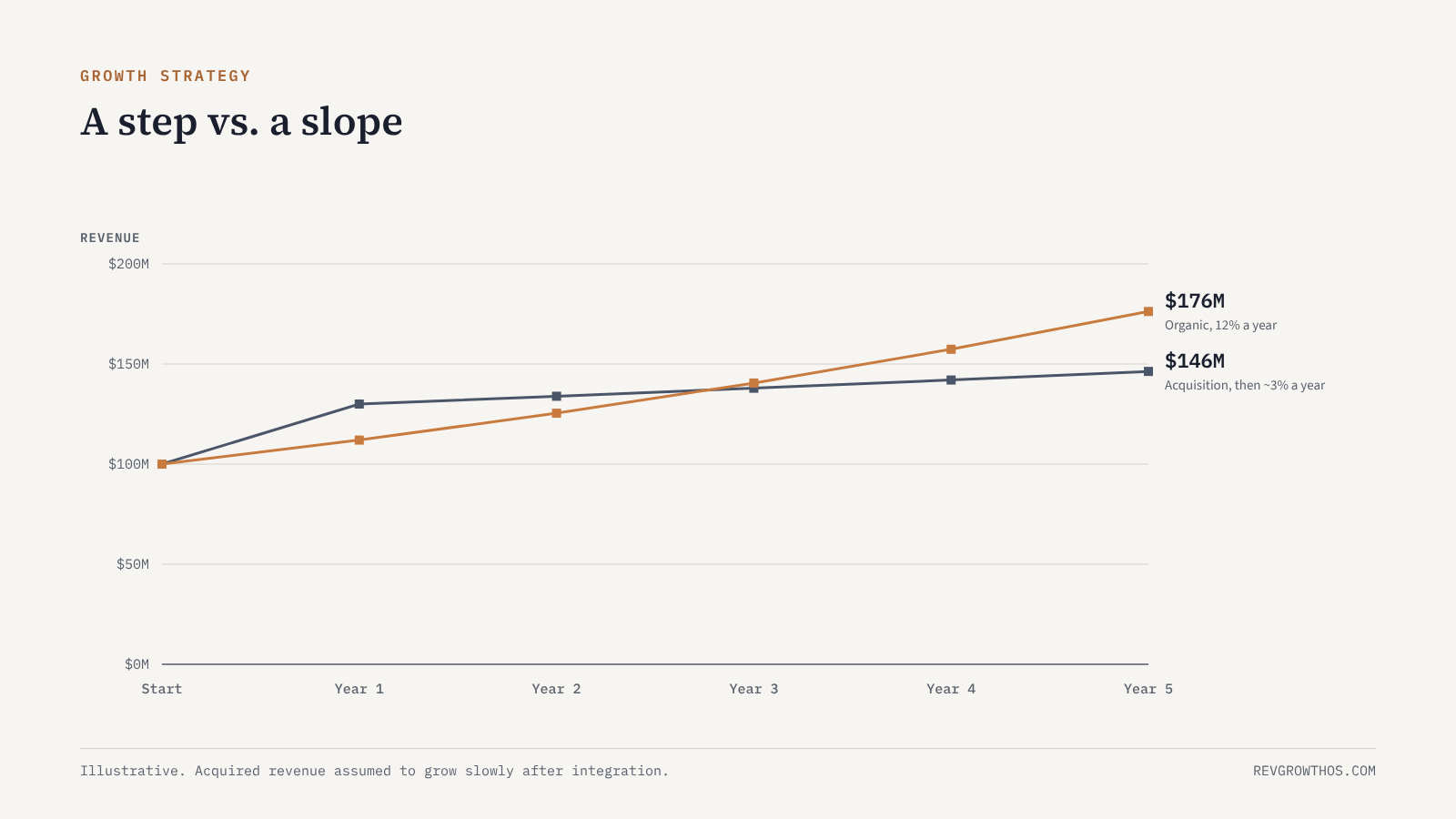
Organic growth compounds. Bought growth steps up.
Acquisitions create a one-time increase in revenue. Organic growth creates a continuous upward trajectory.
This difference becomes clear over time. Companies that improve revenue drivers each year—through retention, pricing, and account depth—extract more value from the same customer base. Gains compound because Acquisition, Retention, and Transaction multiply.
Benchmark data calls attention to the gap. Among over 200 mid-market companies, top quartile growth is 38.6% per year, while the bottom quartile is 5.7%. Most of this difference results from how growth is built internally, not from acquisition volume.
The economics usually favor organic.
Organic growth offers practical advantages for cash management.
Organic growth is less expensive per dollar of revenue. There are no premiums for acquired customers, no banker fees, and no integration costs. It is funded from the operating budget, often in small increments, and spending can be adjusted quickly.
Organic growth carries lower risk. A failed acquisition can tie up management and capital for years. An unsuccessful organic initiative can be discontinued quickly.
Organic revenue typically delivers better margins. Revenue earned through pricing discipline, retention, and account expansion usually costs less to serve than acquired revenue that requires integration.
Multiple arbitrage is a real factor. Acquiring smaller companies at lower multiples and combining them into a higher-valued platform is central to many private equity strategies. However, this advantage depends on the buyer's confidence in continued growth, which relies on a strong organic engine.
Buy on top of a strong engine, no instead of one.
Effective acquirers use M&A as an amplifier. They first build a strong organic growth system with measured drivers, pricing discipline, account management, and a structured review process. They then integrate acquired customers into this system.
When this approach is effective, acquired revenue grows faster post-acquisition. Customers receive improved coverage. Pricing becomes more consistent. Service agreements are added to previously standalone equipment sales.
If the sequence is reversed, acquisitions add unresolved problems to existing ones. Revenue may increase, but value frequently lags.
A strong organic engine also increases credibility as an acquirer. Sellers and customers recognize operational strength, and lenders reflect this in their terms.
Consider the sequence your company is following.
Decide what comes next with two questions.
Before the next deal, evaluate two factors. First, are your revenue drivers strong enough to retain and expand an acquired customer base? Second, can you identify, with data, which drivers you would apply to the acquired business immediately?
If either answer is negative, invest internally first. Strengthen the weakest driver before pursuing acquisitions. This approach increases the value of future deals.
The free RevGrowth Simulation benchmarks your growth drivers against over 200 mid-market companies. It provides a fast assessment of whether your engine can absorb an acquisition or if organic growth remains the better option.

Russ Holder
Founder & CEO, RevGrowth OS. 30 years in growth strategy, five published books.
You've read what the data says. Now run your numbers through it.
A one-hour working session with your own data. We run it through the RevGrowth Benchmark live, so you see the method applied to your company before you spend a dollar.
One hour. Your data. Zero cost.