
Blog / Growth Strategy
Hiring a CRO Won't Fix a System Problem
By Russ Holder
3-minute read

When growth stalls in a mid-market company, the most common response I see is a hire. A chief revenue officer, a VP of sales, a new head of business development. Someone with a strong résumé and a track record somewhere else.
Sometimes it works. Often it doesn't, and the reason is usually the same. The company had a system problem and hired a person to fix it.
A good revenue leader can run a growth system. Few can build one from scratch while also hitting this quarter's number. Asking them to do both is how a lot of expensive hires end in a quiet departure eighteen months later.
What a system problem looks like.
A system problem is one that persists no matter who's in the seat.
Forecasts miss by 15% in both directions, year after year. Price increases get announced and only partly collected. Customers drift away and nobody notices for months. The founder still approves every large quote. Each of these has survived at least one previous sales leader, which is a strong hint that the person wasn't the cause.
People problems look different. A specific leader can't build a team, or doesn't fit the culture, or lacks the industry knowledge. Replace them and things improve quickly.
How can you tell which you have? Look at how long the problem has existed. If it predates the current leader, it's probably structural.
Another test: ask what happens when your best salesperson takes two weeks off. If their accounts stall, quotes sit and nobody else knows the pricing history, the company is relying on people to do what a system should. That's not a criticism of the salesperson. It's a description of the structure around them.
What usually happens after the hire.
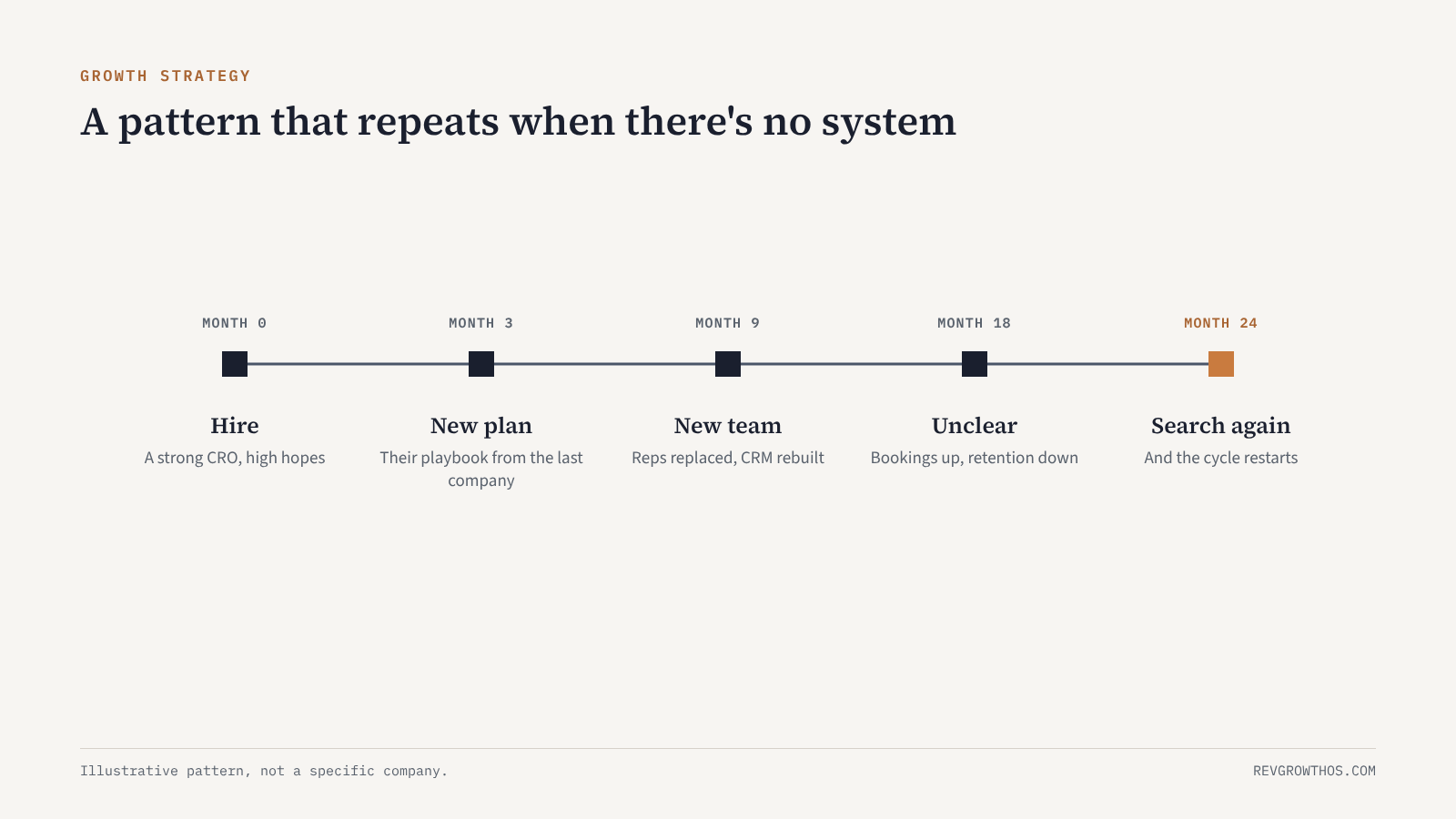
The pattern is familiar enough that I can sketch it in advance.
Month zero: a strong CRO joins with high expectations. Month three: they present a plan, usually adapted from what worked at their last company. Month nine: some of the sales team has been replaced, the CRM has been reconfigured and the comp plan has changed. Month eighteen: bookings are up a bit, but margins are down, retention has slipped and the forecast still misses. Month twenty-four: the CEO starts another search.
The CRO wasn't incompetent. They did what the role usually asks: push the top of the funnel and hit the number. The trouble was that nobody defined the system they were meant to run. So they built their own version of it, and the next leader will build another.
The hidden cost is larger than the salary. Each new leader resets the CRM, the comp plan and often the team. Customers see new faces. Institutional knowledge gets thinner with each turn. After two or three cycles, the company has spent years and a meaningful amount of money and is no closer to a system than when it started.
Why a person can't be the system.
There are three reasons a hire alone rarely fixes a structural growth problem.
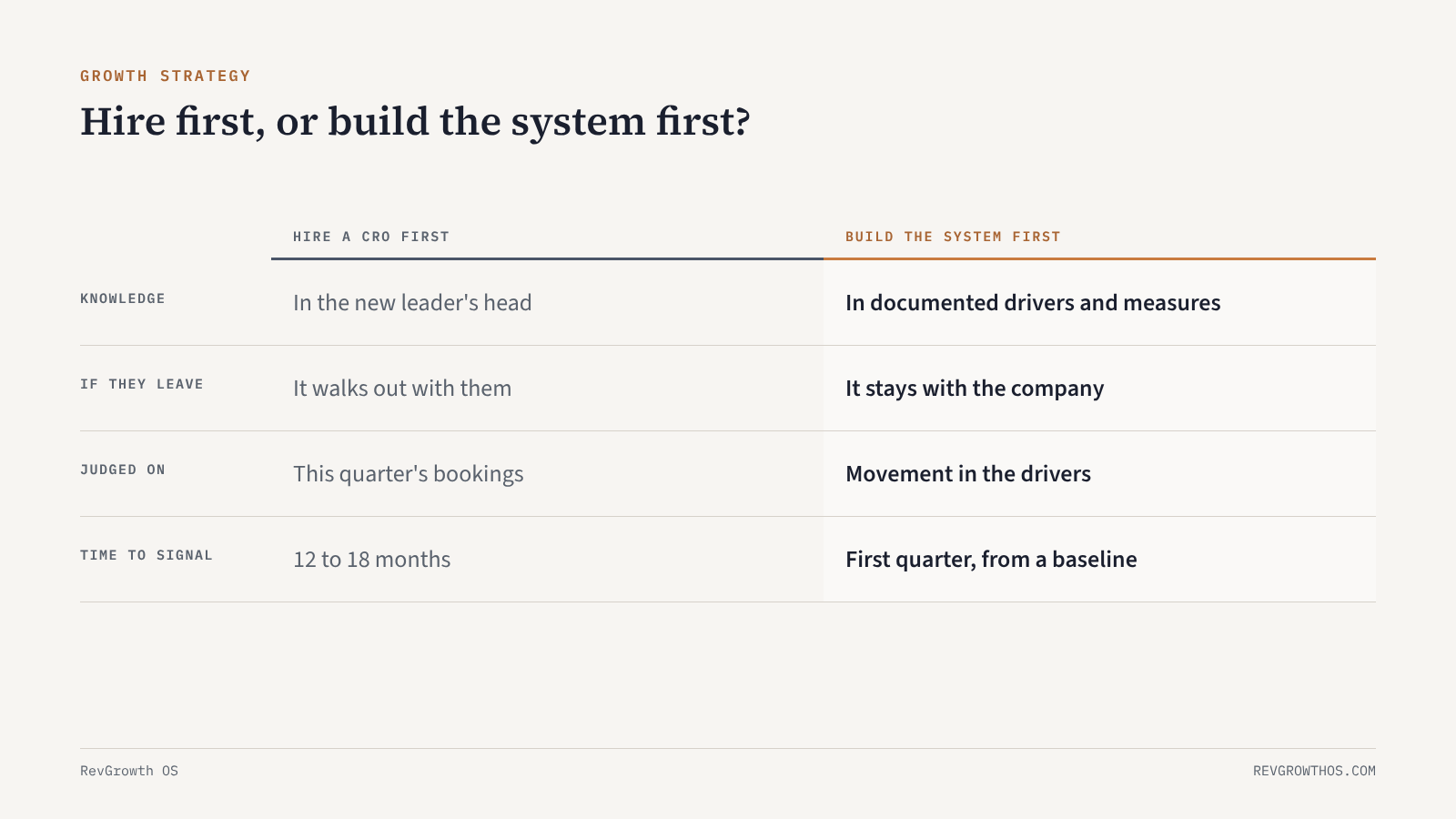
First, knowledge leaves with people. If pricing logic, key account strategy and forecasting method live in the CRO's head, they walk out the door when the CRO does. The company is back where it started, minus two years.
Second, a single leader sees through their own function. A sales leader will usually diagnose a sales problem. If the real constraint is retention or pricing, their natural fixes won't reach it.
Third, there's no baseline to judge them against. Without measured positions on the drivers before they arrive, nobody can tell whether the CRO improved anything or simply rode a market. That's unfair to them and expensive for you.
Build the system first, then hire into it.
The order matters. Define the growth system, then hire someone to run it.
That starts with measuring the nine revenue drivers: lead generation, conversion and referrals; attrition, buying lifetime and reactivation; order size, frequency and price. Score each against companies like yours, so you know which ones are weak.
Then write down how the important things work. How pricing decisions get made and who can approve exceptions. How key accounts are managed. How the forecast is built. Assign an owner to each driver, with a target and a review date.
Now the hire has a job description that means something. You're not asking them to invent a growth system. You're asking them to run one and improve it, with clear measures from day one.
What to look for in the hire.
When the system exists, the profile of the right leader changes.
You want someone who's comfortable being measured on driver movement rather than just bookings. Someone who'll spend time on retention and pricing, not only on new logos. Someone who documents what they do, so it outlasts them.
Ask candidates how they'd measure their own success in the first six months. If the only answer is pipeline and bookings, keep looking.
Be honest with candidates about what exists. A strong leader would rather join a company that knows its weak drivers than one that hopes they'll find out. The candidates who are excited by a measured starting point are usually the ones who'll build on it rather than replace it.
The cheaper first step.
A senior revenue hire costs a few hundred thousand dollars a year, plus recruiting fees and a long ramp. Measuring the system first costs a fraction of that and makes the hire far more likely to work.
The free RevGrowth Simulation scores your revenue drivers against 200-plus mid-market companies in about an hour. It's worth doing before you start the search, so you know what problem you're hiring to solve.

Russ Holder
Founder & CEO, RevGrowth OS. 30 years in growth strategy, five published books.
You've read what the data says. Now run your numbers through it.
A one-hour working session with your own data. We run it through the RevGrowth Benchmark live, so you see the method applied to your company before you spend a dollar.
One hour. Your data. Zero cost.