
Blog / Growth Strategy
Four Things Every Growing Company Has
By Russ Holder
5-minute read

After 30 years of working with growing companies, I've stopped being surprised by what they sell or where they sell it. Fast growers show up in dull industries. Slow growers show up in hot ones.
What I do notice is a pattern in how they're built. Companies that keep growing, year after year, tend to have the same four things in place. Companies that stall tend to be missing at least one, and usually don't know which.
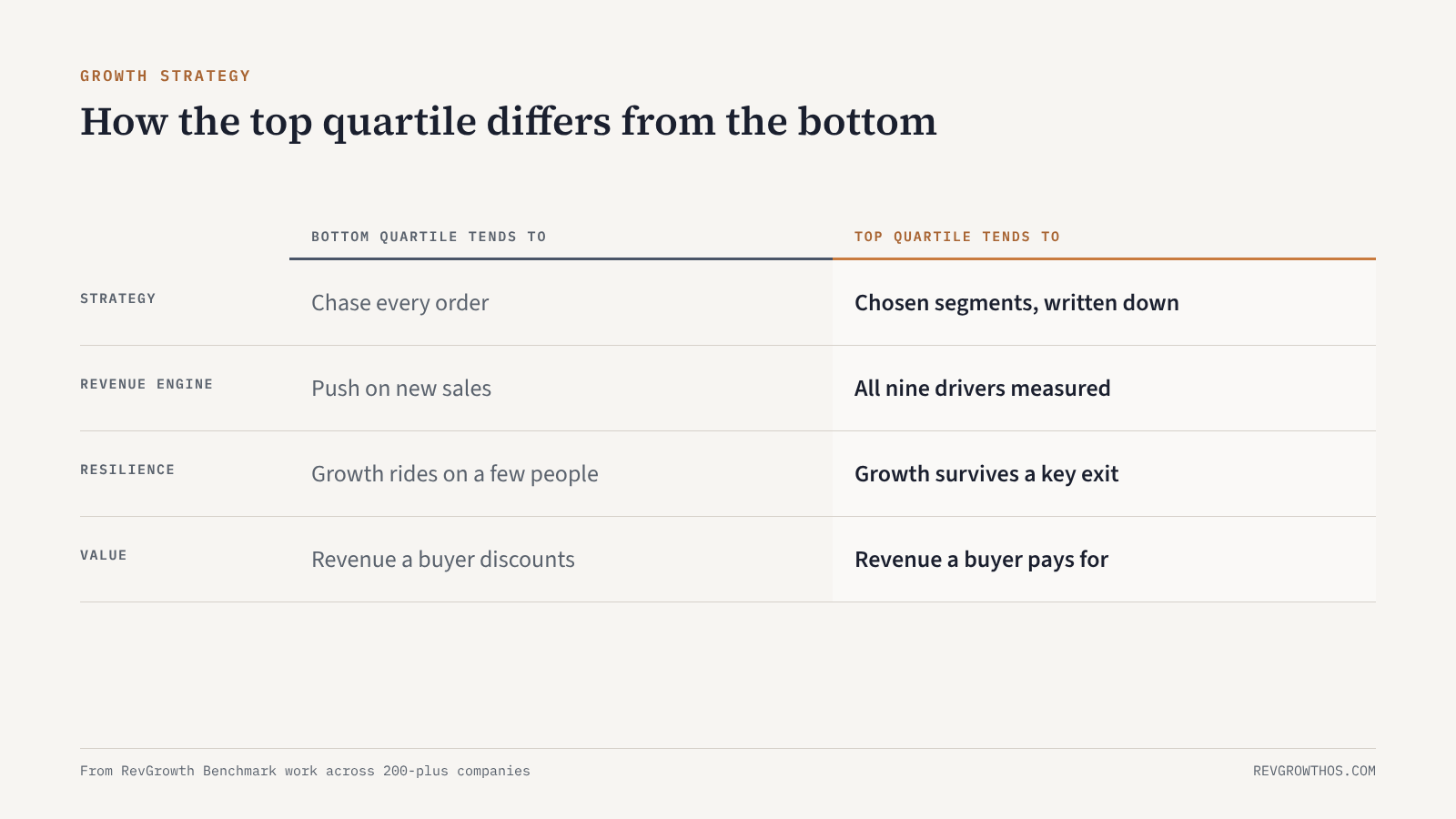
Our benchmark of 200-plus mid-market companies bears this out. The top quartile grows 38.6% a year. The bottom quartile grows 5.7%. The gap between them maps closely to these four things.
A clear place to win.
Growing companies know where they're going to compete, and they've written it down.
That means chosen markets, chosen customer types and a clear reason customers pick them over the alternatives. In our framework, this is the Strategic Foundation.
It's the least glamorous of the four, and the one most often skipped. A lot of companies run on a general sense of "we serve industrial customers in the Southeast." That's a description, not a choice. The companies that grow consistently can tell you which industrial customers, why those, and what they've decided not to chase.
Picture a fabricator that serves five industries. Look at margin by segment and you'll often find two of the five produce almost all the profit. Nobody chose the other three. They arrived one customer at a time and stayed because no one decided otherwise.
The payoff is focus. Every salesperson, every marketing dollar and every engineering hour points in the same direction. That alone beats a larger competitor spreading effort across ten markets.
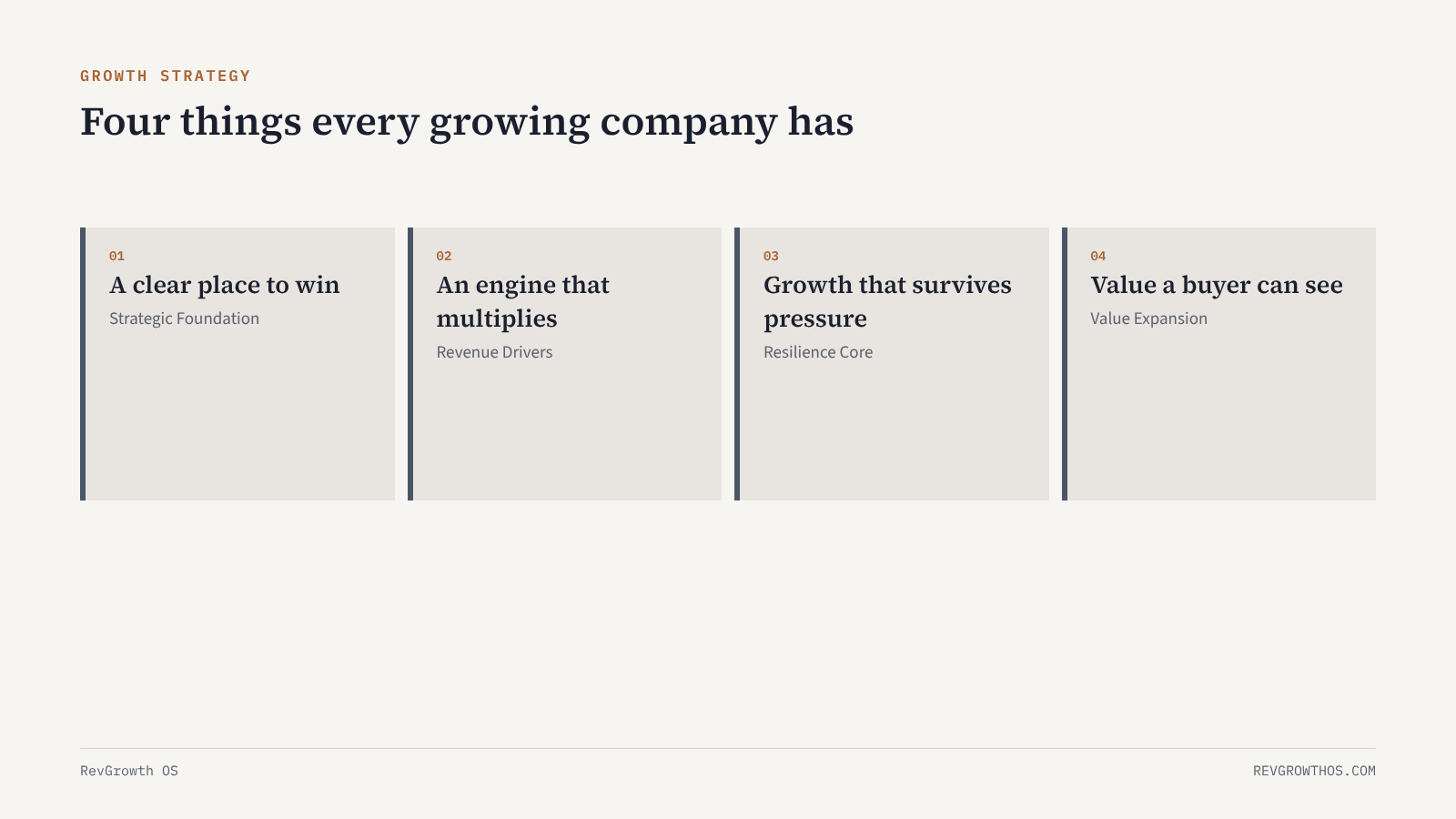
An engine that multiples.
The second thing is a revenue engine that's measured as a whole.
Revenue comes from three groups of drivers working together. Acquisition wins new customers. Retention keeps them. Transaction sets how much and how often each one buys, and at what price. Inside those three sit nine revenue drivers, and they multiply rather than add.
That's why one weak driver costs so much. If acquisition and transaction run at 90% of what top-quartile companies achieve, but retention runs at 50%, the engine runs well under half its potential. New sales keep the top line moving, so the problem hides.
Growing companies watch all nine drivers, not just bookings. They know their revenue retention by customer, their win rate by segment and their price realization against list. When one slips, they see it within a quarter, not a year.
They also improve the drivers in small steps. A 1% gain each quarter on a few drivers sounds modest. Because the drivers multiply, those gains compound into growth rates that look dramatic from the outside, without any single dramatic move.
Growth that survives pressure.
The third thing is resilience. Growth in these companies doesn't depend on one customer, one salesperson or one owner.
We call this the Resilience Core. It covers the parts of the business that decide whether growth holds up under stress: customer concentration, key-person dependence, pricing discipline when a buyer pushes, and the ability to keep selling when a top rep leaves.
You can grow fast without resilience for a while. A company with one large customer can post three great years in a row. Then that customer changes suppliers, and five years of growth disappears in a quarter. Has anyone in your leadership team put a number on what that would cost you?
Companies that keep growing build the system so no single loss can stop it. They spread their base, document how big accounts are managed and make sure pricing decisions don't live in one person's head.
Value a buyer can see.
The fourth thing is easy to overlook while you're busy growing. Strong companies turn their growth into value someone else will pay for.
That's Value Expansion. It's the difference between revenue and enterprise value. Two companies can each post $50 million in revenue and be worth sharply different amounts, depending on how much of that revenue a buyer believes will still be there in five years.
Growing companies make their growth verifiable. Forecasts land. Revenue is spread across many customers. A good share of it repeats under contract or by habit. The owner isn't the only person who can close a large deal. None of this is about selling the company tomorrow. It's about building something that's worth more every year, whether you sell or not.
Most companies have two or three.
When I look at companies in the middle of our benchmark, they rarely lack all four. They usually have two or three in decent shape and one that's quietly holding everything back.
A common profile: a strong engine and real resilience, but no clear place to win, so growth is spread thin. Another: a clear strategy and a good engine, but most of the growth runs through the founder, so the value a buyer sees is far below the revenue.
The fix starts with knowing which one is missing. That's harder than it sounds from the inside, because each leader sees the company through their own function.
Where to start.
Pick the one of the four that would hurt most if it failed this year. For most mid-market companies, it's either resilience or the engine. Put a measure on it, give it an owner and review it monthly.
If you'd rather see it against real numbers, the free RevGrowth Simulation scores your revenue drivers against the benchmark in about an hour. It shows where your engine is strongest, where it's weakest, and what closing the gap could be worth.

Russ Holder
Founder & CEO, RevGrowth OS. 30 years in growth strategy, five published books.
You've read what the data says. Now run your numbers through it.
A one-hour working session with your own data. We run it through the RevGrowth Benchmark live, so you see the method applied to your company before you spend a dollar.
One hour. Your data. Zero cost.