
Blog / Growth Strategy
Stop running your $100M ambition on a $10M operating system.
By Russ Holder
3-minute read
Here's a situation I run into all the time. A company is doing $40 million. The board has signed off on a plan to reach $100 million in five years. The plan is a spreadsheet.
Revenue increases 20% a year. Headcount rises. Add a few reps, expand the trade show budget, consider an acquisition in year three.
What the plan doesn't touch is how the company actually grows. The founder still approves every quote over $250,000. Pricing still comes off the cost-plus sheet someone built in 2011. The forecast still lives in the sales VP's head.
The ambition got bigger. The operating system didn't.
The system that got you here has a ceiling.
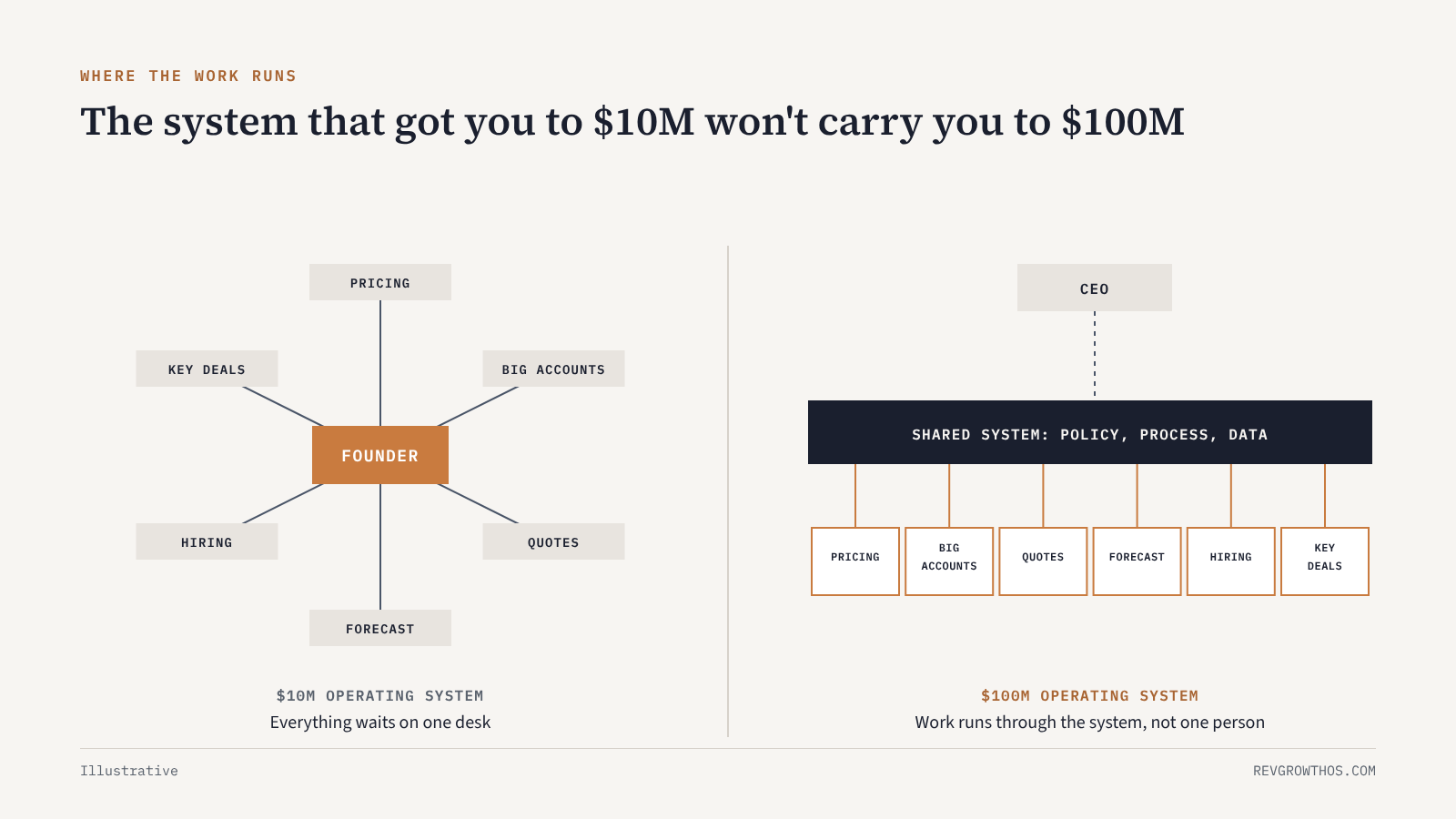
Every company's operating system fits the size it was when the system took shape. At $10 million, the system is usually one person. The founder knows every customer, sets every price, and can feel a bad quarter coming three months out. It works because one person can hold the whole business in their head.
Strain typically appears between $25 million and $60 million in revenue, depending on the business. The transition is gradual. Quote approvals slow as they accumulate on one desk. Discounts increase because sales representatives lack clarity on deal priorities. Customers accustomed to direct founder engagement are reassigned to account managers and may start looking elsewhere.
Nobody calls this an operating system problem. They call it a sales problem, a people problem, or a market problem. So they hire. And the new VP of Sales spends eighteen months fighting a system that was never built to run without the founder.
How to spot a $10M operating system.
You can usually spot one in a single meeting.
- Growth decisions run through one or two people.
- Pricing gets set deal by deal, and nobody can say what margin the last fifty orders earned.
- The forecast is a number someone believes, rather than one someone can defend.
- Major customers are managed through personal relationships without formal account plans.
- Success is measured by bookings, the only metric the system tracks.
These are not character flaws. They are typical of companies that have grown rapidly through talent and effort. However, buyers, lenders, and investors view them as risks.
Why more effort won't close the distance.
When the system is the constraint, increasing effort can worsen outcomes. Adding sales representatives to a founder-controlled process only increases bottlenecks. Increasing marketing spend without tracking retention fails to tackle underlying issues.
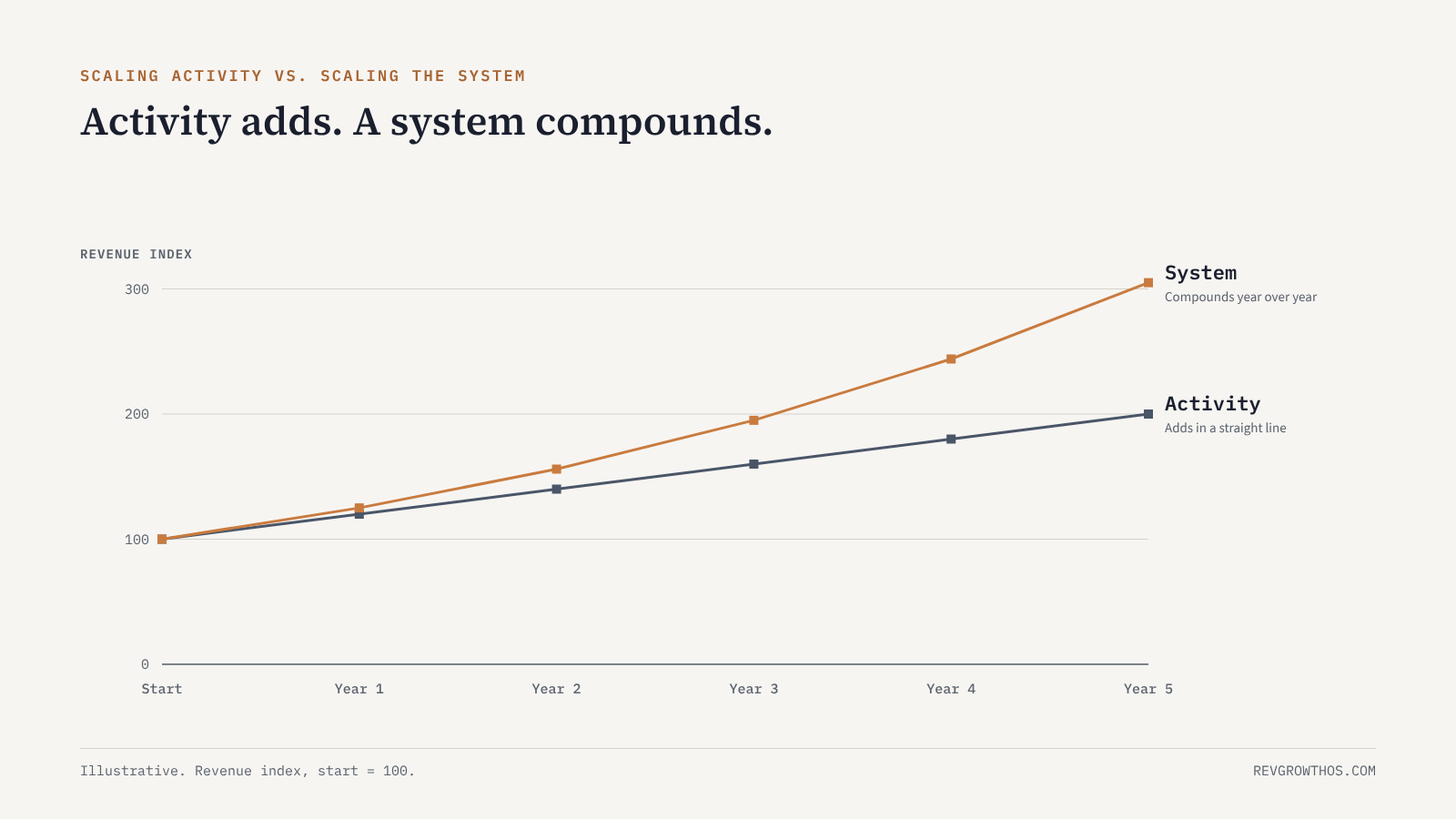
That's the difference between scaling activity and scaling the system. Activity scales in a straight line at best. You spend 20% more and hope for 20% more revenue. A system compounds, because each improvement makes the next dollar of revenue easier to win and worth more once you have it.
Benchmark data supports this conclusion. Among more than 200 mid-market companies, the top quartile achieves 38.6% annual growth, while the bottom quartile grows at 5.7%. The fastest-growing companies are not working significantly harder; they have built systems that support greater growth.
What a $100M operating system needs.
A $100 million operating system does not require the CEO to review every deal. It requires key processes to function independently.
The company has decided which customers it wants and which it will walk away from, and the sales team knows the difference. Pricing follows a written policy tied to value, with discount authority spelled out and tracked. Retention gets measured by account, and somebody owns it. The forecast is held to a standard, and misses get explained. The way your best people win business is written down well enough that a new hire can do it in six months instead of three years.
At RevGrowth OS we build that in four layers: a Strategic Foundation, a Revenue Engine, a Resilience Core, and Value Expansion. You don't have to use our names for it. You do have to build all four, because a company that only fixes sales ends up with a faster engine bolted to the same weak frame.
Building a strong operating system costs less than inaction. Running a $100 million plan on a $10 million system leads to stalled growth and lower valuation at exit.
Start by naming the constraint.
Before building the next growth plan, identify the current constraint. Find the part of the system that would fail first if revenue doubled.
Most CEOs can identify the constraint quickly. It may be the founder's schedule, the pricing process, the forecast, or customer concentration. Document this constraint at the beginning of the plan, before setting revenue targets.
If you'd like an outside view, the free RevGrowth Simulation measures your current system against 200-plus companies and shows which constraint would pay off fastest to fix.

Russ Holder
Founder & CEO, RevGrowth OS. 30 years in growth strategy, five published books.
More from the Revenue-to-Value Gap blog.
03
The RevGrowth Architecture: the 4-7-25 structure, explained
You've read what the data says. Now run your numbers through it.
A one-hour working session with your own data. We run it through the RevGrowth Benchmark live, so you see the method applied to your company before you spend a dollar.
One hour. Your data. Zero cost.