
Blog / Growth Strategy
The Strategic Foundation: Where Growth Starts
By Russ Holder
3-minute read

Most growth problems I'm asked to fix show up in sales. The pipeline is thin, conversion is soft, or the team keeps chasing work that doesn't pay. Dig a little and a surprising number of them start somewhere else.
They start with a strategy that was never written down. Or one that was written down, approved and then ignored the first time a big order came in from outside it.
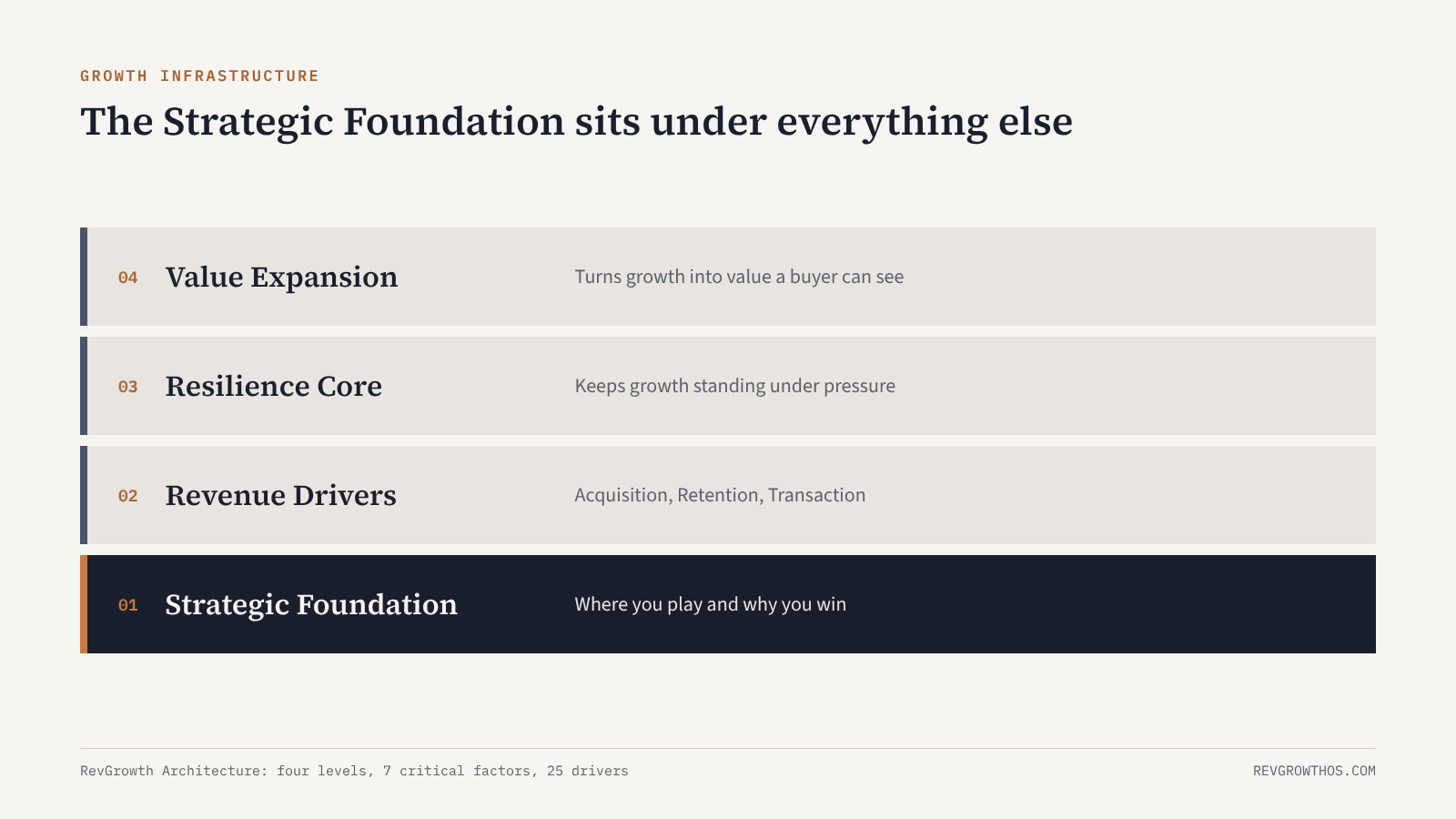
That's what the Strategic Foundation is for. It's the first of the four levels in the RevGrowth Architecture, and everything above it depends on it.
The bottom layer of the growth system.
The RevGrowth Architecture has four levels. The Strategic Foundation sets how you'll win and how winning turns into profit. The Revenue Drivers level runs the engine: Acquisition, Retention and Transaction. The Resilience Core keeps growth standing when a key person leaves or a large customer cuts back. Value Expansion turns all of it into value a buyer can see.
The Strategic Foundation sits at the bottom for a reason. If it's weak, every level above it works harder for less. Sales chases every opportunity because nobody said which ones to skip. Pricing bends to whatever the customer asks, because there's no agreed reason customers should pay more. Marketing spreads a small budget across too many audiences.
Strong companies at the top of our benchmark tend to have one thing in common at this level. They've made choices, and they've made them on purpose.
A weak foundation also makes the other levels harder to read. When growth stalls, leaders look at the engine first: leads, conversion, pricing. Those numbers may well be soft. But if the company is chasing three unrelated markets at once, no amount of sales training will fix it. The engine is being asked to run in too many directions.
Growth strategy has two jobs.
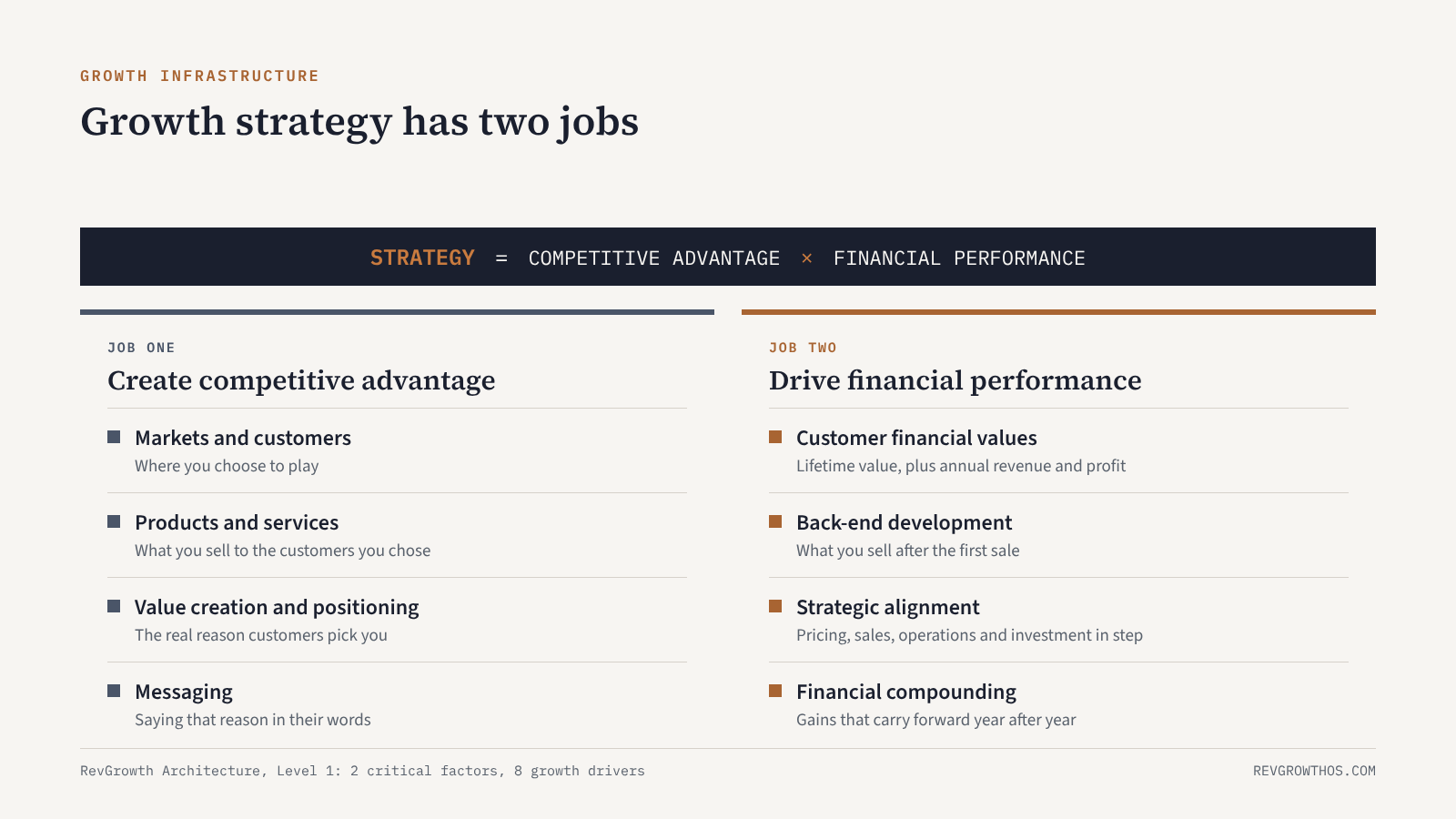
Strip away the off-site retreats and the binders, and growth strategy has two jobs. It has to create competitive advantage, and it has to drive financial performance. That's what your Strategic Foundation needs to do.
In the RevGrowth Architecture, it's written as an equation: Strategy = Competitive Advantage × Financial Performance.
The multiplication matters. A company with a real edge and weak economics wins plenty of business and keeps too little of it. A company with good economics and no edge looks fine until a competitor decides to match its price. You need both, and weakness on either side drags down the whole thing.
Job one: create competitive advantage.
Competitive advantage is how you win where you play. It rests on four drivers.
Markets and customers. Which industries, customer sizes, regions and applications you choose to serve. Most mid-market companies I meet serve whoever calls. A precision machining shop might do aerospace, medical, oil and gas, and agricultural work at once, because each customer arrived through a different relationship. That's fine at $8 million. At $40 million, it means four sets of quality requirements, four sales conversations and no real depth in any of them.
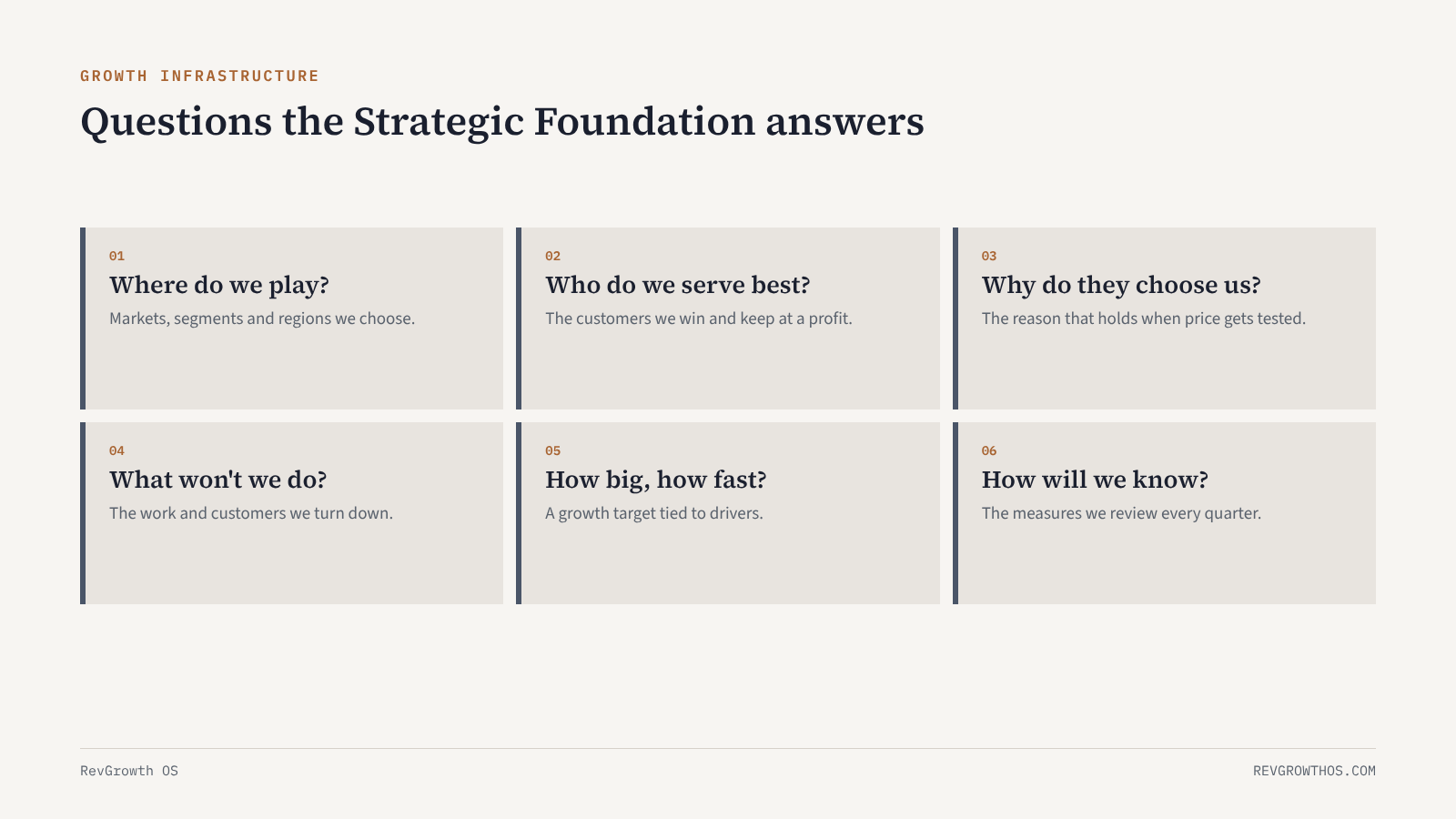
Choosing doesn't mean firing customers tomorrow. It means deciding where the next salesperson, the next trade show and the next capital investment go. It also means writing down the work you'll turn away, so sales can walk away from a bad fit without asking the CEO every time.
Products and services. What you sell, and how well it fits the customers you've chosen. Every line built for someone outside the target pulls engineering time and scheduling capacity away from the work that matters. How many of last year's headaches came from jobs you never should have quoted?
Value creation and positioning. The real reason customers pick you over the alternatives. Not the brochure version. Ask your five best customers and you'll usually hear something specific: you answer the phone, you ship in four days when others take three weeks, you'll engineer a part nobody else will touch. That reason tells you what to protect and what you can charge for. A company that knows it can hold price when a buyer pushes. A company that doesn't will discount, because it has no other argument.
Messaging. How clearly you say that reason, in the words customers use. Here's the test. If a competitor could say your main sentence with a straight face, it isn't a reason. It's a category description, and you'll need to keep looking.
Job two: drive financial performance.
Winning customers is half the work. The other half is making sure winning pays, and keeps paying. Four drivers handle that.
Customer financial values. What a customer is worth: lifetime value, plus the annual value each one brings in revenue and in profit. Revenue alone flatters. A large account can turn out to be one of your least profitable once freight, expediting and engineering hours are counted. Know both numbers for your top accounts and your main segments, and the markets you chose in job one will start to look either smarter or riskier.
Back-end development. What you sell after the first sale: spare parts, service agreements, upgrades, consumables, training. The first order often does little more than cover the cost of winning the customer. The margin tends to live in the back end, and many companies never build one on purpose.
Strategic alignment. Whether pricing, sales, operations and investment all point at the same strategy. A target like "grow 20% next year" is a wish unless you can say where the 20% comes from: how many new customers in the chosen segments, at what retention rate and what price realization. Once the target breaks down that way, people can act on it, and the leadership team can see early whether it's working.
Financial compounding. How gains carry forward. A point of margin kept this year is still there next year, on a larger revenue base. A customer kept one more year buys again at full value. Small improvements that stick compound over time. One-time wins don't.
How to tell if your strategic foundation is weak.
There are a few quick tests. Ask three members of your leadership team, separately, to name your target markets and the main reason customers choose you. If the answers don't match, the competitive advantage side of your foundation isn't doing its job.
Look at last year's new customers. What share came from your chosen segments? If it's under half, your strategy is describing hopes rather than directing effort.
Then test the financial side. Ask for the annual profit, not just revenue, from each of your top 20 customers, and for the share of revenue that comes from follow-on sales. If those numbers take a week to assemble, nobody is managing them.
And check how often big decisions get made by exception. If the strategy gets set aside whenever a large order arrives, the company is running on opportunity rather than choice.
None of these are hard to fix once you see them. The harder part is seeing them clearly. The free RevGrowth Simulation scores your revenue drivers against 200-plus companies in about an hour, and a weak foundation usually shows up there first, as gaps the drivers can't explain on their own.

Russ Holder
Founder & CEO, RevGrowth OS. 30 years in growth strategy, five published books.
More from the Revenue-to-Value Gap blog.
You've read what the data says. Now run your numbers through it.
A one-hour working session with your own data. We run it through the RevGrowth Benchmark live, so you see the method applied to your company before you spend a dollar.
One hour. Your data. Zero cost.