
Blog / Growth Risk
The Hidden Cost of not Benchmarking Your Growth Strategy
By Russ Holder
3-minute read
Every CFO I know can tell you what the company spends on growth. Sales salaries, marketing programs, trade shows, a new CRM, maybe a consultant or two. It's in the budget, line by line.
Few can tell you what the company loses by not knowing whether that spending is aimed at the right thing. That cost doesn't appear in any budget. It shows up years later as growth that should have happened and didn't.
I'd argue it's the largest line item most mid-market companies never see.
The gap compounds quietly.
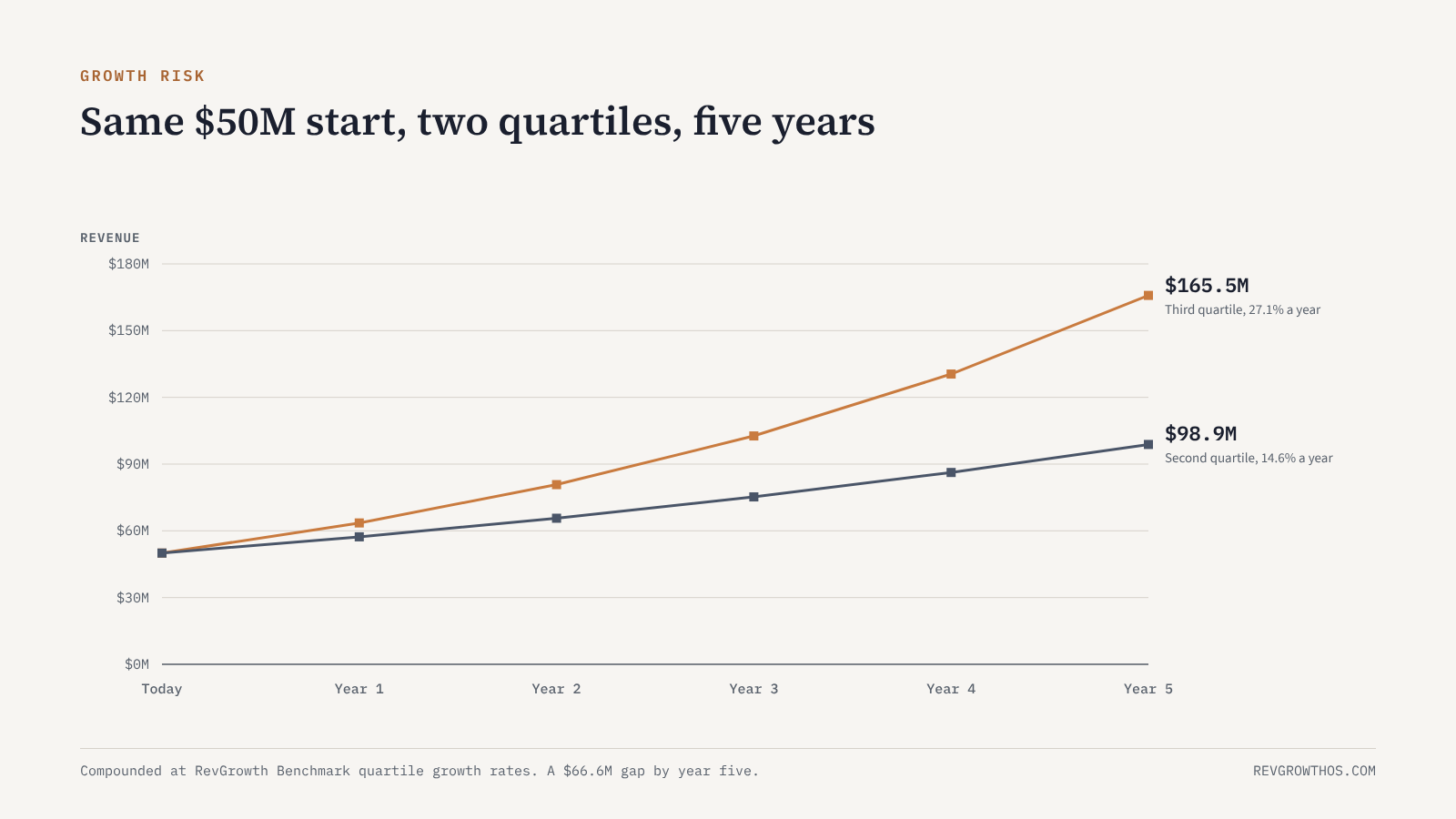
Start with the benchmark numbers. In our dataset of 200-plus mid-market companies, the second quartile grows 14.6% a year. The third quartile grows 27.1%.
Take a $50 million company in each. After five years, the second-quartile company is at about $99 million. The third-quartile company is at about $165 million. Same starting point, same five years, a $66 million difference in revenue.
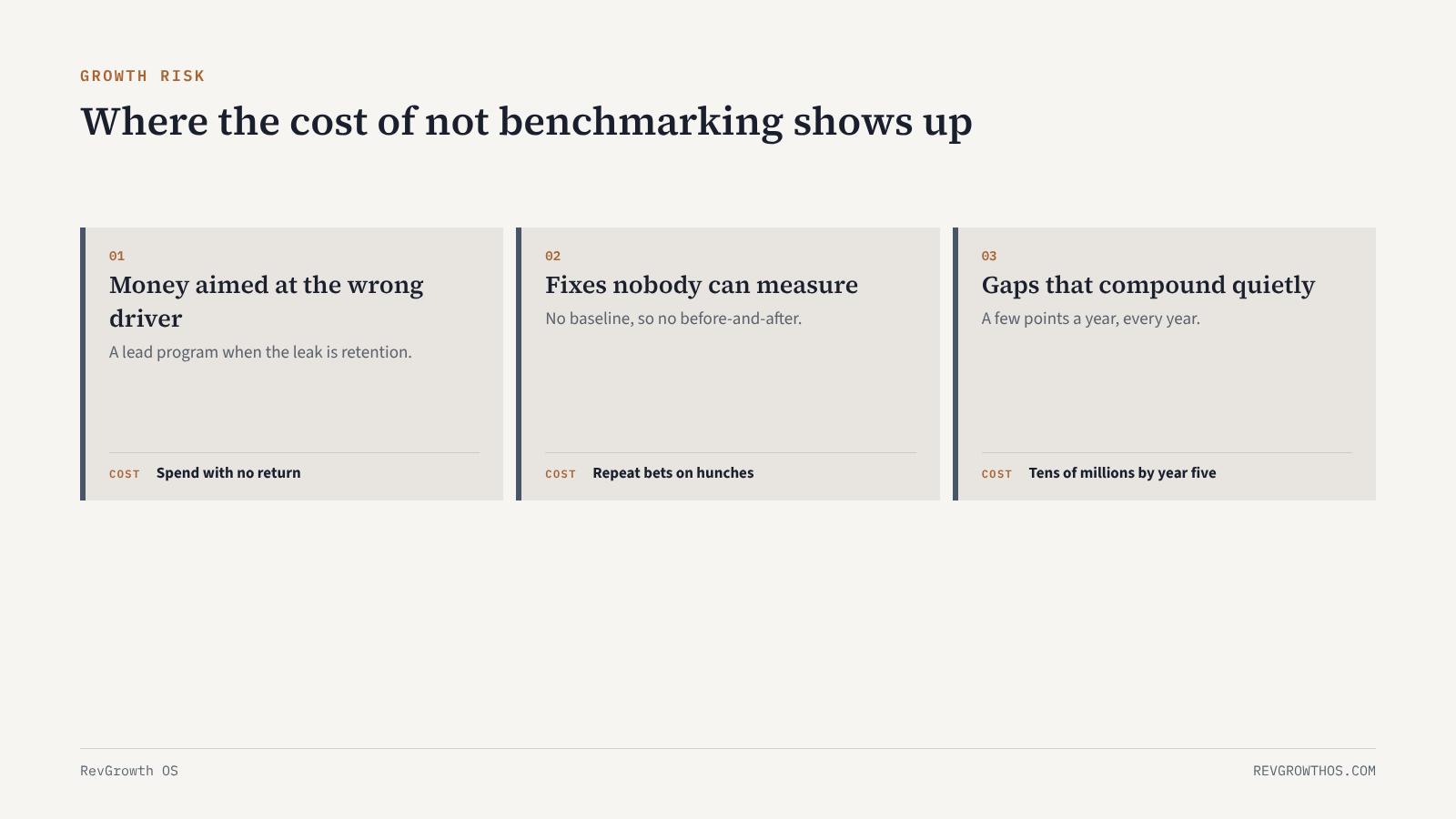
That's the scale of what's at stake when a company sits in the wrong quartile and doesn't know it. The gap doesn't arrive as a crisis. It arrives as a few points of growth a year, every year, that look like normal performance from the inside.
Most leadership teams compare this year with last year. They feel good about 14%. Without a benchmark, nobody asks whether companies like theirs are doing 27%.
The same thing happens inside the drivers. A company might improve its win rate from 19% to 21% and celebrate. If similar companies convert at 30%, the improvement is real but the gap is still large. Internal trends tell you about direction. Only a comparison tells you about distance.
Money aimed at the wrong driver.
The most direct cost is spending on the wrong problem.
Revenue comes from nine drivers in three groups: Acquisition, Retention and Transaction. When growth slows, most companies push on acquisition, because it's the most visible. Hire another salesperson. Increase the lead budget. Exhibit at one more trade show.
If the real constraint is retention, that money pours water into a leaky bucket faster. If it's pricing, more volume makes the margin problem bigger. A $200,000 sales hire aimed at the wrong driver doesn't just fail to help. It costs $200,000 a year, plus the twelve to eighteen months it takes to learn that it didn't work.
A benchmark ranks the gaps before you spend. It tells you whether your weakest driver is lead generation, conversion, attrition or price realization, measured against companies like yours. That turns the budget conversation from "what should we try" into "which gap is worth the most to close."
Fixes nobody can measure.
The second cost is subtler. Without a baseline, you can't tell what worked.
Most companies launch several growth initiatives a year. A new pricing policy. A customer review program. A partner channel. Twelve months later, revenue is up 9%. Which initiative did that? Usually nobody knows, so the company keeps all of them, or drops the wrong one.
That's a capital allocation problem, and it's one finance teams would never accept anywhere else. You wouldn't approve a plant investment without a way to measure its return. Growth spending gets approved that way every year.
A scored baseline fixes it. If you know your price realization was 93% before the new policy and 96% after, you know what the policy was worth. Was last year's biggest growth initiative worth what it cost? With a baseline, you can answer that.
Gaps that compound in value, too.
Revenue isn't the only thing that compounds. Valuation does as well.
A company with high customer concentration, inconsistent forecasts and growth that depends on the founder gets a lower multiple at sale. Those are measurable conditions. A benchmark would flag every one of them years before a buyer does.
Left unmeasured, they sit in the business until diligence. Then they show up as a lower price, a longer earnout or a deal that doesn't close. By that point, fixing them takes longer than the sale process allows.
For a CFO, that's the hardest version of the hidden cost: value you could have built, discovered too late to build.
Think about what a turn of EBITDA multiple is worth on your business. For a company with $10 million of EBITDA, one turn is $10 million of value. Concentration, owner dependence and unreliable forecasts can each take a turn or more off the price. Measured early, each is a project with a timeline. Found in diligence, each is a discount.
Why companies skip it.
If the cost is this large, why don't more companies benchmark?
Part of it is habit. Growth planning has always run on last year's number plus a reasonable increase, and that's felt good enough. Part of it is that the cost is invisible. A missing 12 points of growth never appears as a variance in the monthly report.
And part of it, honestly, is discomfort. A benchmark might show that a function everyone thought was strong sits in the bottom half. That's not a fun meeting.
It's a cheaper meeting than the one where a buyer tells you the same thing.
A small cost against a large one.
Benchmarking doesn't require a large budget or a long project. It requires your revenue data, a few hours of leadership time and a willingness to look at the result honestly.
Set against a five-year gap that can run to tens of millions in revenue, and more in enterprise value, it's one of the cheapest decisions a CFO can make.
The free RevGrowth Simulation is a quick place to start. It scores your revenue drivers against 200-plus companies in about an hour and shows which gap is worth the most to close.

Russ Holder
Founder & CEO, RevGrowth OS. 30 years in growth strategy, five published books.
You've read what the data says. Now run your numbers through it.
A one-hour working session with your own data. We run it through the RevGrowth Benchmark live, so you see the method applied to your company before you spend a dollar.
One hour. Your data. Zero cost.