
Blog / Growth Risk
Long Sales Cycles Hide Broken Systems
By Russ Holder
5-minute read

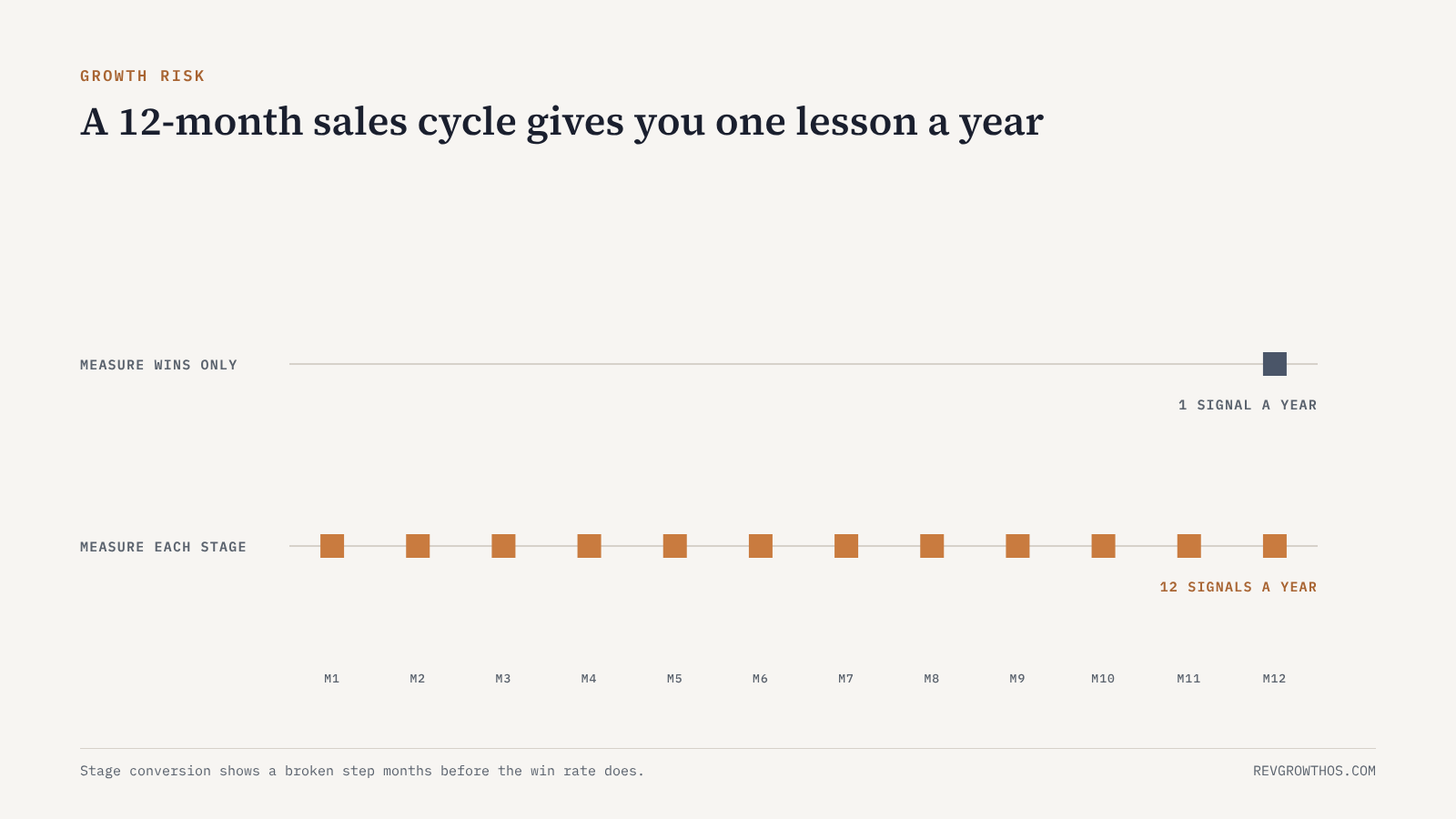
If your average deal takes twelve months to close, you get roughly one clear lesson a year about whether your sales system works. By the time you learn it, the year is gone.
That's the quiet danger of long sales cycles in industrial and B2B markets. Capital equipment, engineered systems, multi-year service contracts and large OEM programs all take time to win. The length isn't the problem. The problem is that a long cycle hides what's broken inside it, often for years.
One signal a year isn't enough.
Most companies judge their sales system by its final output: wins, revenue and maybe win rate. In a short-cycle business, those numbers update fast enough to steer by. If win rate drops in March, you see it in April and adjust.
In a twelve-month cycle, a problem introduced in January doesn't show up in wins until the following year. A new competitor, a pricing change, a weak proposal template or a lost technical champion all take months to reach the scoreboard.
By then, the pipeline behind them carries the same flaw. You're not looking at one lost deal. You're looking at a year's worth of opportunities that went through the same broken step.
How would you know, today, whether something in your sales process broke six months ago?
Measure each stage, not just the end.
The fix is to measure the stages in between, every month.
A long sales cycle has a sequence. An inquiry comes in. It gets qualified. Someone visits or holds a technical call. A quote or proposal goes out. The customer shortlists suppliers. A decision is made.
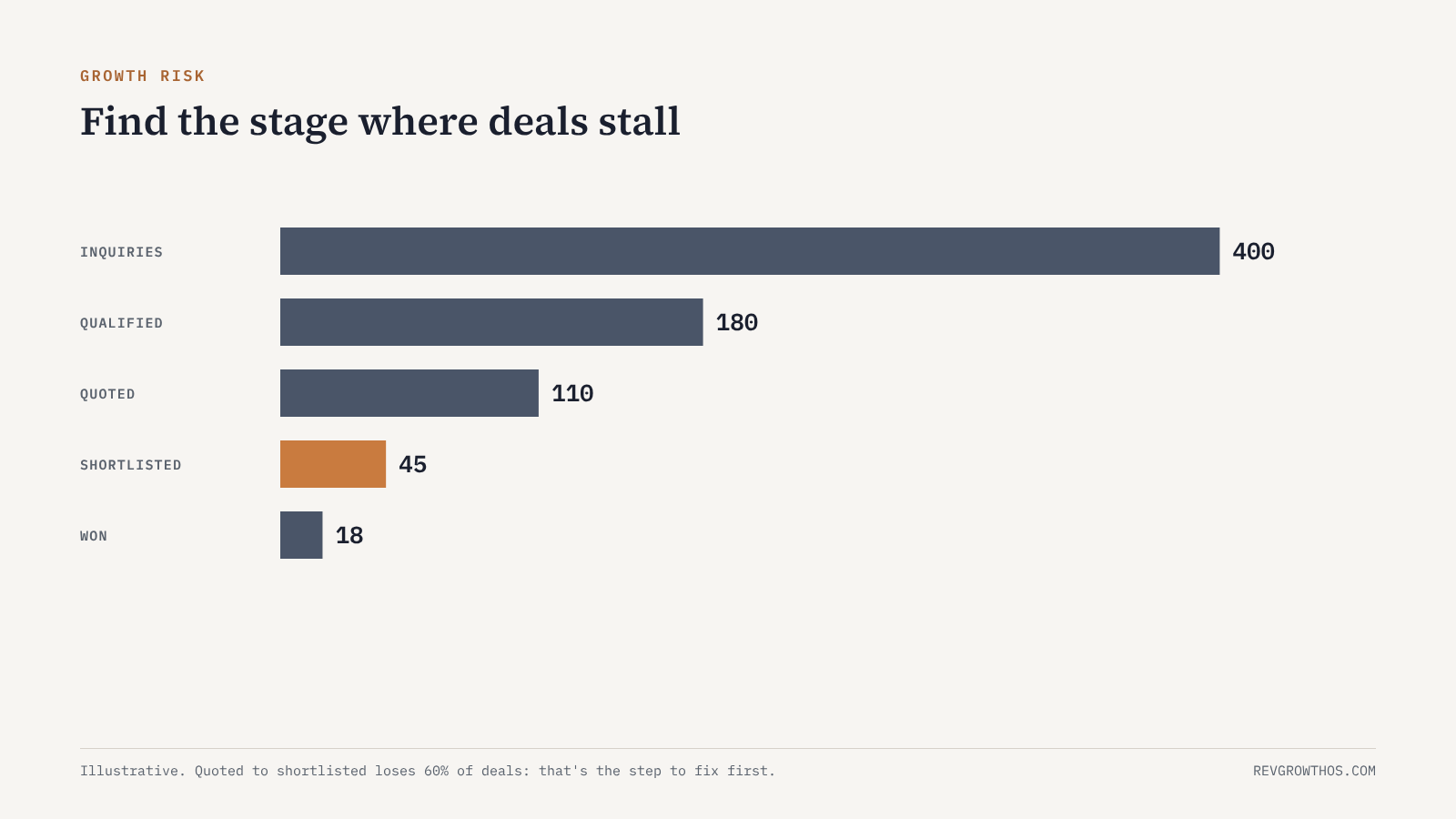
Each of those steps has a conversion rate. Track them separately and you get a dozen signals a year instead of one. If quote-to-shortlist conversion drops from 55% to 40% in the second quarter, you know something changed there. You can find it and fix it while the pipeline still has time to benefit.
You also learn where deals actually stall. In many industrial companies, the leak isn't at the end. It's in the middle, between quoting and shortlisting, where proposals sit unanswered and nobody owns the follow-up.
Stage data also changes the forecast. Instead of a sales leader's judgment on each large deal, you can weight the pipeline by how deals at each stage have actually converted. It won't be perfect. It will be more honest than a list of opportunities everyone hopes will close in the fourth quarter.
The usual hiding places.
Some problems hide better than others in a long cycle. A few show up again and again.
Slow quoting. A quote that takes three weeks tells the customer something about how you'll handle the order. In a long cycle, nobody connects the slow quote to the lost deal eight months later.
Stalled deals left open. Opportunities that went quiet months ago stay in the pipeline because nobody wants to remove them. The pipeline looks full. Its real value keeps falling.
One champion. Large deals often depend on one supporter inside the customer. When that person changes roles, the deal dies slowly, and the cause isn't recorded.
Pricing set deal by deal. Without clear rules, each large quote gets priced from scratch. Margins drift, and the drift only becomes visible when the year's results are added up.
Leading signals that work in long cycles.
Beyond stage conversion, a few measures give early warning in long-cycle businesses.
The age of open opportunities by stage. If the average age keeps rising, deals are stalling, whatever the pipeline total says.
The number of active contacts per major opportunity. Deals with only one relationship are fragile.
Win rate in your chosen segments, tracked quarterly with a rolling twelve-month window. It smooths the lumpiness while still showing direction.
Lost-deal reviews belong here too. When a large opportunity is lost, spend thirty minutes finding out why, ideally from the customer. Record the reason in a few consistent categories: price, timing, technical fit, relationship, responsiveness. After a year, the pattern usually points straight at the stage that's broken.
Long cycles make the system more important, not less.
Leaders in long-cycle businesses sometimes argue that their sales process is too complex to measure. Every deal is different. The relationships matter more than the process.
The relationships do matter. But complexity is a reason to measure more carefully, not less. When each deal is large and slow, losing one to a fixable process problem is expensive. Losing a year's worth of them is a growth stall.
A system with measured stages also survives people changes. When a senior salesperson leaves in the middle of a twelve-month cycle, a documented pipeline with stage history lets someone else pick up the work. Without it, the deals leave with them.
Start with a stage map.
Draw the stages of your sales cycle. Pull the last two years of opportunities and calculate conversion between each stage. Find the step with the biggest drop. That's where to start.
If you want to see how your conversion and other revenue drivers compare with 200-plus mid-market companies, the free RevGrowth Simulation scores them in about an hour. In a long-cycle business, it's a quick way to get a clearer signal than one result a year.

Russ Holder
Founder & CEO, RevGrowth OS. 30 years in growth strategy, five published books.
You've read what the data says. Now run your numbers through it.
A one-hour working session with your own data. We run it through the RevGrowth Benchmark live, so you see the method applied to your company before you spend a dollar.
One hour. Your data. Zero cost.