
Blog / Growth Strategy
When the RevGrowth Benchmark Won't Help You
By Russ Holder
3-minute read

Not every company should benchmark its growth system right now. Some should wait a year. A few should do something else entirely.
I'd rather say that up front than sell a diagnostic to a company that can't use it. A benchmark that lands at the wrong moment produces a good report and no change, and that's worse than nothing because it teaches the team that measurement doesn't matter.
Here's who it fits, and the situations where I'd tell you to hold off.
Who it's built for.
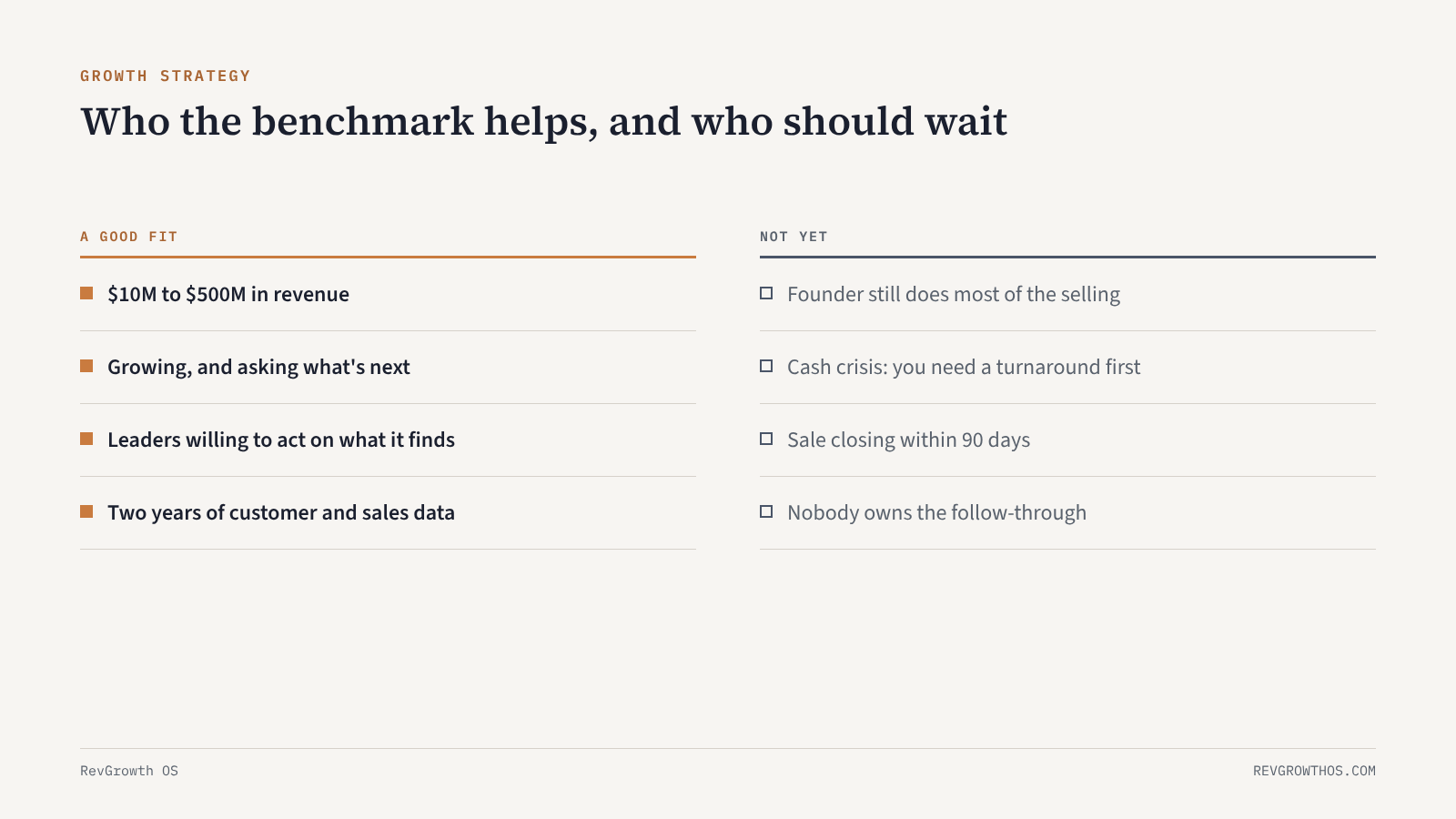
The RevGrowth Benchmark is built for leadership teams of mid-market industrial and B2B companies: manufacturers, distributors and services firms between roughly $10 million and $500 million in revenue.
The best fit is a company that's already doing reasonably well. It's growing, or at least stable. The leadership team suspects there's more available and wants to know where. They're tired of growth plans built on last year's number plus a few points.
If that's you, the benchmark tends to pay for itself quickly, because it replaces debate with a ranked list of gaps.
It also fits companies that have just hit a plateau. Growth was strong for several years, then flattened, and nobody can agree on why. That's exactly the moment a measured position is most useful, because the team has enough history to compare against and enough momentum left to act.
When cash is the problem.
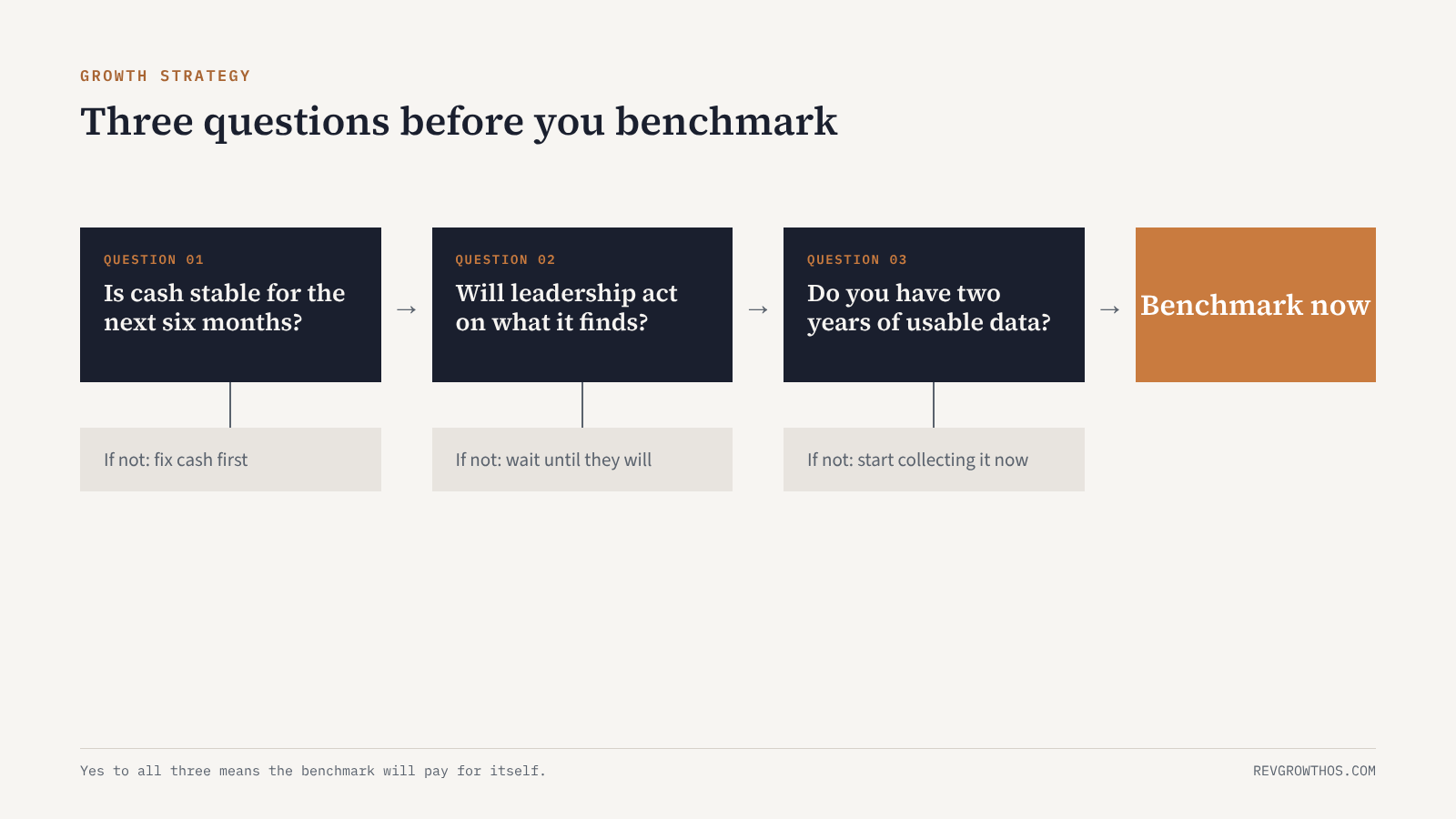
If you have less than six months of runway, or your lender is asking hard questions, a growth benchmark is the wrong tool.
A benchmark looks at how your company is built to grow over the next few years. A cash crisis needs a 13-week cash flow, a cost plan and a conversation with your bank. Those come first. Trying to improve conversion rates while you're working out how to make payroll splits attention you don't have.
Once the cash position is stable, come back. The benchmark will still be there, and so will the gaps.
The same goes for a major operational crisis, like a failed ERP cutover or a quality recall. Fix the fire first. Growth diagnostics need a leadership team with some attention to spare.
When the founder is still the sales department.
Below $10 million, many companies run on one person. The founder knows every customer, prices every big quote and closes most deals personally.
There's nothing wrong with that stage. It's how most good companies start. But a benchmark of a system that's mostly one person's judgment tells you something you already know. The scores will show heavy dependence, and the fix will be hiring and delegation.
At that size, you're usually better served by building the first layer of process: a CRM people actually use, a written pricing approach and one other person who can close. Benchmark once there's a system to measure.
When nobody will act on it.
This is the most common reason a benchmark fails, and it has nothing to do with the data.
If the leadership team isn't willing to change priorities based on what it finds, the report goes in a drawer. I've seen it happen when a CEO wants validation rather than information, or when the real decisions sit with an owner who isn't in the room.
Before you benchmark, ask a plain question. If the data says our biggest gap is retention, not new business, will we move money and people to fix it? If the honest answer is no, wait.
A useful test is to look back at the last strategic plan. How many of its priorities changed what people did on Monday morning? If the answer is few, the problem isn't a lack of information. It's a decision-making habit, and that needs fixing before more data will help.
When a sale is weeks away.
If you're signing a purchase agreement in the next 90 days, the time to build a growth system has passed. Buyers will diligence what exists, not what you're about to start.
Benchmarking still has a role in a sale, but it's earlier. Three years out, it tells you what to fix. Twelve to eighteen months out, it helps you document what you've built so a buyer can verify it. In the last few weeks, there's little a new diagnostic can change, and starting one can raise questions you don't have time to answer.
When the data isn't there yet.
A benchmark needs inputs. At a minimum, two years of revenue by customer, some record of quotes and wins, and basic margin data by account or product line.
Plenty of good companies don't have this in one place. That's fixable, and fixing it is worth doing anyway. But if the numbers live in three spreadsheets and one person's memory, spend a quarter getting them into shape first. You'll get a much sharper read.
Missing data is also a finding. A company that can't tell you its revenue retention by customer has learned something important about how it manages growth.
If you fit, start small.
If none of these apply, you're likely a good candidate. Stable cash, more than one person carrying growth, a team willing to act and a couple of years of data.
The easiest first step is the free RevGrowth Simulation. It takes about an hour and scores your revenue drivers against the benchmark. If it shows gaps worth closing, you'll know it was the right time. If it doesn't, you've spent an hour, not a budget.

Russ Holder
Founder & CEO, RevGrowth OS. 30 years in growth strategy, five published books.
More from the Revenue-to-Value Gap blog.
You've read what the data says. Now run your numbers through it.
A one-hour working session with your own data. We run it through the RevGrowth Benchmark live, so you see the method applied to your company before you spend a dollar.
One hour. Your data. Zero cost.