
The Growth Benchmark Blog
Frameworks give you opinions. Benchmarks give you position.
by Russ Holder
Founder & CEO
RevGrowth OS, LLC
Every growth consultant brings a framework. A 2x2 matrix. A maturity model. A 'seven pillars of growth' deck with your logo on slide two.
Frameworks are not the problem. Most are built by people who understand growth. The real issue is what a framework cannot do. It cannot tell you where you actually stand.
A framework depicts what good looks like. It does not tell you if you are good.
That is the difference. Frameworks give you opinions. Benchmarks give you position.
What a Framework Actually Gives You
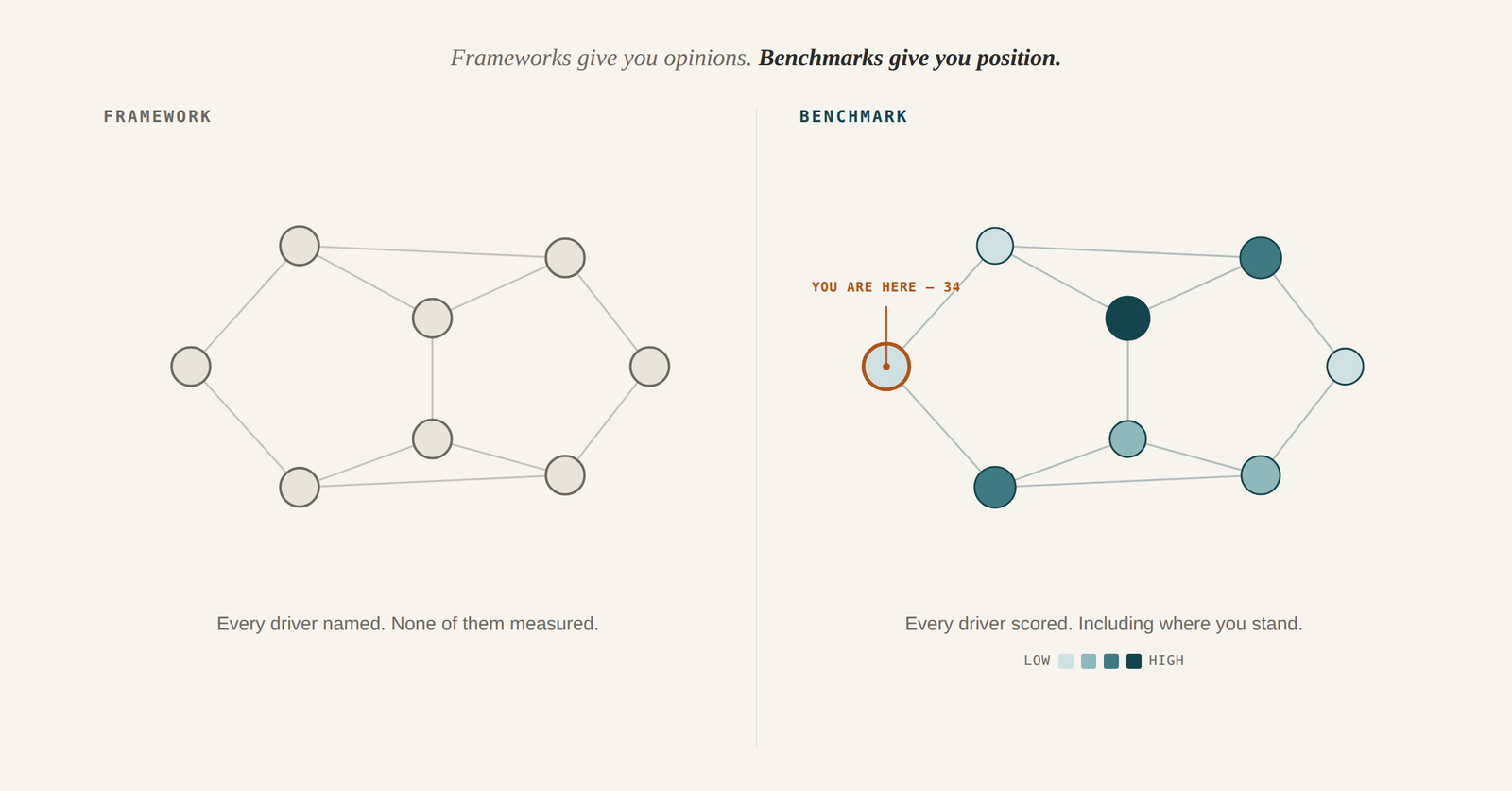
A framework is a map. It lays out the terrain. Here is strategy. Here is execution. Here are the four things that must be true for growth to compound instead of resetting every January. A well-built framework, like RevGrowth Architecture's four levels—Strategic Foundation, Revenue Drivers, Resilience Core, Value Expansion—does real work. It tells you what to look at, in what order, and why those things matter more than the twenty other things competing for your attention this quarter.
But a map, by itself, doesn't tell you where you are on it.
Give ten CEOs the same framework and ask them to self-assess. You will get ten different answers. The framework is not wrong. Self-assessment is just opinion dressed up as rigor. 'We're strong on retention.' According to whom? Compared to what? 'Our positioning is a competitive advantage.' Compared to which companies? Scored how? A framework without measurement is just a well-organized guess. The categories are rigorous, but the scores are still judgment calls.
This is how growth planning becomes a popularity contest. Not because anyone is dishonest. The framework never forced anyone to be objective. The loudest voice, the most recent story, or the best-looking deck wins because nothing outranks them. You would never let the plant floor run this way. Six Sigma measures defect rates. Lean times the process and finds waste. Growth is often the only function where 'I think' and 'I measured' are treated the same.
What a Benchmark Actually Gives You
A benchmark is not a better opinion. It is a position, measured against other companies measured the same way.
The RevGrowth Benchmark doesn't ask what you think about your retention. It scores your retention—0 to 100—against more than 200 other mid-market companies that ran the same 25 Drivers through the same instrument. It doesn't ask if your positioning feels like a competitive advantage. It scores it, quartile by quartile, next to companies your size, in your kind of market, facing your kind of buyer.
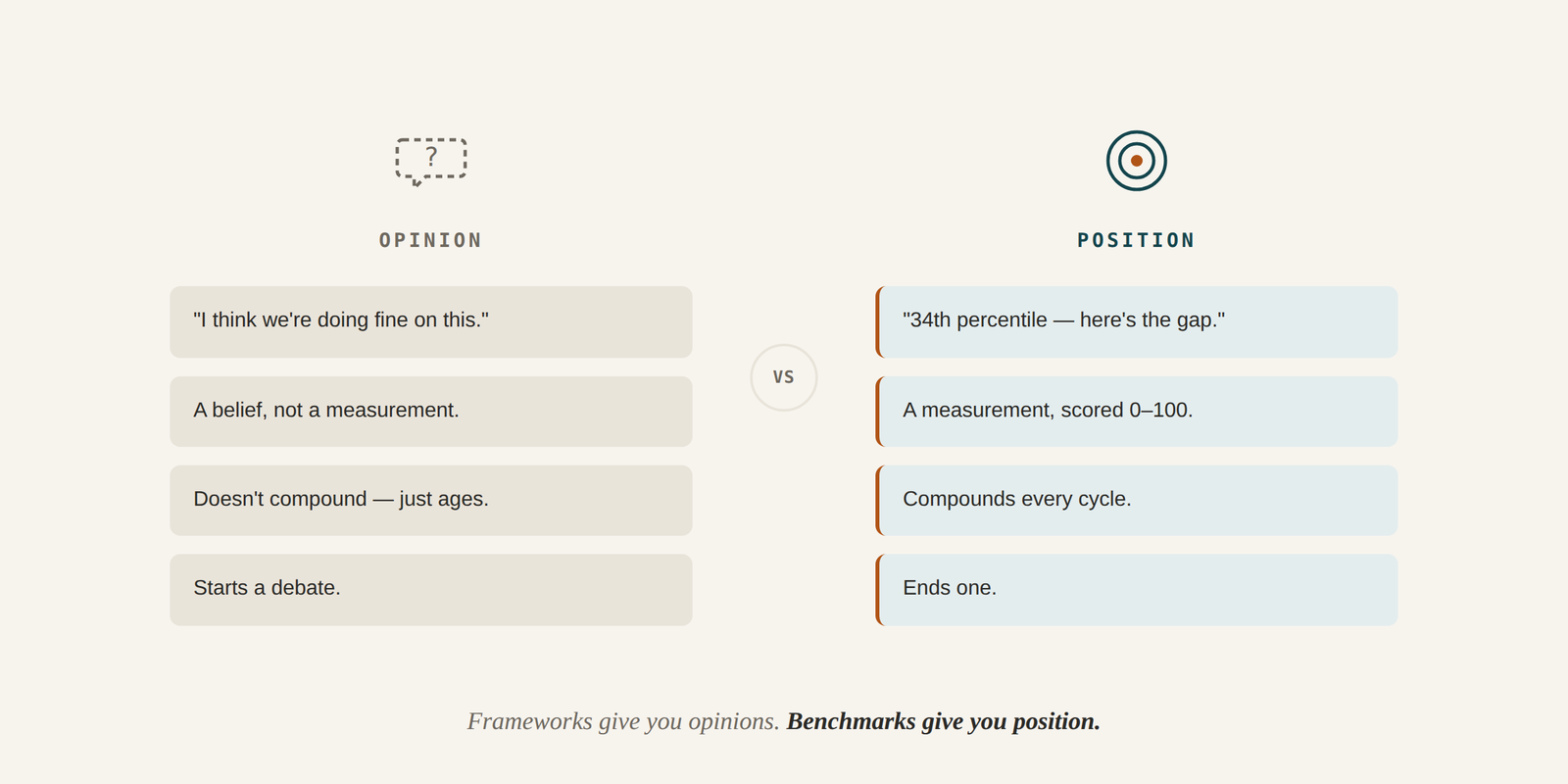
That is the shift a benchmark makes possible. It turns 'I think we are doing fine on this' into 'we are 34th percentile on this, and here is what separates us from the top quartile.' One of those sentences ends a debate. The other starts one.
A benchmark does not stop at telling you where you rank. The same instrument has measured 200+ other companies. It can show you what actually happens to companies that close a given gap. Not a hypothesis. A pattern, already observed in the data.
Why the Gap Between the Two Is Worth More Than It Looks
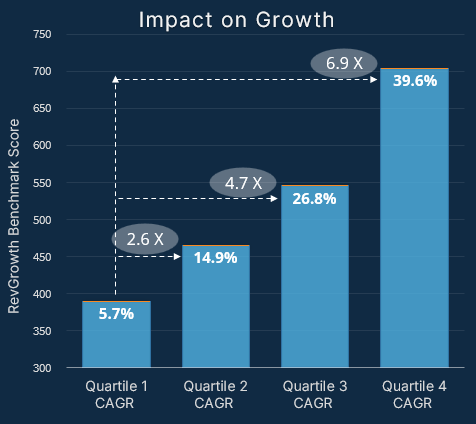
Here is the number that makes this concrete. Across the RevGrowth Benchmark dataset, growth compounds with proximity to the Architecture in a straight line. Bottom-quartile companies grow at 6.1% a year. Second quartile: 15.7%. Third quartile: 28.0%. Top quartile, 39.8%. That is about seven times the growth rate of the companies furthest from the standard, often selling into the same markets, sometimes with a weaker product.
All 204 companies had access to a framework. Growth frameworks are not rare. You can find a dozen credible ones with a single search. The difference between the company growing at 39.8% and the one at 6.1% was not the framework. It was whether anyone measured where the company stood.
That is the uncomfortable part. Two companies can use the same framework, believe the same things about what matters, and still end up seven times apart in outcomes. One knew its actual position. The other operated on opinion. The framework was not the differentiator. The measurement was.
Opinions Don't Compound. Positions Do.
An opinion does not improve on its own. You can revisit it, argue about it, or replace it with a new opinion next planning cycle. It does not get sharper just by sitting there. There is nothing underneath it to sharpen. It is a belief, not a measurement. Beliefs do not accumulate evidence just by aging.
A position does improve. Score your company against the same 25 Drivers this year and next year. You are not looking at two more opinions. You are looking at a trend line. You can see which Drivers moved, by how much, and whether your actions produced the lift you expected. You can also see if your assumed constraint was not the real one. This is how compounding growth works. Not bigger swings, but a tighter loop between what you measured, what you fixed, and what moved next quarter. A framework cannot run that loop - only a repeated benchmark can.
This is why 'we already have a growth strategy' and 'we already know where we stand' are two different claims. Mid-market leaders keep discovering the gap between them the hard way. Almost every company we benchmark already has a framework, a strategy deck, a set of pillars, a version of the map. Almost none have, before the first Benchmark run, a scored, comparative answer to the only question that predicts what happens next: compared to companies already doing this well, where do we really stand?
The Instrument, Not the Argument
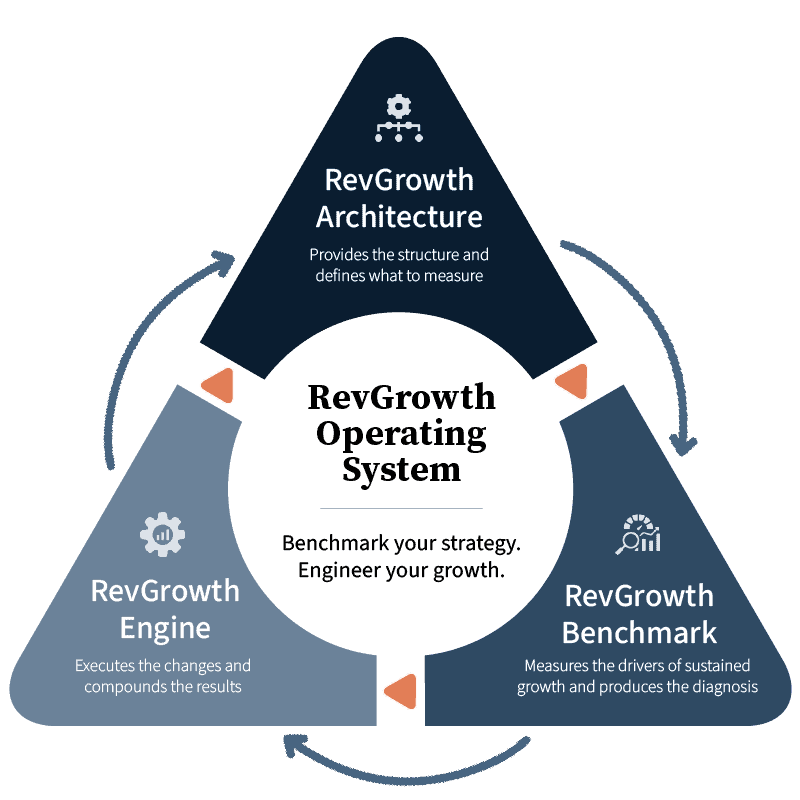
This is why RevGrowth Benchmark exists as its own step.
- The RevGrowth Architecture is our map to sustained, profitable, compounding growth. It is necessary, but still just a framework until something measures a real company against it.
- The RevGrowth Benchmark is that measurement tool. It identifies your gaps and quantifies the opportunity for improvement.
- The RevGrowth Engine is the machinery that moves you forward once you know what to fix.
Benchmark turns the blueprint from an opinion into a scored, evidenced position on where you actually stand. This step must happen for the other two steps to matter. Building against a guess is how companies end up with an expensive system solving the wrong problem.
Frameworks are not worthless, just incomplete on their own. They are the map every company needs, but not the coordinates. The companies pulling seven times ahead in that dataset are not the ones with a better map. They are the ones who stopped debating the map and measured their position on it.
Frameworks give you opinions. Benchmarks give you position.
Benchmark your strategy. Engineer your growth.
When you’re ready to see where you actually stand, the RevGrowth Simulation is where this starts – one hour, your own numbers, no cost, and no proposal at the end of it.

The RevGrowth Score
Ten minutes to find out where you actually sit.
The findings tell you what the data says. They don't tell you where you are in it. The RevGrowth Score scores your company against some of the same non-negotiables and critical factors we score every benchmarked company on. Ten minutes, online, no call required.
You get a position, not a grade.
Ten minutes. Online. No call required.
The RevGrowth Simulation
Find out which one you are.
The RevGrowth Simulation is a one-hour working session using your own numbers. You'll see where your growth system sits against 200+ mid-market companies, and what the gap is worth.
60 minutes - built on your data - CEO level - no obligation