
The Growth Benchmark Blog
Why growth fails without growth infrastructure.
by Russ Holder
Founder & CEO
RevGrowth OS, LLC
Ask a room of executives when their growth strategy failed, and most of them will describe a bad quarter, a missed number, a lost account, or a launch that didn't land.
That's not when it usually fails. By the time a bad quarter appears, the failure has often been running quietly for a year or more. It rarely looks like failure. It looks like "good."
Growth doesn't fail loudly.
Plans decay. Systems compound. That is the difference. It is why growth failure is easy to miss until it becomes expensive.
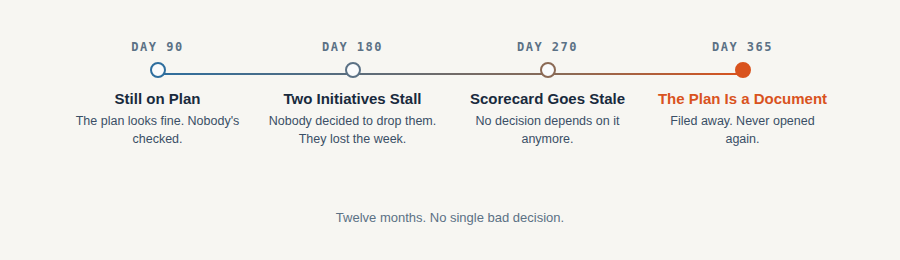
Nothing dramatic happens. No one makes a bad call. A plan is built at the start of the year. Ninety days in, the company is still on track. At six months, an initiative or two has quietly stalled. Nobody decided to drop them, they just lost priority to a fire burning hotter. At nine months, the scorecard has not been updated in a quarter. Nobody notices because no decision depends on it anymore. By month twelve, the plan is just a document. It sits in a shared drive nobody has opened since Q1.
None of these individual failure modes look like a crisis. It’s priority drift. A cadence that moves once and then disappears from the calendar. Ownership that gets unclear between the kickoff meeting and now. This is what makes them dangerous. None of them ever triggers a response.
The real failure mode: growth by heroics.
Here's the pattern underneath almost every one of those quiet failures: growth that depends on a person instead of a system.
From inside the company, growth by heroics looks like commitment. A great quarter happens because someone worked eighty-hour weeks to save a key account, or the founder personally closed the deal that made the number. It feels like a win, and in the moment, it is one.
From the outside, this is fragility disguised as a good quarter. The company's growth strategy is only as strong as the memory, energy, and presence of whoever is carrying it. Every plan starts over as a fresh guess because nothing from last year's plan was measured well enough to know what to keep or discard. The highest-leverage fixes, the specific 1% improvements in your own numbers, stay invisible. Nobody is looking with the right instrument.
Traditional growth consulting rarely fixes this. It is built on the same premise it claims to solve. Growth becomes a problem handed off to someone else's opinion, delivered as a one-time project, based on a generic playbook for companies in a different position than yours.
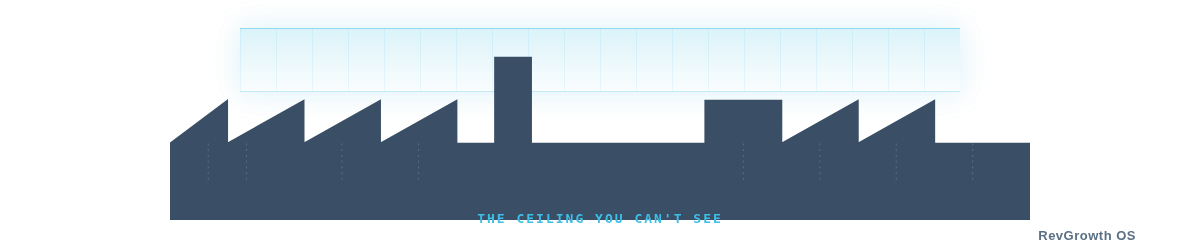
The ceiling you can't see.
Here's what makes this failure mode so hard to catch: it doesn't look broken while it's happening. If revenue is up, the pipeline looks fine, and last year was decent, there's no burning platform demanding a fix.
That absence of crisis is what lets a company run a function on tribal knowledge indefinitely. The company is not failing. It is plateauing. It hits a ceiling that is real but invisible, because nothing has measured it. Performance is good, but it stalls where instinct runs out, and nobody has the data to push further.
You can't optimize what you've never measured. You can't compound an advantage you can't see. And you can't tell the difference between "we grew" and "we grew on purpose" without instrumentation that most companies don't have.
Why more effort doesn't fix it.
When growth stalls, the instinct is to push harder on the same unmeasured process. Another sales push. Another campaign. Another all-hands meeting about hitting the number. That instinct is backward. No well-run plant would make this mistake.
If a production line's defect rate spikes, a good operations leader does not start by asking who is lazy. Six Sigma does not work that way. It measures the process, finds the specific step producing the variance, and fixes the step. Everyone running that plant knows a capable crew can still get bad output from an unmeasured, unstable process.
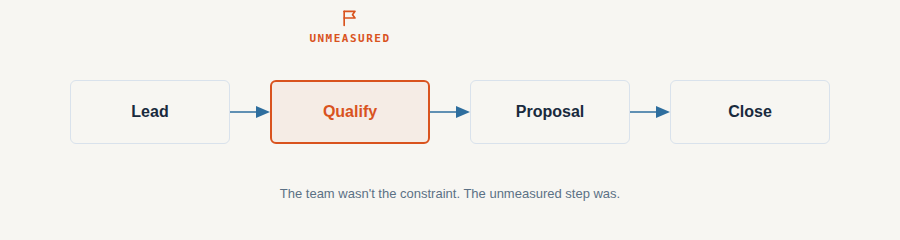
Growth is usually the one function that does not get this same treatment. A sales team can close every good lead they are given and still sit on a broken lead-qualification step nobody has measured. A retention team can do everything right on renewal calls and still lose accounts to a pricing structure nobody has benchmarked against similar companies. The team is not the constraint most of the time. The absence of instrumentation is.
What changes with growth infrastructure.
Growth Infrastructure does not fix this by working harder. It fixes it by making the invisible visible. It provides a blueprint that defines what must be true for growth to compound. It uses an instrument that scores your company against 200+ benchmarked peers on 25 specific Drivers. It creates a governed cadence that keeps the plan running past the first ninety days, instead of letting it decay into a document nobody opens.
Most companies that finally measure this way have the same reaction. Relief, not defensiveness. Relief because the plateau finally has an explanation that is not "try harder." The fix points to something concrete: which specific Driver is weak, not which person isn't trying hard enough.
Growth was never supposed to be the one function running on heroics while everything else in the business ran on a system. It doesn't have to keep failing quietly. It just has to start being measured.
Benchmark your strategy. Engineer your growth.
When you’re ready to see where you actually stand, the RevGrowth Simulation is where this starts. One hour, your own numbers, no cost, and no proposal at the end of it.

The RevGrowth Score
Ten minutes to find out where you actually sit.
The findings tell you what the data says. They don't tell you where you are in it. The RevGrowth Score scores your company against some of the same non-negotiables and critical factors we score every benchmarked company on. Ten minutes, online, no call required.
You get a position, not a grade.
Ten minutes. Online. No call required.
The RevGrowth Simulation
Find out which one you are.
The RevGrowth Simulation is a one-hour working session using your own numbers. You'll see where your growth system sits against 200+ mid-market companies, and what the gap is worth.
60 minutes - built on your data - CEO level - no obligation