
The Growth Benchmark Blog
Growth Infrastructure:
The Manifesto
200+ companies. One straight line. The difference between good and great was never a secret - it was unmeasured.
by Russ Holder
Founder & CEO
RevGrowth OS, LLC
You already know how to build discipline. You just haven't built it here.
You didn't grow to $10 million, $50 million, or $200 million by accident. You engineered it.
You put Lean on the plant floor and ran Six Sigma until variance became the enemy and root cause became standard practice. You installed TPM so machines stopped surprising you. You gave Finance an ERP and GAAP. You gave Engineering a defined development lifecycle and HR a system of record.
Every function in your business runs on something codified, measurable, repeatable, and governable. You know that discipline is what turns a good operation into a great one.
Except one function.
The function that pays for all the others. The function every department in your company depends on to keep the lights on, the plant running, and the balance sheet growing. Revenue growth.
Where does growth strategy live in your company? Not the answer on the org chart, the real answer. It lives in the heads of a few key people. It lives in a rep’s pipeline instincts. It lives in whatever seemed to work last time - repeated because it worked, not because anyone proved why. It lives in a quarterly review, a gut check, a plan built the same way it was built five years ago because nobody had the time or the system to ask if it should be built differently.
You already know what happens to any function that runs this way. You've spent your career fixing it everywhere else.
The problem that nobody says out loud.
Here's the trap: growth doesn't feel broken when it's working.
No burning platform exists when revenue is up and the pipeline looks fine. No obvious failure demanding a fix. That absence of crisis is what lets an entire function keep running on tribal knowledge indefinitely.
This is the real problem. It's systemic, not cosmetic. Growth is the only major function in a mid-market industrial company that does not run on infrastructure. Not a better sales script. Not a new CRM. Not another training. The real issue is the absence of a system. No governed, measurable, repeatable way to know what is actually driving growth and what is just noise.
You can't optimize what you've never measured. And you can't tell the difference between “we grew” and “we grew on purpose” without instrumentation that most companies your size don't currently have.
That gap doesn't show up as a crisis. It shows up as a ceiling - a plateau nobody can quite explain. Good performance - clearly good - but that stalls exactly where intuition runs out and nobody has the data to push further.
The Real Enemy Isn't a Competitor. It's Growth by Heroics.
The enemy isn't a rival company. It's not even a bad quarter. It is the belief, quiet and unexamined, rarely said aloud, that growth is supposed to run on instinct. That it is an art, not an engineering discipline. That the plan lives in someone's head because it always has, and that is just how growth works.
From inside the company, growth by heroics resembles commitment. From the outside, it’s fragile and hidden behind a good year. Too often a growth strategy is only as good as the memory, energy, and continued presence of whoever is carrying it. Every plan is a fresh guess, because nothing from last year's plan was measured well enough to know what to keep and what to throw away. The biggest lever for improving performance stays invisible because nobody is looking with the right instrument.
Traditional growth consulting doesn’t fix this. It’s built on the same premise it claims to solve. Growth is treated as a problem to hand off to someone else's opinion, delivered as a one-time project, based on a generic playbook built for companies in a completely different position than yours. Those are companies trying to survive, not companies trying to get from good to great.
That model was built for companies in trouble. But you are good, and you know good isn’t the ceiling. The old model has nothing left to offer you because it wasn’t built for where you actually are.
Discipline isn't the enemy of growth. It's the multiplier.
Here's the flip.
Every instinct you have built running an industrial operation tells you the opposite of what growth orthodoxy claims. Growth marketing has spent a decade insisting that growth is creative, instinctual, and too fluid to systematize. The logic of measurement and governance from the plant floor does not translate, they say.
It's wrong. And you already know it's wrong, because you've watched the same principle work everywhere else you've applied it.
Systems do not slow down growth. They make growth compound instead of resetting to zero every year. A governed process does not kill the upside. It lets you find the upside that instinct alone will always miss, because instinct cannot see what it has never measured. The instinct to run growth like you run the plant is not a metaphor. It is the answer.
Most companies never change this frame. Growth is not the exception to operational discipline. It is the function that has needed it the most, for the longest, and received it the least.
Growth infrastructure is the new world.
There is a category for what comes next, and it's not a consultancy, a framework, or a set of tactics you bolt onto what you're already doing.
It’s Growth Infrastructure. It is the same kind of foundational, governed system that every other function in your business already runs on. Now it is finally built for the one that pays for all of them.
The RevGrowth Operating System is that infrastructure. Unlike traditional consulting, it’s not advice delivered once and left to age. And unlike most growth systems, it’s not a generic playbook borrowed from companies in a different fight than yours.
RevGrowth OS is a measurable, repeatable system built specifically for companies that are already winning and ready to raise the bar. It is a data-driven flywheel customized to your unique business goals - three components working together, every cycle, getting sharper each time it turns.
The RevGrowth Architecture comes first. It is a four-level blueprint for long-term growth: Strategic Foundation, Revenue
Drivers, Resilience Core, Value Expansion. It defines what must be true for growth to compound instead of reset. It is not a response to what any one company is missing. It is the standard, set before anyone gets measured against it.
The RevGrowth Benchmark is the instrumentation. It measures 4 non-negotiables, 7 critical factors, and 25 Drivers - each one is a piece of the Architecture, scored against a living dataset of more than 200 benchmarked companies, with more added every month. This is the diagnostic engine. It replaces opinion with evidence about where you actually stand against the standard. If you skip this step and act on the Architecture directly, you are building against a guess instead of a measurement. That is the fastest way to end up with an expensive system solving the wrong problem.
The RevGrowth Engine is the machine that turns the Architecture and Benchmark data into an actionable plan. Every initiative has an owner and a date. The process runs on a governed cadence and closes the loop. Re-benchmark against the same Architecture, and the cycle starts again, a little sharper than before.
You don’t run a plant without a blueprint, instrumentation, and machinery working together. Growth should not run without them either. A growth strategy built with RevGrowth OS doesn’t stop when construction is finished. It is built to keep turning and to compound a little more with every rotation.
Growth. Engineered.
Here's what 200+ companies already told us.
This isn't a philosophy pitched on faith. It's a claim you can check.
RevGrowth Architecture defines what must be true for growth to compound instead of reset - a standard set before anyone gets measured against it.
RevGrowth Benchmark is what measures a company against that standard: 4 non-negotiables, 7 critical factors, 25 Drivers, each one a piece of the Architecture, scored 0 to 100.
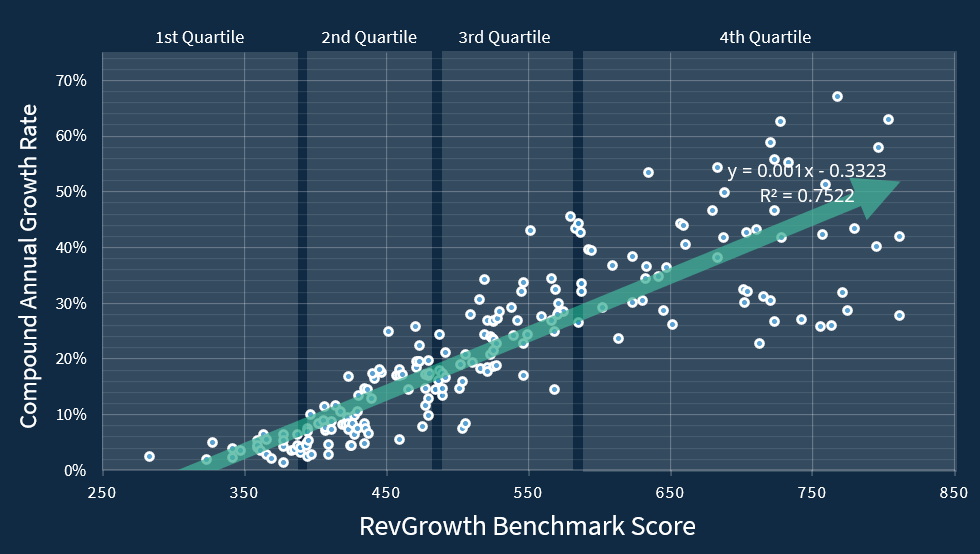
The Benchmark dataset spans 200+ companies and keeps growing - every new company measured against the same fixed Architecture sharpens the picture for the next one - and the pattern inside it is the same one you'd expect from any process that's finally been instrumented: the gap between “good” and “great” isn't made of one big broken thing. It's made of small, specific, identifiable levers - the strategic 1% improvements that never surface under instinct alone, because instinct only sees what it already expects to look for.
Companies that find and act on those levers compound them into 20–40% annual growth in revenue, profit, and enterprise value. Not from a single bold bet. From knowing precisely where they stood against the Architecture, relative to the best-in-class companies actually meeting it and closing the specific gaps that mattered most.
Here is the number that should concern you. Across the dataset, growth compounds in a straight line with how closely a company matches the Architecture.
- Bottom-quartile companies grow at 6.1% a year.
- Second quartile: 14.9%
- Third quartile: 26.8%
- Top quartile: 39.6%
That is roughly seven times the growth rate of the companies furthest from the standard, often selling into the same markets, sometimes with a weaker product. That spread isn't talent, and it isn't luck. It is proximity to an Architecture most companies have never seen written down.
If you don't know where the bar is, you cannot know how close you already are to clearing it. Companies sitting on real, findable, near-term upside routinely have no idea it exists - not because the opportunity isn't there, but because nothing in their current process was built to reveal it. The benchmark isn't a nice-to-have layer on top of your strategy. It's the only way to know whether “good” is five points from great, or fifty.
Frameworks give you opinions. Benchmarks give you position.
Every quarter you run growth without this instrumentation is a quarter you compound on a guess instead of measuring against the standard.
Growth runs on a system now.
You didn't build your operation by trusting instinct over instrumentation. You won't build what comes next that way either.
The companies who win the next decade in this industry won't be the ones who tried hardest or got lucky with the right rep in the right territory at the right time. They'll be the ones who did to growth what they already did to everything else that mattered: they engineered it.
This is the category for companies that refuse to plateau. Not because they are in trouble, but because they have never mistaken good for a finish line. It is for leaders who already believe operational discipline works, because they have spent a career proving it everywhere except the one function that funds it all.
Growth is not a guessing game. It is not a heroic effort you renew every January. It is a governed system, the same kind you already trust everywhere else in your business, and it is ready to run here too.
Benchmark your strategy. Engineer your growth.
When you’re ready to see where you actually stand, the RevGrowth Simulation is where this starts – one hour, your own numbers, no cost, and no proposal at the end of it.

The RevGrowth Score
Ten minutes to find out where you actually sit.
The findings tell you what the data says. They don't tell you where you are in it. The RevGrowth Score scores your company against some of the same non-negotiables and critical factors we score every benchmarked company on. Ten minutes, online, no call required.
You get a position, not a grade.
Ten minutes. Online. No call required.
The RevGrowth Simulation
Find out which one you are.
The RevGrowth Simulation is a one-hour working session using your own numbers. You'll see where your growth system sits against 200+ mid-market companies, and what the gap is worth.
60 minutes - built on your data - CEO level - no obligation