
The Growth Benchmark Blog
Growth infrastructure vs sales and marketing: two departments, one missing system.
by Russ Holder
Founder & CEO
RevGrowth OS, LLC

Most CEOs will say growth comes from sales and marketing. That answer is only part of the truth. The real gap is between having those departments and having real growth infrastructure. That gap is where most mid-market companies hit a plateau.
Two departments, not a system.
Sales and marketing are functions. They’re boxes on the org chart, each having its own budget, leadership, and scorecard. Every company needs people generating demand and people closing deals. But a function is not a system. That difference matters more than most realize.
A defined standard governs a system. It is measured the same way every cycle and built to compound. A function does its job, reports its numbers, and hands off to the next step. No single layer determines whether the handoff works or whether both functions optimize for the same outcome.
Most mid-market companies lack that layer. They have two departments, two sets of KPIs, and assume that if both are performing, growth will follow.
What sales and marketing are built to optimize.
Marketing optimizes for its own funnel: leads, MQLs, campaign performance, brand awareness. Sales optimizes for its own funnel: pipeline, quota attainment, close rate. Both scorecards can look strong even when overall growth stalls. Neither was built to measure what matters most: whether the full system, from first touch to renewal, is compounding.
This creates the familiar friction. Marketing says the leads were qualified. Sales says the leads were weak. Both can be right because each function reports against its own metric. Nobody owns the metric that settles the argument: what happens to revenue when a lead moves from one function to the other.
Neither department is the problem. Both are doing what they were built and measured to do. The real issue is that sales and marketing are only half the answer to how growth happens. The visible half on the org chart is not the half that determines whether growth compounds.
What's missing between them.
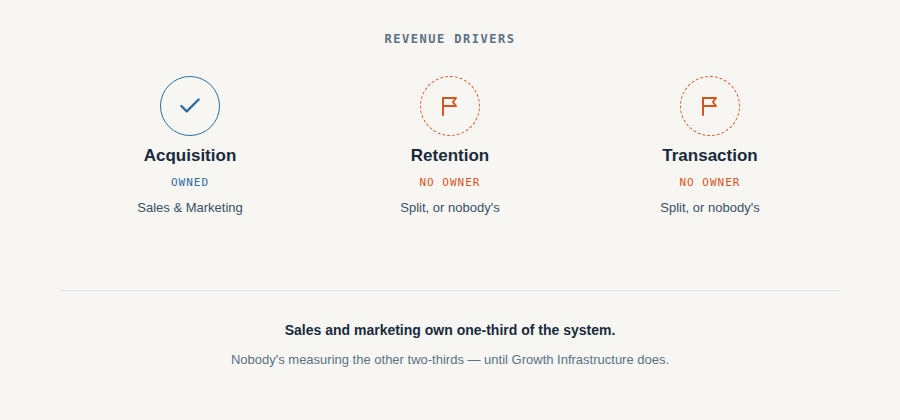
Revenue Drivers, the level of growth infrastructure that determines outcome, break into three parts: Acquisition, Retention, and Transaction. Sales and marketing mostly own Acquisition. Retention, which covers why customers stay, expand, or churn, and Transaction, which covers how pricing, packaging, and deal structure convert activity into margin, often have no clear owner. These areas are usually split across customer success, finance, and product, with no shared instrument connecting them.
This blind spot comes from traditional sales and marketing thinking. A company can excel at acquisition and still lose growth through retention or transaction. Nobody would know because nobody is measuring the full system. Only the parts that map to existing departments get measured.
Sales and marketing don’t cover everything. They don't address whether the company's competitive position and strategic foundation support the growth plan. They don't measure whether the organization is resilient enough to keep growing under pressure, or whether growth is converting into enterprise value instead of just revenue. None of this lives inside a sales or marketing budget. All of it determines whether good becomes great.
What growth infrastructure adds.
Growth Infrastructure is not a third department competing for headcount or turf. It is the governing layer above sales and marketing. It provides the blueprint, instrumentation, and cadence to measure the entire revenue system. It finds the real constraint, wherever it is, and prioritizes fixes by return, not by department ownership.
Sometimes the highest-ROI fix is in marketing. Often, it is not. In the RevGrowth Benchmark's 200+ companies, the constraint just as often sits in retention, pricing, or organizational resilience. These are areas that neither a sales nor a marketing scorecard was built to see or fix.
This is the real difference. Traditional sales and marketing execute tactics inside their own function. Growth Infrastructure measures and governs the whole system. The company fixes the constraint that limits growth, not just the one that is visible from a single department.
Both, finally governed by the same system.
This does not make sales and marketing less important. It puts them in the role they were meant to play: the execution layer inside a governed system, not the system itself.
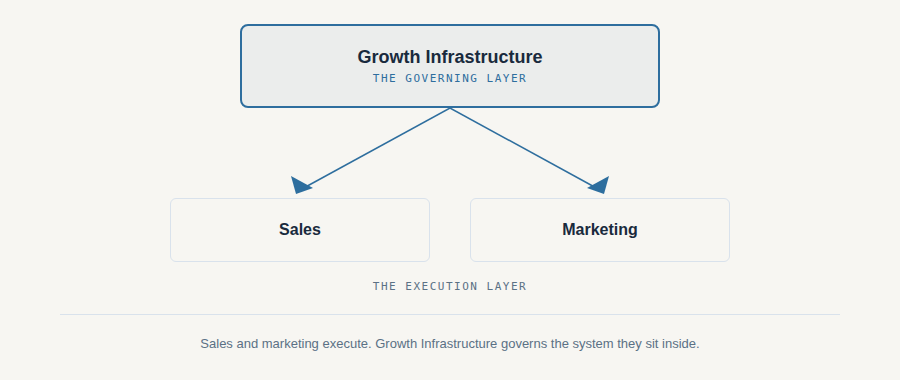
A company with strong sales and marketing but no growth infrastructure is optimizing two-thirds of the picture and hoping the rest will follow. A company with growth infrastructure has a blueprint that covers acquisition, retention, and transaction. It has an instrument that scores all 25 Drivers against 200+ peer companies. It has a governed cadence that tells sales, marketing, and everyone else which specific fix is worth doing next and why.
Frameworks give you opinions about which department to blame. Benchmarks give you position, and position points at the actual constraint, wherever it lives.
Benchmark your strategy. Engineer your growth.
When you’re ready to see where you actually stand, the RevGrowth Simulation is where this starts. One hour, your own numbers, no cost, and no proposal at the end of it.

The RevGrowth Score
Ten minutes to find out where you actually sit.
The findings tell you what the data says. They don't tell you where you are in it. The RevGrowth Score scores your company against some of the same non-negotiables and critical factors we score every benchmarked company on. Ten minutes, online, no call required.
You get a position, not a grade.
Ten minutes. Online. No call required.
The RevGrowth Simulation
Find out which one you are.
The RevGrowth Simulation is a one-hour working session using your own numbers. You'll see where your growth system sits against 200+ mid-market companies, and what the gap is worth.
60 minutes - built on your data - CEO level - no obligation