
The Growth Benchmark Blog
The growth diligence question most PE sponsors don't ask.
by Russ Holder
Founder & CEO
RevGrowth OS, LLC
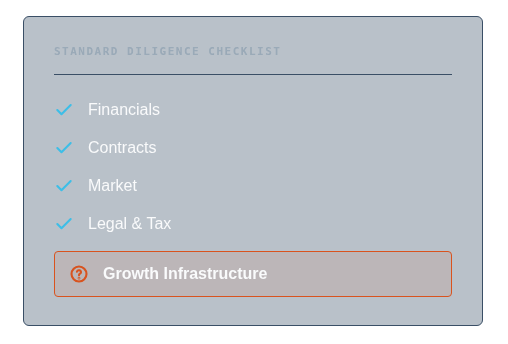
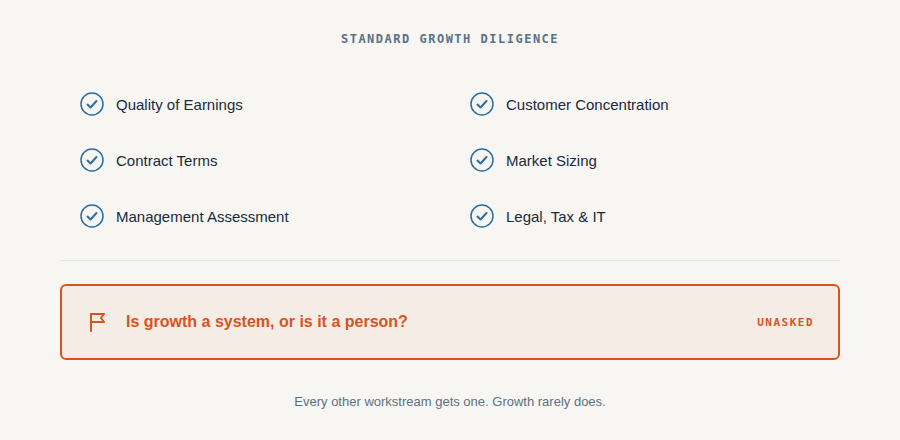
Private equity diligence is, by design, exhaustive. Quality of earnings. Customer concentration. Contract terms. Management assessments. Market sizing. Legal, tax, and IT diligence, each with its own workstream and its own advisor. By the time a deal closes, a sponsor usually knows more about the target than the target's own board does.
And yet almost none of that diligence answers the one question that determines whether the growth number in the CIM survives the transaction: is this growth a system, or is it a person?
What standard diligence already covers.
Standard growth diligence, as most firms run it, is really historical verification. It checks whether the reported CAGR is real, whether the pipeline backing next year's forecast is credible, whether customer concentration creates revenue risk, and whether the market is big enough to support the thesis.
All of that matters. None of it answers whether the mechanism that produced the growth will still be producing it eighteen months after close, under new ownership, quite possibly under a different CEO, and definitely under a different set of incentives than the ones currently in place.
The question that's missing.
Here's the question worth adding to every growth diligence checklist: how much of this company's growth is infrastructure, and how much of it is one person's memory, relationships, and effort?
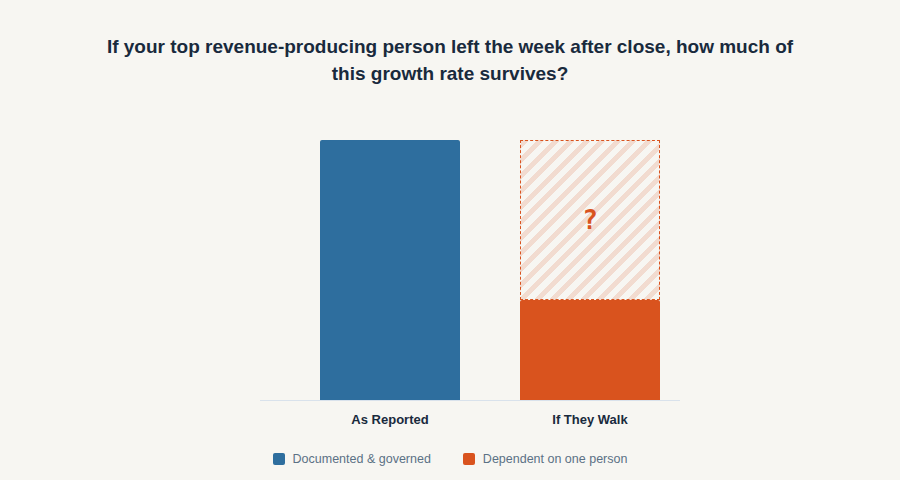
Put more directly, the way it should probably be asked in a management interview: if your top revenue-producing person left the week after close, how much of this growth rate survives?
Most sponsors have never asked their target that question, and most management teams have never been asked it. That means most sponsors don't actually know the answer until well after they own the business, when the answer is a lot more expensive to learn.
Why growth by heroics is a liability, not a strength.
Founder-led and family-owned mid-market companies, a large share of PE deal flow in industrial and B2B sectors, often grow through what amounts to heroics: a founder's personal relationships, a single rainmaker's book of business, a handful of people who carry pricing logic, key-account judgment, and go-to-market instinct entirely in their heads.
From inside a management presentation, that looks like commitment and hustle, and it's frequently presented as a strength: "our people are the reason we win." From a diligence seat, it should read as exactly the opposite. A growth number generated by heroics isn't an asset with a durable multiple attached to it. It's a number that happens to be true today and stops being predictable the moment ownership, incentives, or key people change - which is precisely what a transaction does to all three.
This is the same failure mode that quietly caps growth inside companies that never change hands. In a deal context, it's worse because the transaction itself is often the trigger that removes the person the growth was actually running through.
What the answer actually reveals.
When a target can answer the heroics question with specifics - which parts of revenue generation are documented, governed, and repeatable regardless of who's in the seat, and which parts genuinely depend on one or two individuals — that answer does two things a growth rate alone never can.
- It tells you what you're actually buying: a system that will keep producing, or a number that's currently being produced by people whose retention isn't guaranteed by an earnout alone.
- And it tells you where the real work starts on day one, because the specific gap between "growth happens" and "growth is systemized" is often the fastest, highest-leverage value-creation lever available to a new owner - faster and cheaper, in many deals, than the operational or cost-synergy plan the thesis was actually built around.
How to ask it before you own it.
The honest answer is that this question is hard to get straight from a management interview alone. People describing their own process rarely see it as clearly as an outside instrument would, and a founder mid-negotiation has every incentive to describe growth as more systemized than it is.
That's the actual case for treating growth diligence as its own measured workstream, the same way quality of earnings treats the financials as its own measured workstream - scoring the target's growth infrastructure against a defined standard and a peer set, rather than taking the CIM's growth story at face value.
We cover the specific playbook for doing that - what to measure, who to interview, and how to build it into a 100-day plan instead of discovering it in month four - in the companion piece to this one: The PE Playbook: How to Diligence a Portfolio Company's Growth Strategy Before You Own It.
For now, the single question is enough to start with. Ask it before the deal closes. It's a much cheaper question to ask in diligence than to answer for the first time in the first board meeting.
Benchmark your strategy. Engineer your growth.
When you’re ready to see where you actually stand, the RevGrowth Simulation is where this starts. One hour, no cost, you bring the numbers of one of your portfolio companies, and no proposal at the end of it.
The RevGrowth Score
Ten minutes to find out where you actually sit.
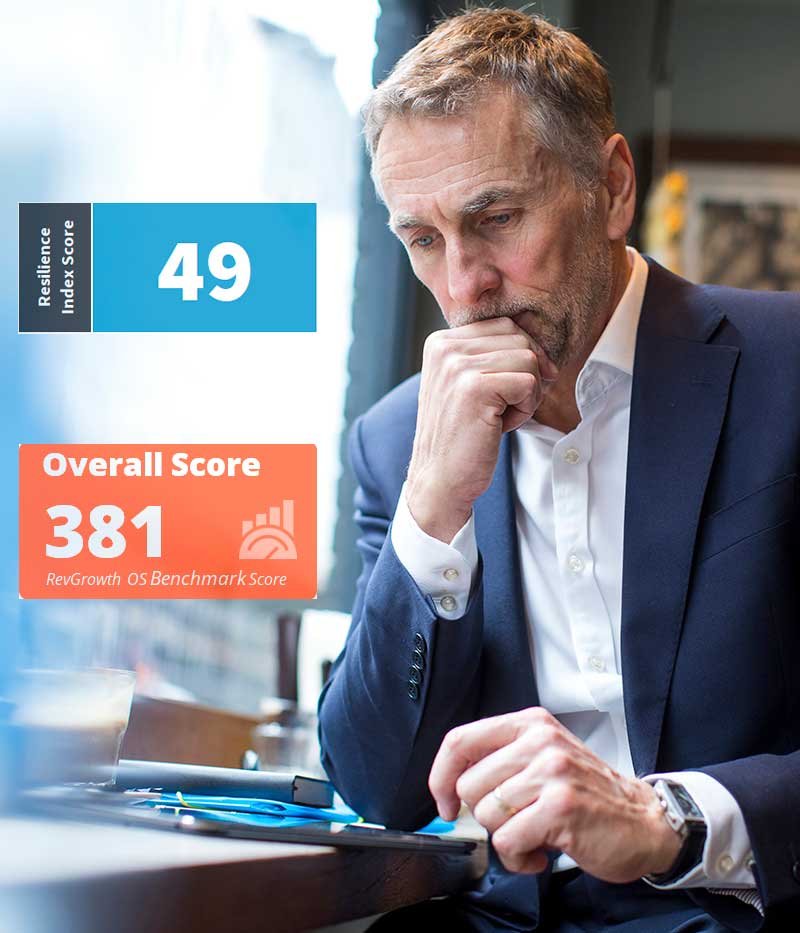
The findings tell you what the data says. They don't tell you where you are in it. The RevGrowth Score scores your company against some of the same non-negotiables and critical factors we score every benchmarked company on. Ten minutes, online, no call required.
You get a position, not a grade.
Ten minutes. Online. No call required.
The RevGrowth Simulation
Find out which one you are.
The RevGrowth Simulation is a one-hour working session using your own numbers. You'll see where your growth system sits against 200+ mid-market companies, and what the gap is worth.
60 minutes - built on your data - CEO level - no obligation